|
|
Rogers Locomotive Company
Zum Vergrößern Bild anklicken
| Name | Rogers Locomotive Company |
| Ortssitz | Paterson (N.J.) |
| Art des Unternehmens | Lokomotivfabrik |
| Anmerkungen | Bis 1856 (Tod von Thomas Rogers) unter der Firma "Rogers, Ketchum & Grosvenor" (s.d.). Danach mit Jacob A. Rogers (Sohn von Thomas Rogers) als Präsident und William A. Hudson als Chefingenieur und Betriebsleiter. 1868/74/89: "Rogers Locomotive and Machine Works" mit J. J. Rogers als Präsident. 1893: R. S. Hughes (Präsident), G. H. Longbottom (Sekretär), Reuben Wells (Betriebsleiter), G. E. Hannah (Finanzleiter); Büro in New York, 44 Exchange Place. Ab 1901 unter der Firma "Rogers Locomotiv Works". Gehört seit 1905 zu "Alco" |
| Quellenangaben | [Metzeltin: Die Lokomotive (1971)] [Poor's Manual of Railroads 26 (1893) Anzeige] Internet [Wiley: American iron trade manual (1874) 63] [Bishop: History of American manufacturers 3 (1868) 222] |
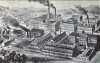
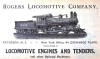
| Hinweise | [Trumbull: History of industrial Paterson (1882) 111] [Leo: Examination of the technology that evolved from the Rogers Locomotive & Machine Co., Paterson, NJ (1975); Northeast Historical Archaeology 4 (1974)] Siehe auch: http://patersongreatfalls.org/rogers.html. [Rogers Locomotive Co. (1897)]: Werksansicht; [Poor's Manual of Railroads 26 (1893)]: Anzeige "Locomotive Engines and Tenders"; [Poor's Manual of Railroads 22 (1889) 289]: Anzeige mit 2'B-Lokomotive |
| Zeit |
Ereignis |
| 1831 |
Gründung Ursprungsunternehmens durch Thomas Rogers |
| 1832 |
Gründung der Vorgängerfirma "Rogers, Ketchum & Grosvenor" durch Thomas Rogers |
| 1832 |
Morris Ketchum und Jasper Grosvenor treten ein und gründen die Firma "Rogers, Ketchum & Grosvenor". |
| 1837 |
Bau der ersten Lokomotive "Sandusky" mit der Achsfolge 2'A, Holzrahmen und 4,5 ft. (= 1372 mm) Treibraddurchmesser und Innenzylindern mit d= 11", h= 16" (d = 279 mm, h= 406 mm), mit Muschelschieber und Hakensteuerung (Exzenter außerhalb des Rahmens und hinten liegende Pendelwelle). |
| 01.11.1838 |
Im ersten Jahr, das am 01. November endet, werden sieben Lokomotiven gebaut |
| 1839 |
Bau einer Lokomotive "Uncle Sam", Fabr.-Nr. 11, Achsfolge 2'A) für die "New Jersey Railroad and Transportation Company", welche mit Leichtigkeit einen Zug mit 24 beladenen Wagen von 120 bis 130 tons auf einer Steigung von 26 feet pro mile (4,9 o/oo), mit einer durchschnittlichen Geschwindigkeit von 24 miles pro Stunde (39,4 km/h) befördert, eine Leistung, welche durch keine der in England gebauten Lokomotiven erreicht wird. |
| 1839 |
Einführung des Funkenfängers aus Drahtgewebe |
| 1840 |
Einführung der Expansion Braces (= federnde Zugstange?) um 1840 |
| 1843 |
Einführung von Wärmeschutzverkleidungen an den Zylindern |
| 1846 |
Rogers baut die größte dreiachsige Drehgestelllokomotive (Achsfolge 2'A) in den Vereinigten Staaten; die "Licking", Fabr.-Nr. 92, gebaut für die "Mansfield and Sandusky Railroad". Sie hat einen Dampfdruck von 110 psi (7,6 atm und kann einen Zug mit 380 short-ton (345 t; 339-long-ton) auf einer Steigung von 16 feet per mile (3 o/oo) ziehen |
| 1849 |
Einführung der Lokomotivsteuerung |
| 1850 |
Einführung von gußeisernen Ringen an den Enden der Lokomotiv-Rauchrohre, um diese dicht zu halten. |
| 1850 |
William S. Hudson, mechanischer Leiter der "Attica and Buffalo Railroad", entwickelt ein Verfahren zur Reparatur undichter Kesselrohre. Daher zieht er das Interesse von Rogers auf sich, wohin er zwei Jahre später wechselt |
| 1850 |
Einführung des "Wagon-type boilers", Kessel mit konischem Übergang zwischen dem Langkessel mit kleinerem Durchmesser zum Stehkessel zur Vergrößerung des Dampfraums und der besseren Zugänglichkeit der Feuerbüchsdecke von der Dampfseite bei Reparaturen |
| 1852 |
Der in England geborene William S. Hudson wird Leiter der Lokomotivfabrik von Rogers, genau in der Zeit, seit moderne Lokomotiven gebaut (Achsfolge 2'B) werden |
| bis 1854 |
Seit dem Beginn 1837 wurden bisher 103 Lokomotiven gebaut |
| Dez. 1855 |
Fertigstellung der Lokomotive "General" bei "Rogers, Ketchum & Grosvenor", entworfen von Thomas Rogers, zusammen mit William Hudson dem Leiter der Werkstätten. Achsfolge 2'B, Spurweite: 5 ft. = 1524 mm. Sie wird für $8,850 an die im Staatseigentum befindliche "Georgia's Western & Atlantic Railroad" (Strecke Atlanta - Chattanooga) verkauft. - Sie wird am 12. Mai 1862 im Zezessionskrieg entführt, was den Stoff für die Filme "Der General" von Buster Keaton (1926) und "The Gerat Locomotive Chase" (1956) liefert |
| 04.1856 |
Tod von Thomas Rogers |
| 1856 |
Nach dem Tode von Thomas Rogers wird William S. Hudson Betriebsleiter |
| 16.06.1856 |
Die Firma "Rogers, Ketchum & Grosvenor" wird nach dem Tod des Seniorpartners durch die überlebenden Partner in eine Aktiengesellschaft umgewandelt, die am 16. Juni 1856 unter dem Namen "The Rogers Locomotive and Machine Works" eingetragen wird. |
| 1858 |
Die "Rogers Locomotive Works" führen als erste das Bissell-Gestell ein. - Bis 1860 haben sie viele ihrer Lokomotiven damit ausgerüstet. |
| 1859 |
Die Chilenische Südbahn bestellt von Rogers eine Güterzug- und eine Personenzuglokomotive, zu selben Zeit, wo sie einen Auftrag nach England für ähnliche Maschinen schickt. Die Bahn beabsichtigt einen vergleichenden Test der amerikanischen und englischen Lokomotiven. Die englischen Hersteller, besorgt, den südamerikanischen Markt für sich zu sichern, machen die Zylinder von beiden Lokomotiven beträchtlich größer als bestellt, in Hinblick darauf, mehr Kraft zu erzielen. Der Versuch währt vier Tage - einen Tag für jede Lokomotive - das Ergebnis ist die Darstellung der sehr großen Überlegenheit der amerikanischen Lokomotiven. Während die amerikanische Güterzuglokomotive "San Bernardo" die Arbeit in 41 Minuten verrichtet, benötigt die englische Lokomotive 88 Minuten. Die amerikanische Personenzuglokomotive zieht den beladenen Zug über eine steile Steigung 17 Meilen in 34,5 Minuten, was die englische Maschine in nicht weniger als 49 Minuten vermag. |
| 1859 |
Hudson experimentiert bei Rogers mit Speisewasservorwärmern zur Brennstoffersparnis |
| 1864 |
Die Rogers Company erhält einen Auftrag von der Regierung der Vereinigten Staaten für 19 Lokomotiven im Wert von je $20.000, die innerhalb von drei Monaten gebaut werden. |
| 05.04.1864 |
William S. Hudson erhält das U.S.-Patent 42.193 "Improved mode of connecting trucks to locomotives" (Lokomotivdrehgestelle) |
| 1867 |
Charles Conrad Schneider geht in die USA und ist als Zeichner bei den "Rogers Locomotive Works" in Paterson, N.J., tätig |
| Nov. 1868 |
Bau der Lokomotive Nr. 119 der "Union Pacific Railroad" Fabr.-Nr. 1558 (gemeinsames Los mit den Loks Nr. 116, 117, 118 und 120). Sie ist in Odgen (Utah) beheimatet und zieht am 10. Mai 1869 den Sonderzug von Thomas C. Durant zum Promontory Summit, wo sich die Gleise mit denen der "Southern Pacific Railroad" treffen. - Die Lokomotive wird 1903 verschrottet und um 1979 nachgebaut. |
| 1871 |
Hudson entwirft ein Bohrwerk, das bei "William Sellers & Co." hergestellt und von Rogers 1871 erworben wird. Es kann einen 16 x 14"-Zylinder in acht Stunden ausbohren |
| 1872 |
Einführung der Bremse an den Lokomotiv-Treibrädern; andere Hersteller führen sie erst ab 1875 ein |
| 13.02.1879 |
Ein Feuer zerstört den Mühlenbau und die Schmiede |
| Jan. 1881 |
Ein neues Zeichenbüro wird bezogen. Es ist ein feuersicherer Bau mit Ziegelgewölben in Stahlträgern (Kappengewölbe) |
| 1881 |
Das alte Lagerhaus und die benachbarten Gebäude werden abgerissen, und eine neue Maschinenwerkstätte in Ziegelfachwerk wird errichtet. |
| 20.07.1881 |
Tod von William S. Hudson, bisher Betriebsleiter (superintendent) bei Rogers in seinem Wohnsitz in Haledon bei Paterson. Er wird auf dem Cedar Lawn Cemetery beigesetzt |
| 23.01.1888 |
Das Gebäude der Jefferson-Werke von 1831 wird durch einen Brand total zerstört, und die Maschinenwerkstatt von 1881 wird beschädigt. Der Schaden beträgt ca. $50.000 |
| 1901 |
Ein Syndikat, geleitet von Elliot C. Smith und Francis H. Halloran aus New York, erwirbt das Werk und führt es unter der Firma "Rogers Locomotiv Works" fort. |
| 1902 |
Francis J. Cole wechselt von den "Rogers Locomotive Works" zu ALCO |
| 1904/05 |
Die "American Locomotive Co." erwirbt fast die gesamten Aktien |
| 1905 |
Anschluß an "American Locomotive Co." |
| 1913 |
Schließung |
| Produkt |
ab |
Bem. |
bis |
Bem. |
Kommentar |
| Dampflokomotiven |
1856 |
Umfirmierung |
1909 |
Ende (seit 1905: Alco); ca. 6300 Loks gebaut |
Insgesamt 6261 Lokomotiven gebaut |
| Zeit |
gesamt |
Arbeiter |
Angest. |
Lehrl. |
männl. |
weibl. |
Kommentar |
| 1873 |
1648 |
|
|
|
|
|
|
| von |
bis |
Produkt |
im Jahr |
am Tag |
Einheit |
Kommentar |
| 1856 |
1856 |
Lokomotiven |
94 |
|
|
|
| 1857 |
1857 |
Lokomotiven |
84 |
|
|
|
| 1858 |
1858 |
Lokomotiven |
24 |
|
|
|
| 1859 |
1859 |
Lokomotiven |
58 |
|
|
|
| 1860 |
1860 |
Lokomotiven |
80 |
|
|
|
| 1861 |
1861 |
Lokomotiven |
28 |
|
|
|
| 1862 |
1862 |
Lokomotiven |
42 |
|
|
|
| 1863 |
1863 |
Lokomotiven |
74 |
|
|
|
| 1864 |
1864 |
Lokomotiven |
104 |
|
|
|
| 1865 |
1865 |
Lokomotiven |
96 |
|
|
|
| 1866 |
1866 |
Lokomotiven |
103 |
|
|
|
| 1867 |
1867 |
Lokomotiven |
71 |
|
|
|
| 1868 |
1868 |
Lokomotiven |
67 |
|
|
|
| 1869 |
1869 |
Lokomotiven |
123 |
|
|
|
| 1870 |
1870 |
Lokomotiven |
145 |
|
|
|
| 1871 |
1871 |
Lokomotiven |
164 |
|
|
|
| 1872 |
1872 |
Lokomotiven |
174 |
|
|
|
| 1873 |
1873 |
Lokomotiven |
190 |
|
|
|
| 1874 |
1874 |
Lokomotiven |
20 |
|
|
|
| 1875 |
1875 |
Lokomotiven |
42 |
|
|
|
| 1876 |
1876 |
Lokomotiven |
16 |
|
|
|
| 1877 |
1877 |
Lokomotiven |
14 |
|
|
|
| 1878 |
1878 |
Lokomotiven |
47 |
|
|
|
| 1879 |
1879 |
Lokomotiven |
64 |
|
|
|
| 1880 |
1880 |
Lokomotiven |
125 |
|
|
|
| 1881 |
1881 |
Lokomotiven |
240 |
|
|
|
Zeit = 1: Zeitpunkt unbekannt
| ZEIT | 1868 |
| THEMA | Firmenbeschreibung |
| TEXT | Founded in 1831 by Thomas Rogers, for the purpose of building Cotton, Woollen, and Flax Machinery. In the succeeding year he was joined by Morris Ketchum and Jasper Grosvenor, establishing the firm of Rogers, Ketchum & Grosvenor, who, in their day, attained great celebrity as builders of Locomotives and Cotton Machinery. The first Locomotive built by this firm was the "Sandusky", which was delivered to the Mad River and Lake Erie Railroad Company, October 14, 1837. During the first year, ending November 1, 1838, they built seven Locomotives. In 1839, they built a Locomotive for the New Jersey Railroad that conveyed with the greatest ease a train of loaded cars, weighing from one hundred and twenty to one hundred and thirty tons, up a grade of twenty-six feet per mile, at an average speed of over twenty-four miles per hour, a performance which, at that time, had not been equalled by any Locomotives constructed in England. During the administration of Mr. Rogers, which continued until his decease in 1856, he made many valuable improvements that contributed to the perfection of the American Locomotives, and which are now generally adopted. As early as 1839 he protected the wire gauze in the Smoke Pipe by an Inverted Cone, placed in the axis of the Pipe, with its base curled over, so as to scatter the sparks over a large portion of the surface of the wire-cloth, and thus prevent the top of the spark-catcher from being burnt out before the other part was materially injured. He, at that time, also used driving-wheels with hollow spokes and rims, and two years previously counterbalanced the wheels, for which he entered a specification in the Patent Office in 1837. He also originated an arrangement for forcing the eccentric rods in and out of gear by the use of V hooks at the ends of the rods, in connection with the reversing lever and shaft, by which the reversing depended on no contingency, and a single handle only was required to manage the engine more efficiently than had heretofore been done. Messrs. Rogers, Ketchum & Grosvenor were the first to introduce and use Expansion Braces - which was about the year 1840 - and the Link Motion, which they adopted in 1849, and which has nearly superseded all other valve motions. They were also the first Locomotive builders who put cast-iron ferrules in the ends of the flues to keep them tight, an improvement that is now generally adopted, as they are peculiarly suited to the purpose. This was in the year 1850. The Rogers Boilers were also distinguished from those of other makers by their greater length and increased number of flues, being eight feet long for an eight ton engine, with one hundred and twenty flues, while the usual length was seven feet, with from eighty to ninety flues. By this deviation from the early standard, he not only obtained more heating surface, but the beat remained longer in contact with the flues, and the addition of weight was a trifle in comparison with the advantages derived from the saving of fuel. He, in fact, may be said to have originated a style of Locomotive that is now regarded as an acknowledged standard. The firm of Rogers, Ketchum & Grosvenor maintained a prosperous existence until the decease of the senior partner in April, 1856, when the surviving partners took measures to form a Joint Stock Company, which was incorporated June 16th, 1856, undor the name of "The Rogers Locomotive and Machine Works." In 1859, the Southern Railroad of Chili ordered from the Rogers Works a freight and passenger engine, at the same time that they sent an order to England for similar engines, with a view of testing the comparative merits of American and English Locomotives. The English builders, anxious to secure the South American market for their engines, made the cylinders of both their engines considerably larger than ordered, with a view of obtaining more power. The trial lasted through four days - one day for each Locomotive - and resulted in demonstrating the very great superiority of the American Locomotives, as the American freight engine "San Bernardo" performed work in forty-one minutes which the English engine could only do in eighty-eight minutes; and the American Passenger Locomotive hauled a loaded train, up a steep grade, seventeen miles in thirty-four and a half minutes, which the English engine could not do in less than forty-nine minutes. In 1864, the Rogers Company received an order from the United States Government for nineteen Locomotives, of the value of $20.000 each, which they completed and delivered in three months, a feat of rapid workmanship not paralleled we think, as ordinarily four or five months are required for the execution of an order for half the number. The Works of this Company include two Blacksmith shops, one two hundred feet long by thirty-one feet wide, the other one hundred and two by forty feet; a Boiler shop, thirty-three by two hundred feet; an Erecting shop of the same size, and numerous auxiliary buildings, with the requisite tools and accommodation for a thousand workmen. The President of the Company is J. S. Rogers; the Secretary and Treasurer, R. S. Hughes, of New York; and the Superintendent, William S. Hudson. They are now employing over eight hundred and fifty hands, and turning out an average of ten Locomotives per month, besides a variety of machinery for Cotton and Woollen manufacturers. |
| QUELLE | [Bishop: History of American manufacturers 3 (1868) 222] |
| |
| ZEIT | 1882 |
| THEMA | Anfänge, Biographie von Thomas Rogers |
| TEXT | Thomas Rogers, the founder of the locomotive-building establishment which bears his uame, the productions of which vast industry have achieved a world-wide renown, was born March 16th, 1792, in the town of Groton, Connecticut. This is in New London County, and lies on the opposite side of the Thames river from the city of New London. Mr. Rogers served in the war of 1812 with much distinction. He was a lineal descendant of Thomas Rogers, one of the Pilgrim Fathers, who came over in the Mayflower. At the age of sixteen he was apprenticed to learn the trade of house carpenter, and four years later, or in the Summer of 1812, he came to Paterson, then a small village, but prosperous on account of the demand for American manufactures brought about by the war with Great Britain. Upon this, the nucleus of the future industrial centre, the sturdy New Englander was destined to leave the impress of his wonderful skill and indomitable energy. The collapse of 1815, elsewhere alluded to in this work, followed very soon, however, and Mr. Rogers did not find the opening a very brilliant one. For a time he was employed as a journeyman carpenter, during which he was noted
for his constant application to his work, his good judgment and extraordinary force of character. Later he associated himself with Paul Rutan, and the two together are said to have been possessed of a capital amounting to at least 50. They built the woodwork of the residence of the late Judge Dickerson, on Broadway, corner of Straight street; also the residence on the Northwest corner of Broadway and Paterson street, known as the "Bibby House." The former, now the property of John Gould, a son-in-law of Judge Dickerson, is among the oldest houses in Paterson. After Mr. Rogers had been working in Paterson a few years, Captain Ward, a somewhat famous character in that day, who had been travelling in Europe, where he had witnessed the power-loom in operation, came to Paterson for the purpose of engaging in the manufacture of cotton duck. Mr. Rogers, whose natural ability and acquired skill were at once recognized by Captain Ward, was employed by him in making the patterns for his looms, and in the end, being fascinated with the idea, he purchased from Captain Ward the right of making the looms, a business which he afterward prosecuted with great success. Next we find Mr. Rogers in the machine shop of John Clark, the elder, where he applied for and was given work. The introduction of power-looms was just then attracting much attention, and as the looms were largely built of wood the builders were, so to speak, a sort of machine-carpenters, and skill and originality were excellent qualities in a workman. Mr. Rogers was noted for making more shavings and turning off more work than any of his fellows, and, what was still more important, his inventive genius enabled him to make many valuable improvements. After the retirement of John Clark, Sr., about 1816, John Clark, Jr., and Mr. Rogers became partners, and engaged in the manufacture of machinery, at first in a very small way, at the same location. Afterward General Abraham Godwin, Jr., his father's successor as host of the "Old Godwin House," and who was also one of the earliest storekeepers in Paterson, was admitted, and the style of the firm was "Godwin, Rogers & Co.". While the firm consisted of Messrs. Clark and Rogers only they continued to occupy the "Little Beaver Mill," and Mr. Rogers visited Mexico and other distant countries and received quite large orders, for that day, for looms and other machinery. After their association with Mr. Godwin the works were removed to Market, then Congress, street, the site of the present Danforth Works, occupying a building erected by Robert Collett for a cotton mill. The firm of "Clark & Rogers" was not very well supplied with capital, but when the third partner was taken into the concern it was financially strong. Prior to the formation of the first partnership John Clark, Sr., was the head and front of all the machinery business in Paterson; from the partnership dates the commencement of the great Rogers enterprise, which a few years later resulted in building the first locomotive in Paterson, the inauguration of one of its grandest industries. The Collett Mill, still standing in the rear of the Danforth lot, was soon found to be too small, and the Danforth machine shop and foundry (as existing before the destructive fires of quite recent date) were built, half size. In April, 1823, the firm bought out the foundry and moulding shop, the entire plant, of William Jacobs, located on the rear of what was since known as the Van Winkle lot, Van Houten street, now included in the premises of the Phoenix Manufacturing Company. This plant was removed the following month to the foundry of the firm
in Market street, and thus nearly a quarter of a century from the humble beginning of the elder Clark all branches of the iron industry connected with the building of machinery were united under one management. Subsequent to the establishment of the company with all their works complete "Godwin, Rogers & Co." experienced about eight years of successful operation, when, in 1831, the firm dissolved, Mr. Rogers retiring. According to the record found on the old books of the company, the date was June 27, 1831, the entire stock at that time being valued at 150.382,86. Mr. Rogers judging, and with reason, that the property of the firm was overvalued, sold his interest for 36.266,05 in hand. This
was a sad blow to the remaining partners, and Mr. Rogers was wont to remark of the transaction: "They gave me about 10.000 to go out, and they haven't much Left." The fact was he was the backbone of the establishment, so far as active operations were concerned. All the partners, together with the other leading men of Paterson in that day, were in the habit of spending their evenings at the great rendezvous of the time, the "Godwin House", afterward the Passaic Hotel, and most of them frequently prolonged their sittings to a late hour. Mr. Rogers, on the contrary, rarely overstayed ten o'clock; when that hour struck he would arise and, making some remark implying that he had work on the morrow, betake himself to his home. Next morning, when the others were feeling dull and indisposed to business, he would be abroad with the earliest of the men, alert, tireless and full of resources. Upon the withdrawal of Mr. Rogers from Godwin, Rogers & Co. he proceeded to erect the Jefferson Works, or Mill, having purchased a site on the back raceway, the location being next adjoining the present Ivanhoe Mill. The building was erected for the manufacture of cotton, wool and flax machinery and the spinning of cotton yarn; the latter idea, however, was never carried out, at least not to any great extent, in consequence of the increasing demand for machinery. The original design was to occupy only the lower stories in the making of machinery, devoting the upper to the cotton manufacture. On the upper raceway there were at this time no factories except two little cotton mills and a small machine shop, the latter owned by "Paul & Beggs". The Jefferson Works were literally an encroachment on the forest between Mill and Spruce streets. All was swamp, covered with pines and, so says the tradition, as populous with snakes as it has since become with human beings The new building being completed, Mr. Rogers, in the early part of 1832, associated with himself Messrs. Morris Ketchum and Jasper Grosvenor, both of New York, and both men of capital, but totally ignorant of manufacturing operations, and the business was thenceforth carried on under the firm name of "Rogers, Ketchum & Grosvenor". This title remained unchanged until Mr. Rogers' death, which occurred in New York city, April 19th, 1856. |
| QUELLE | [Trumbull: History of industrial Paterson (1882) 111] |
| |
| ZEIT | 1882 |
| THEMA | "Rogers, Ketchum & Grosvenor" und "Rogers Locomotive Co." |
| TEXT | The earlier history of this establishment has been given in the preceding sketch of its founder, Thomas Bogers, and the thread may now be taken up at the point at which the Jefferson Works, on the back raceway, were completed, in the latter part of 1832, about which time Morris Ketchum and Jasper Grosvenor, New York capitalists, were admitted to partnerships. About this time public attention began to be directed to the construction of railroads and railroad machinery. The railroad from Jersey City to Paterson was approaching completion, the iron work for the Passaic and Hackensack bridges having been made by Mr. Bogers. About the same date an order was executed, also, for one hundred sets of wheels and axles for a South Carolina railroad. Next came the making of wrought iron tires for car wheels, which, after encountering many difficulties, was made a success at these works. Attempts at locomotive building had already been made by Messrs. Paul & Beggs, who had quite an extensive machine shop, for those days, a short distance
from the Jefferson Works, and this enterprising firm had a small engine nearly complete when, on the 18th of May, 1835, their buildings took fire and were consumed, and with them was destroyed this unfinished locomotive engine. It was being built by William Beggs, a brother of the junior partner, who but for this fire would, in all probability, have had the honor of building the first locomotive in Paterson, for the statement is that it promised to be a success. In 1835 some additional buildings were begun by "Rogers, Ketchum & Grosvenor" with a view to the manufacture of locomotives; it was not, however, until eighteen months afterward that the first locomotive, the "Sandusky " was turned out, after many difficulties had been surmounted. On the 6th of October, 1837, the Sandusky was finally completed and a trial trip made from Paterson to Jersey City and New Brunswick and back, Timothy Smith acting as engineer. The time actually required for the construction of the Sandusky was sixteen months, during which tools had to be made, numberless experiments tried and the men instructed in the work. The performance of this first engine was perfectly satisfactory. The gauge of the road was 4 feet 10 inches, the same as that of the "New Jersey Railroad and Transportation Co.", for which road the engine was intended. It was, however, never placed on that road, being bought by President James, of the "Mad River & Lake Erie Railroad", for use on that line, and shipped October 14th, via canal and lake, in charge of Thomas Hogg, on the schooner Sandusky for its destination. Mr. Hogg had worked on the engine from its commencement. It arrived at Sandusky November 17th, at which time not a foot of track had been laid for it to run on. The road was then built to suit the gauge of the engine, and the Legislature of Ohio soon after passed an act prescribing that all roads built in the State should be constructed of the same gauge as the Sandusky. Mr. Hogg continued to run the engine about three years, keeping it in repair. Subsequently he became Master Mechanic of the road, continuing to hold this position, on the Mad River and other roads, for about thirty years thereafter. The Sandusky was used about a year in the construction of the road; afterward it was set to pulling trains for the conveyance of passengers between Sandusky and Belleview, a distance of sixteen miles. It was continued in service many years, until the traffic of the road required a larger class of engines to do the work. It was an unqualified success, and at a recent date was still reported as being in a serviceable condition. It may not be amiss to give in passing a brief description of this first Paterson locomotive. The Sandusky's cylinders were 11 inches in diameter, with 16 inches stroke; she had one pair of driving wheels, 4 feet 6 inches in diameter, situated forward of the furnaces; the truck had four thirty-inch wheels ; the eccentrics were outside the frame, the eccentric rods extending back to the rock shafts, which were situated under the foot-board; the smokepipe was of the "bonnet" kind, having a deflecting cone curled over at the edge in its centre, so as to deflect the sparks downward and thus prevent their passing through the wire "bonnet," as well as preventing the "bonnets" wearing out too fast. Among the improvements introduced in this first engine perhaps the most important was "counterbalancing," for which Mr. Rogers filed a specification in the Patent Office in 1837. The following is the description in the specification: "The nature of my improvement consists in providing the section of the wheel opposite to the crank with sufficient weight to counterbalance the weight of the
crank and connecting rods, making the resistance of the engine less in starting and in running, also preventing that irregularity of motion caused by that side of the wheels when the cranks are placed in other modes of fitting them up. The irregular motion which arises from not having the cranks and connecting rods balanced is attended with much injury to the engine, and to the road, and with much loss of power." The importance of counterbalancing was not generally recognized as being necessary until several years after it had been introduced by Mr. Rogers, and when attention was finally attracted to its importance many yet doubted the necessity of balancing anything more than the cranks. Another novelty consisted in making the driving wheels with hollow spokes and hollow rim ; the rim on the opposite side of
the crank being cast solid. The spokes were oval and the rim very much the same in shape as seen at the present time. In fact the driving wheel invented by Mr. Rogers about forty years ago lias scarcely been improved upon in any essential particular since. Of this first locomotive John Cooke says : "With its round top-boiler, two drivers and wooden frame, it was quite a different affair from the locomotive of the present day." The Northern Monthly, date of December, 1867, in treating of "Paterson - its Works and Ways," a very valuable article, speaking of the Sandusky said
"This engine would be a striking contrast could it be placed alongside of one of the magnificent machines now turned out of the Paterson shops (there have been many finer and better ones turned out since 1867) and which seem to have reached the perfection of mechanism, although, doubtless, the locomotive of the future will be as far beyond that of the present day as the 'America' is above the 'Sandusky.' This was prophetic. It may be interesting to know in this connection somewhat as to the order, relative to time, in which the first Paterson locomotive was built. The Sandusky,
though not the first, was among the first engines built in this country, and was probably a signal improvement on all others running on American roads. According to Bishop's History of American Manufactures, published in 1866, the first locomotive that appeared in this country was brought by Horatio Allen from England in the Fall of 1829, and was set up at West Point and placed on the Delaware and Hudson River Railroad either at Honesdale or at Carbondale, Penn., the next Spring. This engine proved too heavy for the track, a crude and imperfect one, and was soon abandoned. The same authority states that the first engine built in this country was turned out at the West Point shops in 1830, for a South Carolina railroad. This engine, named the "Phoenix," was a partial success. A writer in Science, however, gives the credit of building the first American locomotive to Peter Cooper. It is described as weighing less than a ton, with a three-and-a-half inch cylinder, and a boiler about "as large as an ordinary kitchen boiler," with gun barrels for flues. It was named the "Tom Thumb". The same authority says that the first American locomotive built for actual service was "The Best Friend", built at West Point for the Charleston & Augusta Railway and placed there on October
20th, 1830. The writer adds: "The name of the first American locomotive seems to have been inspired, for it has in the largest sense proved our 'Best Friend'". The first locomotive for a Northern road was built under the auspices of Governor De Witt Clinton, of New York, for the Mohawk & Hudson Railway, from Albany to Schenectady. This was the first locomotive in the State of New York; it was named the "De Witt Clinton". It was not a success. The next in order was commenced in 1832 at the now famous Baldwin Works, Philadelphia, for the Philadelphia & Germantown road, and was placed on the road in January, 1833. This was a signal success; Bishop says it made a mile in less than a minute, up and down
grade, and this performance was not excelled for many years thereafter. The same authority says of the first locomotives turned out at the Rogers Works, one or more, for the New Jersey Railroad, that one of them drew a train of 120 to 130 tons up a grade of 26 feet to the mile at an average rate of speed of 24 miles an hour, which feat had not been equalled by any of the engines that had been brought from England at that time. Having given a description of the first Paterson locomotive and its performance, it may be well at this point to devote some space to a brief sketch of the builder. Although forty-four years have elapsed since the Sandusky was built - nearly half a century - and the man to whose natural genius, acquired skill and indomitable perseverance its successful completion was mainly due was at the time in the vigor of his manhood, he is still not only living, but is comparatively hale and strong. He is found performing daily the responsible duties devolving upon him as Comptroller of the city of Paterson, to which office he is elected from year to year without even the shadow of opposition, his eminent ability and fitness being acknowledged by all, regardless of political preference or private ambitions. William Swinburne was born in Brooklyn in 1805, and is, with perhaps one or two exceptions, the only one living who had anything to do with building the Sandusky. While working at his trade as a carpenter, at the age of eighteen, Mr. Swinburne assisted in building the old St. Ann's P. E. Church, opposite the Sands Street M. E. Church, Brooklyn. In St. Ann's Church were 1,500 small window lights in Gothic sashes with circular-headed frames, and these sashes were the work of Mr. Swinburne. This church, after standing about fifty-seven years, was razed about two years since to make way for the march of improvement in the shape of the great Brooklyn bridge. Mr. Swinburne's memory, which is excellent, reaches back to the time when there was no way of crossing between Brooklyn and New York except by row-boat. The first step toward improved facilities was the horse-boat; next came the first steam ferry-boat, the "Nassau", about 1814. This was shortly after Fulton had made his experiments on the North Biver. In 1827, when Mr. Swinburne was about twenty-two years of age, two notable events occurred; one was his removal to Matteawan; the other was his marriage to Melissa Doughty, of that place. At Matteawan he was engaged until 1833 in making patterns for machinery, etc. In that year he came to Paterson and went to work for Rogers, Ketchum & Grosvenor in the Jefferson Works, then just completed. The product was cotton machinery almost exclusively. Mr. Swinburne made the patterns and soon attracted attention by his skill and industry. At this time Paul & Beggs were running their works, nearly as extensive as those of Rogers, Ketchum & Grosvenor, and turning out mill-gearing, they being the only millwrights to be found within all the section of country about Paterson, and sending out men to a great distance to put up their work and equip new mills. When the fire occurred which consumed the establishment of Paul & Beggs, about 1835, together with all their patterns for mill-gearing - invaluable in those days - and a locomotive nearly completed, as before described, mill-owners were driven to Rogers, Ketchum & Grosvenor to induce the firm to go into the production of mill-gearing. What was left of the plant of Paul & Beggs was taken by Rogers, Ketchum & Grosvenor, and a millwright shop was built, one story, of stone, on the Southeast corner of Spruce and Market streets.
Here the new line of work was undertaken, Mr. Swinburne making all the patterns being, in fact, about the only one capable of doing it at the time. When the Hudson River Railroad from Jersey City to Paterson was completed Mr. Swinburne went to see its operation, wdien only a trial trip had been made over the road. The Paterson depot was where St. John's Catholic Church now stands. He was very greatly impressed with the wonders of the iron horse on the iron track - quite overcome, in fact - and, as he says, would have deemed any one mad who told him that he would one day build a better locomotive than the English-built "McNiel". So he kept on making patterns at the millwright shop until, in 1835, the building of the Sandusky was begun and his services were required in a new direction. Great expectations were entertained by the firm as to the result of the skill of Mr. Hodge, an English mechanical draughtsman, upon whom every dependence was placed in connection with the production of the first locomotive. It is said that he was a very accomplished man, but he was not a genius, and it was soon clear that he had undertaken a task he was utterly unfitted for In the beginning Mr. Swinburne was employed in making patterns after his drawings, but soon the natural talent of the former enabled him to see that no good could result from Mr. Hodge's plans. He convicted him, in argument, of being from 25 to 30 per cent, out of the way in his calculations as to the passages from the boiler to the steam chest,
and demonstrated so clearly that he, Mr. Swinburne, was right that the other, whose pride was terribly wounded, was compelled to acknowledge his error. But he fell into others. He had the boiler made first, and so far astray were his calculations that when it was completed there was found to be not space enough to put the furnace in the shell. There were other difficulties also, and at last Mr. Rogers discharged him. He assented, was paid, and left the works in high dudgeon. Then Mr Rogers, discouraged and hopeless, said "Lay the whole business up; put it away." Mr. Swinburne answered, counselling another effort; reminding his employer that much of the work was done, and assuring him there would be no difficulty in getting it out. Said Mr. Rogers : "Who'll do it?" "I will," was the answer. "You!" "Yes; I." "And can you ?" "I am sure of it," "Then go ahead. Go look at the engine at the depot, and see if you can understand it." Mr. Rogers referred to the "McNiel." Mr. Swinburne went to the depot and, examined the different parts with the practised eye of a skilled mechanic and a natural genius combined. Six months later the Sandusky was completed and, as already shown, was a perfect success. Mr. Swinburne did or directed everything toward the work, making the drawings and the patterns and showing the workmen how to produce the requisite parts. Mr. Rogers left all with him. Mr. Hodge, after his failure at the Rogers Works, was sent out to Russia as an engineer by Ross Winans, of Baltimore, and he died there a few years later. After the success of the Sandusky was assured the firm of Rogers, Ketchum & Grosvenor continued to build locomotives. The next one was built for the N. J. Railroad and Transportation Company, and was named the Arreseoh No. 2. This was larger than the Sandusky and was equally a success. For this, also, Mr. Swinburne made the plans and was general factotum, serving as draughtsman, pattern-maker, superintendent of construction and foreman of foundry, blacksmith and machine shops. There was not another foreman beside in any department. The shop where the first locomotives were built was 40x100 feet, two stories in height, From 30 to 10 men were employed. After five or six engines had been built the works were greatly extended, until they were 40x200 feet, three stories, of brick. Later,
still further additions were made, and the demand for engines came in from every direction; from the East, West, North and South. About 1840 Watts Cooke, the father of John, Watts and the other brothers Cooke, came from Matteawan (it is wonderful how many of those great pioneer mechanics and successful manufacturers came to Paterson by the way of Matteawan) where he was engaged in pattern-making. When Mr. Swinburne was drawn from the business of making patterns for mill-gearing to locomotive work Mr. Cooke succeeded him and was the only one engaged in that department until, on one occasion, all being very busy, it was proposed to bring John Cooke, his son, in to assist. The young man was then about seventeen years of age. Mr. Swinburne wished to set him at work to make a cylinder pattern. Watts Cooke, his father, demurred, but Mr. Swinburne insisted that the young man would succeed, and persevered, instructing him until John turned out a very good pattern. He continued to improve, making rapid progress, and soon was set to finish full-size drawings. When Mr. Swinburne left the works of Rogers, Ketchum & Grosvenor, about 1845, he recommended a Mr. Thurston as his successor, but that gentleman proving incapable, John Cooke soon succeeded him and became Superintendent of the entire locomotive business of the concern, showing remarkable ability, though he was still very
young - not more than twenty years of age. The third engine built at the Rogers Works differed from the two first; its
cylinders being 10x18 inch stroke and the gauge 4 feet, 8 1/2 inches. Both the driving and truck wheels of this engine had hollow, oval spokes and hollow rims with wrought iron tires. It was named the "Clinton" and was built for the Lockport & Niagara Falls road ; it was delivered in April, 1838. It was sold in 1843 to the Toledo and Adrian Railway Co. for 6.500 - first cost. William E. Cooper, the engineer who ran it, says that when sold the Clinton was regarded as the very best working engine in existence. The fourth engine built at the works was the "Experiment," made for the South Carolina Railroad, and delivered in June, 1838. This differed from any of the others in having a smaller cylinder and a longer stroke. The fifth was named the "Batavia", and was completed in October, 1838, for the Tonawanda road. This differed from any other foregoing in having the driving wheels back of the furnace, which was semi-circular at the rear part, and had a hemispherical top surmounted by a dome. The Batavia was so constructed that a part of the weight of the tender could be transferred to it to increase the adhesion, should it be found necessary. An extraordinary feat of an early Rogers locomotive is related in the American Railroad Journal and Mechanics' Magazine, published in 1839, in an article on American locomotives, as follows: "Owing to some circumstances of which I am not informed, it became necessary for a locomotive on the way from Jersey City to New Brunswick to take, in addition to its own load, the cars attached to another engine, which made the number equal to 24 loaded four-wheel cars, and this it did with as much apparent ease as could he desired, notwithstanding the grade for four miles is equal to 26 feet per mile, stopping on the grade to take in passengers, aud starting again with the greatest ease. The average speed on the grade was 24 1/2 miles an hour. This may not be in your estimation anything extraordinary, yet I consider it a performance worth recording, by way of contrast with the greatest and most remarkable performance of a locomotive ever heard of in those days, which occurred on the Liverpool and Manchester Railroad in 1829, only ten years ago. Twenty tons on a level road at the rate of ten miles per hour, was then considered wonderful ! astonishing ! even in a country famed for its extraordinary discoveries; yet here, only ten years after, we see an engine, built in this country too, taking a load probably equal, cars and tender included, to 120 or 130 tons at the rate of 24 1/2 miles per hour up a grade of 26 feet per mile. This engine was built, I understand, at Paterson, New Jersey, by Messrs. Rogers, Ketchum and Grosvenor, a concern not yet so well known to this railroad community as manufacturers of locomotives as they ought to be, or as they soon will be if they continue to turn out such machines as the one above allude I to. If such have been the
improvements in the past, what may they not be, permit me to ask, in the next teu years? Pardon me for thus troubling you, but my aim is rather to call attention to the rapid march of improvement in this mode of communication, than to direct attention to any individual or company, although those gentlemen, in my opinion, deserve as manufacturers much more than I have said of them. Yours respectfully, JERSEY BLUE. Newark, N. J., December Hth, 1839."
In spite of financial revulsions, the establishment of Rogers, Ketchum & Grosvenor continued to go on and prosper, increasing its facilities with the growth of business. When it is considered that the pioneers of industrial enterprises have generally gone to the wall, the successful career of this firm is the more to be wondered at; but the New York partners were men of abundant means and decided financial ability, while Mr. Rogers joined to great penetration, irresistible energy and a powerful will sufficient cautiousness to make his judgment almost infallible. In the year 1838 seven engines in all were completed, after which the production gradually increased until in the year 1854 one hundred and three engines were built. The works were enlarged and improved from time to time until the many
vast and substantial structures occupied for locomotive-building and its dependencies presented the appearance of a considerable village, extending on both sides of Spruce street far Southward from Market; also across to Pine street to the Eastward and back to "the Cedars" West of Spruce. The equipment of the works up to the time of the disastrous fire in the Winter of 1879 was not excelled in this or any country, comprising all the tools and facilities for turning out perfectly accurate work; many of them being of new and improved design, manufactured expressly to the order of the Company. These have been replaced, since the fire, at a tremendous outlay of money. During the war the Rogers Works turned out from ten to twelve engines each month, and the three locomotive works then in operation an average of at least one per day. In 1873 the capacity of the Rogers establishment was rated at one completed locomotive for every second working clay in the year. The firm of Rogers, Ketchum & Grosvenor maintained a prosperous existence until the death of Thomas Rogers, the great projector of the industry, in 1856, when the surviving partners reorganized under a charter and the name was changed to the "Rogers Locomotive and Machine Works", which is still retained. Since 1869 the company have discontinued the building of machinery and have devoted the entire capacity of the works to the production of locomotives. This vast establishment has shown that mature years do not necessarily result in the sere and yellow leaf of inertia or decadence. Evidence of this is found in the style that marks their engines, a point less thought of usually where ripe self-sufficiency prevails. Wherever one travels and meets one of the splendid engines from Rogers' he may know at a glance its builders. It is certain that the average judgment of travelers awards this verdict and the leading railroad officers agree. Perhaps no concern in this country has done so much to popularize the locomotive and to make it the easily-managed and powerful motor it is today - the veritable "iron horse": a servant that yields as ready obedience to its driver as its fleshly namesake. The statement is made, and on good authority, that no first-class engine is made in this country which doss not use, either in boiler, or wheels, or smoke stack, or lever, one or more principles first introduced by the skilled artisans above alluded to. Among the many valuable improvements brought out at this establishment for the first time in this country, or indeed anywhere, may be mentioned expansion plates and braces, outside connections, vertical flues in boilers, V hooks and wide pendent cut-off valves, shifting-link motion, counterbalancing, hollow spoke cast-iron wheels, the horizontal cylinder and spread track, etc. Since 18-19 more particularly have these engines taken the highest position, so that Paterson locomotives are now admitted to present the most perfect type of any built. The Railway Times in an issue of recent date publishes a report made by the Buffalo and State Line R. R. in regard to one of the Rogers ordinary six-wheel driver freight engines, which was put on the road December 15th, 1856, and had run two years and eighteen days when the report was made, showing the following record: trips: 617; miles: 55.530; cars hauled: 18.295; average train: 30 cars. The aggregate cost of repairs was 11.110, or 2,5 cents per mile run. If the number of cars is multiplied by 88 miles, the length of the road, the result is equivalent to one car hauled 1.609.906 miles, and if, as stated, 12,5 cents be the average
earnings of a car per mile, this would make a total of 201.245 as the actual earnings of tins freight engine in a few days over two years. In 1860, when the works were turning out locomotives at the rate of upward of eighty per annum, there were 550 men employed on engines and on cotton machinery. It would be impossible, within moderate limits, to attempt to name even the principal roads on which Rogers locomotives are running; it would be less difficult to name those where they are not. They have gone to every country in the civilized world. For one road alone, the Illinois Central, over one hundred have been built. Two Rogers engines competed with English engines on the Southern Railroad of Chili about twenty years ago and won a signal victory, and since that date many engines have been sent to that and other South American countries. This test of Amercan vs. English engines is thus described by Bishop: "In 1859 the Southern Railroad of Chili ordered from the Rogers Works a freight and a passenger engine; at the same time they sent an order to England for similar engines, with a view of testing the comparative merits of American and English locomotives. The English builders, anxious to secure the South American market for their engines, made the cylinders of both their engines considerably larger than ordered, with a view of obtaining more power. The trial lasted through four days - one day for each locomotive - and resulted in demonstrating the very great superiority of the American locomotives, as the American freight engine "San Bernardo" performed in forty-one minutes what the English engine could only do in eighty-eight minutes; and the American passenger locomotive hauled a loaded train up a steep grade seventeen miles in thirty-four and a half minutes, which the English engine could not do in less than forty-nine minutes." The American Railroad Journal, date of September 24th, 1859, says of this locomotive tournament: "A summary of the dimensions and comparative calculated powers of the respective locomotive-engines on the Southern Railway of Chili, showed that the English engines should have exerted an effect more than 11 per cent, greater than the American. Now for the result as indicated by notes taken at the trial: "The 1st day. - The San Bernardo, American goods engine, by the Rogers Locomotive and Machine Works of Paterson, New Jersey, took her train of 35 eight-wheeled cars, gross tonnage 587, from Santiago to the summit, 11 2/3 miles, in 41 minutes, making one experimental stop of 1,5 minutes on the way, to see if she had adhesion sufficient to start her train on a gradient of 13 feet per mile, which she did without slipping, one brake being on by carelessness. At 13 3/4 [?] miles stopped and switched off 10 cars, took water, and carried 25 cars to the Maipu river. Returning, carried back to Santiago 20 loaded cars, total 360 [?] gross tons - run to the summit from the bridge, 6 miles, in 20,5 minutes - made steam very free - had to keep the fire-door open most of the time to keep the steam down to the limit, 115 pounds. The 2d day. - The "Varas", English goods engine, by R. & W. Hawthorne, of Newcastle, started the same train of 35 cars, load 587 tons, of the day before on a descending gradient of 20 feet per mile for one mile; thence one mile nearly level, thence one mile ascending a gradient of 31,5 feet per mile; she ran this distance of three miles in 10 minutes, then stopped for want of steam. The train was then backed to the 1,5 mile post, and again started with 130 pounds of steam; this time she reached the 21 mile point, and again stopped, not being able to supply herself with steam. The train was then backed to the station, when a third trial was made, with 20 loaded cars; gross tonnage, including engine and tender, 370; she ran to the 4,5 mile point in 14,5 minutes, and stopped for waut of steam; stopped 20 minutes, then started with 115 pounds of steam, and run to 9,5 mile point in 30 minutes, and again stopped for waut of steam; remained there 16 minutes, and again started with 95 pounds of steam, and run to the 11th mile in 7 minutes, making the 11 miles in 88 minutes. She then stopped and retimed
with the train to Santiago. The 3d day. - The English passenger engine "Montt", by R. & W. Hawthorne, of Newcastle, started from the Santiago station, taking a train of 15 loaded eight-wheeled cars - gross tonnage of train, 288 - running to the summit, ll,5 miles, in 37 minutes 50 seconds, including one stop of 3 minutes 15 seconds, to experiment on starting, which she did without difficulty. Total time to the 17th mile, the end of the route, 49 minutes; returning, she carried back the same train to the summit, 6 miles from the Maipu River, in 25 minutes 4 seconds, and returned with her train down grade to Santiago. The 4th day. - The American passenger engine "Santiago", by the Rogers Locomotive and Machine Works, of Paterson, started from the Santiago station, taking a train of fifteen loaded eight-wheeled cars, gross tonnage of train, 290 - running to the summit, 11,5 miles, iu 26 minutes 6 seconds, including one stop of one minute to experiment on starting, which she did without difficulty. Total time to the 17th mile, the
end of the route, 34 minutes 30 seconds. Returning, she carried back the same train to the summit, 6 miles from the Maipu bridge, in 22 minutes 31 seconds, and returned with her train down grade to Santiago. This closed the trial, which resulted in the superiority of the Rogers locomotives, of both classes, going and coming, although the calculated power of the Hawthorne engines was, in each class, 12 per cent, the greatest as to tractive power, and more as to fire surface and adhesion." The result of the trial created the liveliest satisfaction on the part of the American engineers and residents in Chili, as it completely vindicated their national reputation in the matter of mechanical skill, upon which physical superiority, at least, depends; and at once placed them in favor with a people with whom the locomotive engine is too new a wonder not to have its performances viewed with admiration, and who accept superior merit in such an affair as a test of national superiority. The manufacturers, though some 10,000 miles away, whose skill supplied the means for the triumph, came in for a large share of the gratification felt and expressed. From the data given, we are unable to point out the precise cause of the superiority of the American engine. Whatever it may have been, it must be referred to superior mechanical skill, either in the better adjustment of the parts, in their more perfect finish, or in the use of those contrivances which utilize the power generated in the highest degree. For the English engineer to point out the cause of the unsatisfactory results attending his engines at the trial would be simply a confession of mechanical inferiority. A triumph like the one recorded is of national value. The reputation of the Rogers Works at home has been firmly established by the uniform excellence of the engines constructed by it, from the first one turned out to the present time. To create a reputation for its engines in other countries is to elevate in the eyes of the world our mechanical skill as a people, and to open outlets for the products of our industry, in which others can share as well as those who, by the excellence of their work, first opened the markets to us."
In 1864 the Rogers Company received an order from the United States Government for nineteen locomotives, of the value of 20.000 each, which they completed and delivered in three months, a feat of rapid workmanship not paralleled, it is held, as ordinarily four or five months are required for the execution of an order for half the number. In 1868-69 the works of this company included two blacksmith shops, one two hundred feet long by thirty-one feet wide, the other one hundred and two by forty feet; a boiler shop, thirty-three by two hundred feet ; an erecting shop of the same size, and numerous auxiliary buildings, with the requisite tools and accommodation for a thousand workmen. They were employing over eight hundred and fifty hands and turned out an average of ten locomotives per month, besides a variety of machinery for cotton and woolen manufacture. The only great fire which has occurred at the Sogers Works was that of February 13th, 1879, at which time the immense millwright shop, with its almost invaluable contents, patterns, tools, machinery, etc, were destroyed, entailing a loss above the comparatively slight insurance of fully 100.000. The burned portion of the works has since been entirely rebuilt ami large additions made thereto. Several years prior to the date of this great fire there was a considerable fire in the foundry belonging to the works, but with these exceptions tins establishment has enjoyed a remarkable immunity from disaster of this nature. During 1881 there was completed a fine new fireproof building, of pressed brick, three stories in height, for offices, draughting rooms and the storage of valuable documents and drawings. This was built on the site of the old one-story office and the polishing shop, on Spruce street next adjoining the Ivanhoe Paper Mill. Other important additions and improvements were made during the year 1881. The old storehouse at the corner of Stony Road and Spruce street, also other buildings adjoining, have been torn down and remodelled into one extensive building, affording double the capacity of those removed. This is occupied for frame-fitting and light machine work. Adjoining, at the rear, over the race, a new brick storehouse has been built. Other important changes have been made, and new boilers have been put in at the millwright, erection and tank shops. Following is a comparative exhibit of the operations of this establishment, stretching over a space of nearly half a century: Status at the date of fullest operation, in 1873, just before the panic: Number of hands employed: 1.618; amount disbursed in wages: 993.500 for the year; value of product: 3.300.000; number of locomotives turned out: 190.
Status at lowest point of depression, in 1877: Number of hands employed: 50; disbursed in wages: 77.896 for the year; value of product: 200.000; number of locomotives turned out: 14. Status at the close of 1880: Number of hands: 1.200; amount total of wages paid: 500.000 for the year; total product: 962.000; number of locomotives built: 125. Status at the close of 1881: Number of hands employed: 1.800; amount disbursed in wages: 675.000 for the year; total product: 240 locomotives - fifty more than were built at the works in the palmiest days of the locomotive industry, in 1873, and nearly double the product of 1880; total value of product for 1881: 2.400.000. The total area of flooring space occupied is about 300.000 square feet; number of buildings composing the works: 25. The following will show the number of engines turned out each year since the commencement of the locomotive industry by Rogers, Ketchum & Grosvenor in
1836, and by this it will be seen that to the close of 1881, a grand total of 2.926 locomotives have been built at these works - a wonderful exhibit. This number, if the average cost be estimated at 15.000 each, would represent a total value amounting to the enormous sum of 43.890.000. It will be marked by noting these figures how very gradually the industry grew, and also how steadily, until 1857, when the general stagnation of business throughout the country set it back just about ten years, there being but two more engines built in 1858 than in 1847. It will also be noted that the last great panic set it back more than thirty years, for there were precisely the same number of engines turned out in 1877 as in 1845. The present officers of the company are: President, Jacob S. Rogers; Secretary and Treasurer, Robert S. Hughes. Mr. Rogers, who succeeded to the Presidency in 1856, is a son of the late Thomas Rogers, and his management of the vast interests of the company is characterized by prudence, energy and skill. He is very rarely in Paterson, at the works, but is found daily at the New York city office of the company. |
| QUELLE | [Trumbull: History of industrial Paterson (1882) 114] |
|