|
|
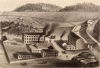
Rogers, Ketchum & Grosvenor
Zum Vergrößern Bild anklicken
| Name | Rogers, Ketchum & Grosvenor |
| Ortssitz | Paterson (N.J.) |
| Straße | Spruce Street |
| Art des Unternehmens | Maschinenfabrik |
| Anmerkungen | Ab 1856 (Tod von Th. Rogers) "Rogers Locomotive Company" (s.d.). |
| Quellenangaben | [Morrell: Evolution of the Rogers Locomotive Co. (https://orb.binghamton.edu)] http://patersongreatfalls.org/rogers.html [Trumbull: History of industrial Paterson (1882) 114] |
| Zeit |
Ereignis |
| 1832 |
Gründung von "Rogers, Ketchum & Grosvenor" als Schmiede mit Eisen- und Metallgießerei durch Thomas Rogers gemeinsam mit Morris Ketchum und Jasper Grosvenor. - Im selben Jahr werden ca. $50.000 investiert |
| um 1832/33 |
Bald nach der Unternehmensgründung gehen umfangreiche Maschinen-Aufträge ein. Darunter eine Nachfrage für 100 Radsätze für Horatio Allen der Carolina Railroad. |
| 1833 |
Das Unternehmen erweitert das Werk durch eine kleine Gießerei an der Ostseite der Sprice Street |
| 1833 |
William Swinburne in Brooklyn beginnt bei "Rogers, Ketchum & Grosvenor" in Paterson als Modellmacher |
| 1832-1835 |
Bau eines Metallhobelwerks und eines Bürogebäudes |
| 1835 |
Bau einer Werkstätte für Müllereimaschinen an der Südwest-Ecke von Market und Spruce Street |
| 1836 |
Bau einer Lokomotivfabrik gegenüber von bisherigen Bürogebäude an der Spruce Street. Es ist ein zweigeschossiger Ziegelbau, 40 x 100 ft. |
| 1836 |
Die "Paterson and Hudson Railroad" kauft eine englische Lokomotive und bringt sie in die USA. Die Lokomtivfabrik nimmt sie vorsichtig auseinander, und Thoas Rogers studiert die Teile und macht vollständige Zeichnungen und Muster |
| 06.10.1837 |
Die Fabrik stellt die erste Lokomotive, die "Sandusky" (Achsfolge 2A), innerhalb von 16 Monaten her. Sie beweist ihre Qualität auf der Probefahrt von Paterson nach Jersey City und New Brunswick am 6. Oktober. |
| 1836-1840 |
Ergänzungsbauten zur ursprünglichen Gießerei und Bau einer neuen Schmiede als südlicher Anbau an die Lokommotivwerkstatt |
| 1840-1850 |
Bau einer Kesselschmiede in der Nähe der neuen Schmiede |
| 1845/46 |
William Swinburne scheidet bei "Rogers, Ketchum & Grosvenor" aus und gründet seine eigene Lokomotivfabrik |
| 1846 |
Bau der ersten amerikanischen 2C-Lokomotive durch Th. Rogers |
| 1850 |
Erweiterung de Lokomotivfabrik auf 200 ft. Länge. Sie reicht nur von der Spruce Street bis zur Pine Street. Ein Gleis führt durch die Werkhalle. |
| 1854 |
Bau einer neuen Schmiede, einer Behälterwerkstatt und verschiedener Lagergebäude |
| 31.12.1854 |
Die jährliche Lokomotivproduktion beträgt 103 Stück. Rogers ist nur für 10 Jahre die führende Lokomotivfabrik in den USA. |
| Dez. 1855 |
Kauf der Lokomotive Fabr.-Nr. 631 durch die "Western & Atlantic Railroad". Sie erhält den Namen "General" und wird im amerikanischen Bürgerkrieg berühmt durch den Versuch der Kavallerie der Unionierten, am 12.04.1862 einen Zug der Konföderierten von Atlanta nach Chattanooga zu entführen. |
| 19.04.1856 |
Tod von Thomas Rogers vmtl. in Paterson. Er wird auf dem Cedar Lawn Cemetry in Paterson begraben |
| Produkt |
ab |
Bem. |
bis |
Bem. |
Kommentar |
| Dampflokomotiven |
1837 |
Beginn "Paterson" |
1856 |
Umfirmierung in "Rogers Loc. Wks." |
|
| landwirtschaftliche Maschinen |
1832 |
vmtl. ab Gründung |
|
|
|
| Textilmaschinen |
1832 |
vmtl. ab Gründung |
|
|
|
| Zeit |
gesamt |
Arbeiter |
Angest. |
Lehrl. |
männl. |
weibl. |
Kommentar |
| 1832 |
121 |
|
|
|
|
|
im Gründungsjahr |
| von |
bis |
Produkt |
im Jahr |
am Tag |
Einheit |
Kommentar |
| 1837 |
1837 |
Lokomotiven |
1 |
|
|
|
| 1838 |
1838 |
Lokomotiven |
7 |
|
|
|
| 1839 |
1839 |
Lokomotiven |
11 |
|
|
|
| 1840 |
1840 |
Lokomotiven |
7 |
|
|
|
| 1841 |
1841 |
Lokomotiven |
9 |
|
|
|
| 1842 |
1842 |
Lokomotiven |
6 |
|
|
|
| 1843 |
1843 |
Lokomotiven |
9 |
|
|
|
| 1844 |
1844 |
Lokomotiven |
12 |
|
|
|
| 1845 |
1845 |
Lokomotiven |
14 |
|
|
|
| 1846 |
1846 |
Lokomotiven |
17 |
|
|
|
| 1847 |
1847 |
Lokomotiven |
22 |
|
|
|
| 1848 |
1848 |
Lokomotiven |
39 |
|
|
|
| 1849 |
1849 |
Lokomotiven |
45 |
|
|
|
| 1850 |
1850 |
Lokomotiven |
43 |
|
|
|
| 1851 |
1851 |
Lokomotiven |
53 |
|
|
|
| 1852 |
1852 |
Lokomotiven |
68 |
|
|
|
| 1853 |
1853 |
Lokomotiven |
89 |
|
|
|
| 1854 |
1854 |
Lokomotiven |
103 |
|
|
|
| 1855 |
1855 |
Lokomotiven |
82 |
|
|
|
| 1856 |
1856 |
Lokomotiven |
94 |
|
|
|
Zeit = 1: Zeitpunkt unbekannt
| ZEIT | bis 1856 |
| THEMA | als Lokomotivfabrik |
| TEXT | The earlier history of this establishment has been given in the preceding sketch of its founder, Thomas Bogers, and the thread may now be taken up at the point at which the Jefferson Works, on the back raceway, were completed, in the latter part of 1832, about which time Morris Ketchum and Jasper Grosvenor, New York capitalists, were admitted to partnerships. About this time public attention began to be directed to the construction of railroads and railroad machinery. The railroad from Jersey City to Paterson was approaching completion, the iron work for the Passaic and Hackensack bridges having been made by Mr. Bogers. About the same date an order was executed, also, for one hundred sets of wheels and axles for a South Carolina railroad. Next came the making of wrought iron tires for car wheels, which, after encountering many difficulties, was made a success at these works. Attempts at locomotive building had already been made by Messrs. Paul & Beggs, who had quite an extensive machine shop, for those days, a short distance
from the Jefferson Works, and this enterprising firm had a small engine nearly complete when, on the 18th of May, 1835, their buildings took fire and were consumed, and with them was destroyed this unfinished locomotive engine. It was being built by William Beggs, a brother of the junior partner, who but for this fire would, in all probability, have had the honor of building the first locomotive in Paterson, for the statement is that it promised to be a success. In 1835 some additional buildings were begun by "Rogers, Ketchum & Grosvenor" with a view to the manufacture of locomotives; it was not, however, until eighteen months afterward that the first locomotive, the "Sandusky " was turned out, after many difficulties had been surmounted. On the 6th of October, 1837, the Sandusky was finally completed and a trial trip made from Paterson to Jersey City and New Brunswick and back, Timothy Smith acting as engineer. The time actually required for the construction of the Sandusky was sixteen months, during which tools had to be made, numberless experiments tried and the men instructed in the work. The performance of this first engine was perfectly satisfactory. The gauge of the road was 4 feet 10 inches, the same as that of the "New Jersey Railroad and Transportation Co.", for which road the engine was intended. It was, however, never placed on that road, being bought by President James, of the "Mad River & Lake Erie Railroad", for use on that line, and shipped October 14th, via canal and lake, in charge of Thomas Hogg, on the schooner Sandusky for its destination. Mr. Hogg had worked on the engine from its commencement. It arrived at Sandusky November 17th, at which time not a foot of track had been laid for it to run on. The road was then built to suit the gauge of the engine, and the Legislature of Ohio soon after passed an act prescribing that all roads built in the State should be constructed of the same gauge as the Sandusky. Mr. Hogg continued to run the engine about three years, keeping it in repair. Subsequently he became Master Mechanic of the road, continuing to hold this position, on the Mad River and other roads, for about thirty years thereafter. The Sandusky was used about a year in the construction of the road; afterward it was set to pulling trains for the conveyance of passengers between Sandusky and Belleview, a distance of sixteen miles. It was continued in service many years, until the traffic of the road required a larger class of engines to do the work. It was an unqualified success, and at a recent date was still reported as being in a serviceable condition. It may not be amiss to give in passing a brief description of this first Paterson locomotive. The Sandusky's cylinders were 11 inches in diameter, with 16 inches stroke; she had one pair of driving wheels, 4 feet 6 inches in diameter, situated forward of the furnaces; the truck had four thirty-inch wheels ; the eccentrics were outside the frame, the eccentric rods extending back to the rock shafts, which were situated under the foot-board; the smokepipe was of the "bonnet" kind, having a deflecting cone curled over at the edge in its centre, so as to deflect the sparks downward and thus prevent their passing through the wire "bonnet," as well as preventing the "bonnets" wearing out too fast. Among the improvements introduced in this first engine perhaps the most important was "counterbalancing," for which Mr. Rogers filed a specification in the Patent Office in 1837. The following is the description in the specification: "The nature of my improvement consists in providing the section of the wheel opposite to the crank with sufficient weight to counterbalance the weight of the
crank and connecting rods, making the resistance of the engine less in starting and in running, also preventing that irregularity of motion caused by that side of the wheels when the cranks are placed in other modes of fitting them up. The irregular motion which arises from not having the cranks and connecting rods balanced is attended with much injury to the engine, and to the road, and with much loss of power." The importance of counterbalancing was not generally recognized as being necessary until several years after it had been introduced by Mr. Rogers, and when attention was finally attracted to its importance many yet doubted the necessity of balancing anything more than the cranks. Another novelty consisted in making the driving wheels with hollow spokes and hollow rim ; the rim on the opposite side of
the crank being cast solid. The spokes were oval and the rim very much the same in shape as seen at the present time. In fact the driving wheel invented by Mr. Rogers about forty years ago lias scarcely been improved upon in any essential particular since. Of this first locomotive John Cooke says : "With its round top-boiler, two drivers and wooden frame, it was quite a different affair from the locomotive of the present day." The Northern Monthly, date of December, 1867, in treating of "Paterson - its Works and Ways," a very valuable article, speaking of the Sandusky said
"This engine would be a striking contrast could it be placed alongside of one of the magnificent machines now turned out of the Paterson shops (there have been many finer and better ones turned out since 1867) and which seem to have reached the perfection of mechanism, although, doubtless, the locomotive of the future will be as far beyond that of the present day as the 'America' is above the 'Sandusky.' This was prophetic. It may be interesting to know in this connection somewhat as to the order, relative to time, in which the first Paterson locomotive was built. The Sandusky,
though not the first, was among the first engines built in this country, and was probably a signal improvement on all others running on American roads. According to Bishop's History of American Manufactures, published in 1866, the first locomotive that appeared in this country was brought by Horatio Allen from England in the Fall of 1829, and was set up at West Point and placed on the Delaware and Hudson River Railroad either at Honesdale or at Carbondale, Penn., the next Spring. This engine proved too heavy for the track, a crude and imperfect one, and was soon abandoned. The same authority states that the first engine built in this country was turned out at the West Point shops in 1830, for a South Carolina railroad. This engine, named the "Phoenix," was a partial success. A writer in Science, however, gives the credit of building the first American locomotive to Peter Cooper. It is described as weighing less than a ton, with a three-and-a-half inch cylinder, and a boiler about "as large as an ordinary kitchen boiler," with gun barrels for flues. It was named the "Tom Thumb". The same authority says that the first American locomotive built for actual service was "The Best Friend", built at West Point for the Charleston & Augusta Railway and placed there on October
20th, 1830. The writer adds: "The name of the first American locomotive seems to have been inspired, for it has in the largest sense proved our 'Best Friend'". The first locomotive for a Northern road was built under the auspices of Governor De Witt Clinton, of New York, for the Mohawk & Hudson Railway, from Albany to Schenectady. This was the first locomotive in the State of New York; it was named the "De Witt Clinton". It was not a success. The next in order was commenced in 1832 at the now famous Baldwin Works, Philadelphia, for the Philadelphia & Germantown road, and was placed on the road in January, 1833. This was a signal success; Bishop says it made a mile in less than a minute, up and down
grade, and this performance was not excelled for many years thereafter. The same authority says of the first locomotives turned out at the Rogers Works, one or more, for the New Jersey Railroad, that one of them drew a train of 120 to 130 tons up a grade of 26 feet to the mile at an average rate of speed of 24 miles an hour, which feat had not been equalled by any of the engines that had been brought from England at that time. Having given a description of the first Paterson locomotive and its performance, it may be well at this point to devote some space to a brief sketch of the builder. Although forty-four years have elapsed since the Sandusky was built - nearly half a century - and the man to whose natural genius, acquired skill and indomitable perseverance its successful completion was mainly due was at the time in the vigor of his manhood, he is still not only living, but is comparatively hale and strong. He is found performing daily the responsible duties devolving upon him as Comptroller of the city of Paterson, to which office he is elected from year to year without even the shadow of opposition, his eminent ability and fitness being acknowledged by all, regardless of political preference or private ambitions. William Swinburne was born in Brooklyn in 1805, and is, with perhaps one or two exceptions, the only one living who had anything to do with building the Sandusky. While working at his trade as a carpenter, at the age of eighteen, Mr. Swinburne assisted in building the old St. Ann's P. E. Church, opposite the Sands Street M. E. Church, Brooklyn. In St. Ann's Church were 1,500 small window lights in Gothic sashes with circular-headed frames, and these sashes were the work of Mr. Swinburne. This church, after standing about fifty-seven years, was razed about two years since to make way for the march of improvement in the shape of the great Brooklyn bridge. Mr. Swinburne's memory, which is excellent, reaches back to the time when there was no way of crossing between Brooklyn and New York except by row-boat. The first step toward improved facilities was the horse-boat; next came the first steam ferry-boat, the "Nassau", about 1814. This was shortly after Fulton had made his experiments on the North Biver. In 1827, when Mr. Swinburne was about twenty-two years of age, two notable events occurred; one was his removal to Matteawan; the other was his marriage to Melissa Doughty, of that place. At Matteawan he was engaged until 1833 in making patterns for machinery, etc. In that year he came to Paterson and went to work for Rogers, Ketchum & Grosvenor in the Jefferson Works, then just completed. The product was cotton machinery almost exclusively. Mr. Swinburne made the patterns and soon attracted attention by his skill and industry. At this time Paul & Beggs were running their works, nearly as extensive as those of Rogers, Ketchum & Grosvenor, and turning out mill-gearing, they being the only millwrights to be found within all the section of country about Paterson, and sending out men to a great distance to put up their work and equip new mills. When the fire occurred which consumed the establishment of Paul & Beggs, about 1835, together with all their patterns for mill-gearing - invaluable in those days - and a locomotive nearly completed, as before described, mill-owners were driven to Rogers, Ketchum & Grosvenor to induce the firm to go into the production of mill-gearing. What was left of the plant of Paul & Beggs was taken by Rogers, Ketchum & Grosvenor, and a millwright shop was built, one story, of stone, on the Southeast corner of Spruce and Market streets.
Here the new line of work was undertaken, Mr. Swinburne making all the patterns being, in fact, about the only one capable of doing it at the time. When the Hudson River Railroad from Jersey City to Paterson was completed Mr. Swinburne went to see its operation, wdien only a trial trip had been made over the road. The Paterson depot was where St. John's Catholic Church now stands. He was very greatly impressed with the wonders of the iron horse on the iron track - quite overcome, in fact - and, as he says, would have deemed any one mad who told him that he would one day build a better locomotive than the English-built "McNiel". So he kept on making patterns at the millwright shop until, in 1835, the building of the Sandusky was begun and his services were required in a new direction. Great expectations were entertained by the firm as to the result of the skill of Mr. Hodge, an English mechanical draughtsman, upon whom every dependence was placed in connection with the production of the first locomotive. It is said that he was a very accomplished man, but he was not a genius, and it was soon clear that he had undertaken a task he was utterly unfitted for In the beginning Mr. Swinburne was employed in making patterns after his drawings, but soon the natural talent of the former enabled him to see that no good could result from Mr. Hodge's plans. He convicted him, in argument, of being from 25 to 30 per cent, out of the way in his calculations as to the passages from the boiler to the steam chest,
and demonstrated so clearly that he, Mr. Swinburne, was right that the other, whose pride was terribly wounded, was compelled to acknowledge his error. But he fell into others. He had the boiler made first, and so far astray were his calculations that when it was completed there was found to be not space enough to put the furnace in the shell. There were other difficulties also, and at last Mr. Rogers discharged him. He assented, was paid, and left the works in high dudgeon. Then Mr Rogers, discouraged and hopeless, said "Lay the whole business up; put it away." Mr. Swinburne answered, counselling another effort; reminding his employer that much of the work was done, and assuring him there would be no difficulty in getting it out. Said Mr. Rogers : "Who'll do it?" "I will," was the answer. "You!" "Yes; I." "And can you ?" "I am sure of it," "Then go ahead. Go look at the engine at the depot, and see if you can understand it." Mr. Rogers referred to the "McNiel." Mr. Swinburne went to the depot and, examined the different parts with the practised eye of a skilled mechanic and a natural genius combined. Six months later the Sandusky was completed and, as already shown, was a perfect success. Mr. Swinburne did or directed everything toward the work, making the drawings and the patterns and showing the workmen how to produce the requisite parts. Mr. Rogers left all with him. Mr. Hodge, after his failure at the Rogers Works, was sent out to Russia as an engineer by Ross Winans, of Baltimore, and he died there a few years later. After the success of the Sandusky was assured the firm of Rogers, Ketchum & Grosvenor continued to build locomotives. The next one was built for the N. J. Railroad and Transportation Company, and was named the Arreseoh No. 2. This was larger than the Sandusky and was equally a success. For this, also, Mr. Swinburne made the plans and was general factotum, serving as draughtsman, pattern-maker, superintendent of construction and foreman of foundry, blacksmith and machine shops. There was not another foreman beside in any department. The shop where the first locomotives were built was 40x100 feet, two stories in height, From 30 to 10 men were employed. After five or six engines had been built the works were greatly extended, until they were 40x200 feet, three stories, of brick. Later,
still further additions were made, and the demand for engines came in from every direction; from the East, West, North and South. About 1840 Watts Cooke, the father of John, Watts and the other brothers Cooke, came from Matteawan (it is wonderful how many of those great pioneer mechanics and successful manufacturers came to Paterson by the way of Matteawan) where he was engaged in pattern-making. When Mr. Swinburne was drawn from the business of making patterns for mill-gearing to locomotive work Mr. Cooke succeeded him and was the only one engaged in that department until, on one occasion, all being very busy, it was proposed to bring John Cooke, his son, in to assist. The young man was then about seventeen years of age. Mr. Swinburne wished to set him at work to make a cylinder pattern. Watts Cooke, his father, demurred, but Mr. Swinburne insisted that the young man would succeed, and persevered, instructing him until John turned out a very good pattern. He continued to improve, making rapid progress, and soon was set to finish full-size drawings. When Mr. Swinburne left the works of Rogers, Ketchum & Grosvenor, about 1845, he recommended a Mr. Thurston as his successor, but that gentleman proving incapable, John Cooke soon succeeded him and became Superintendent of the entire locomotive business of the concern, showing remarkable ability, though he was still very
young - not more than twenty years of age. The third engine built at the Rogers Works differed from the two first; its
cylinders being 10x18 inch stroke and the gauge 4 feet, 8 1/2 inches. Both the driving and truck wheels of this engine had hollow, oval spokes and hollow rims with wrought iron tires. It was named the "Clinton" and was built for the Lockport & Niagara Falls road ; it was delivered in April, 1838. It was sold in 1843 to the Toledo and Adrian Railway Co. for $6.500 - first cost. William E. Cooper, the engineer who ran it, says that when sold the Clinton was regarded as the very best working engine in existence. The fourth engine built at the works was the "Experiment," made for the South Carolina Railroad, and delivered in June, 1838. This differed from any of the others in having a smaller cylinder and a longer stroke. The fifth was named the "Batavia", and was completed in October, 1838, for the Tonawanda road. This differed from any other foregoing in having the driving wheels back of the furnace, which was semi-circular at the rear part, and had a hemispherical top surmounted by a dome. The Batavia was so constructed that a part of the weight of the tender could be transferred to it to increase the adhesion, should it be found necessary. An extraordinary feat of an early Rogers locomotive is related in the American Railroad Journal and Mechanics' Magazine, published in 1839, in an article on American locomotives, as follows: "Owing to some circumstances of which I am not informed, it became necessary for a locomotive on the way from Jersey City to New Brunswick to take, in addition to its own load, the cars attached to another engine, which made the number equal to 24 loaded four-wheel cars, and this it did with as much apparent ease as could he desired, notwithstanding the grade for four miles is equal to 26 feet per mile, stopping on the grade to take in passengers, aud starting again with the greatest ease. The average speed on the grade was 24 1/2 miles an hour. This may not be in your estimation anything extraordinary, yet I consider it a performance worth recording, by way of contrast with the greatest and most remarkable performance of a locomotive ever heard of in those days, which occurred on the Liverpool and Manchester Railroad in 1829, only ten years ago. Twenty tons on a level road at the rate of ten miles per hour, was then considered wonderful ! astonishing ! even in a country famed for its extraordinary discoveries; yet here, only ten years after, we see an engine, built in this country too, taking a load probably equal, cars and tender included, to 120 or 130 tons at the rate of 24 1/2 miles per hour up a grade of 26 feet per mile. This engine was built, I understand, at Paterson, New Jersey, by Messrs. Rogers, Ketchum and Grosvenor, a concern not yet so well known to this railroad community as manufacturers of locomotives as they ought to be, or as they soon will be if they continue to turn out such machines as the one above allude I to. If such have been the
improvements in the past, what may they not be, permit me to ask, in the next teu years? Pardon me for thus troubling you, but my aim is rather to call attention to the rapid march of improvement in this mode of communication, than to direct attention to any individual or company, although those gentlemen, in my opinion, deserve as manufacturers much more than I have said of them. Yours respectfully, JERSEY BLUE. Newark, N. J., December Hth, 1839."
In spite of financial revulsions, the establishment of Rogers, Ketchum & Grosvenor continued to go on and prosper, increasing its facilities with the growth of business. When it is considered that the pioneers of industrial enterprises have generally gone to the wall, the successful career of this firm is the more to be wondered at; but the New York partners were men of abundant means and decided financial ability, while Mr. Rogers joined to great penetration, irresistible energy and a powerful will sufficient cautiousness to make his judgment almost infallible. In the year 1838 seven engines in all were completed, after which the production gradually increased until in the year 1854 one hundred and three engines were built. The works were enlarged and improved from time to time until the many
vast and substantial structures occupied for locomotive-building and its dependencies presented the appearance of a considerable village, extending on both sides of Spruce street far Southward from Market; also across to Pine street to the Eastward and back to "the Cedars" West of Spruce. The equipment of the works up to the time of the disastrous fire in the Winter of 1879 was not excelled in this or any country, comprising all the tools and facilities for turning out perfectly accurate work; many of them being of new and improved design, manufactured expressly to the order of the Company. These have been replaced, since the fire, at a tremendous outlay of money. During the war the Rogers Works turned out from ten to twelve engines each month, and the three locomotive works then in operation an average of at least one per day. |
| QUELLE | [Trumbull: History of industrial Paterson (1882) 114] |
|