|
|
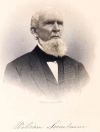
William Swinburne
Zum Vergrößern Bild anklicken
|
| Name | William Swinburne |
| Ortssitz | Paterson (N.J.) |
| Art des Unternehmens | Lokomotivkonstrukteur |
| Anmerkungen | 1805 - 1883. Gründer der Lokomotivfabrik "Swinburne, Smith & Co." (s.d.). Gelernter Tischler, war 1833-45 Betriebsleiter der Lokomotivfabrik von Rogers und rettete dort den Lokomotivbau, als ihn die Firma infolge Unfähigkeit des englischen Konstrukteurs Hodge schon nach der ersten Lokomotive aufgeben wollte. Mit einer Reihe von Mitarbeitern verließ er jedoch die Firma, um in Paterson 1844 die Lokomotivfabrik "Swinburne, Smith & Co." zu gründen, die 1848 ihre erste Lokomotive lieferte. Aber schon 1851 machte er sich mit einer eigenen weiteren Fabrik "Swinburne Locomotive Works" selbständig. Seine Lokomotiven genossen bei der Eriebahn, der er rund 150 Stück lieferte, und der Chicago & Alton-Bahn guten Ruf. 1857 fiel das Unternehmen "Swinburne Locomotive Works" der wirtschaftlichen Krise zum Opfer, das auch 1851 entstandene Nachfolge-Unternehmen "New Jersey Locomotive and Machine Co." hatte länger Bestand. |
| Quellenangaben | [Metzeltin: Die Lokomotive (1971)] [Sinclair: Development of the locomotiv engine (1907) 243 (m. Bild)] [Trumbull: History of industrial Paterson (1882) 117] https://de.findagrave.com |
| Zeit |
Ereignis |
| 13.01.1805 |
Geburt von William Swinburne in Brooklyn |
| 1833 |
William Swinburne in Brooklyn beginnt bei "Rogers, Ketchum & Grosvenor" in Paterson als Modellmacher |
| 1845/46 |
William Swinburne scheidet bei "Rogers, Ketchum & Grosvenor" aus und gründet seine eigene Lokomotivfabrik |
| 1857 |
Die Lokomotivfabrik vom Swinburne scheitert in der Wirtschaftskrise von 1857 |
| 04.11.1883 |
Tod von William Swinburne in Paterson (N.J.). Er wird dort auf dem Cedar Lawn Cemetery beigesetzt (Grabstelle: Sektion 8, Lot 255) |
| Tätig |
ab |
Bem. |
bis |
Bem. |
Kommentar |
| Dampflokomotiven |
|
War vorher bei Rogers |
|
später: Swinburne, Smith & Company |
Unsicher, ob Lokbau unter seinem Namen |
Zeit = 1: Zeitpunkt unbekannt
| ZEIT | 1846 |
| THEMA | Biografie, Tätigkeit bei Rogers |
| TEXT | William Swinburne was born in Brooklyn in 1805, and is, with perhaps one or two exceptions, the only one living who had anything to do with building the Sandusky. While working at his trade as a carpenter, at the age of eighteen, Mr. Swinburne assisted in building the old St. Ann's P. E. Church, opposite the Sands Street M. E. Church, Brooklyn. In St. Ann's Church were 1,500 small window lights in Gothic sashes with circular-headed frames, and these sashes were the work of Mr. Swinburne. This church, after standing about fifty-seven years, was razed about two years since to make way for the march of improvement in the shape of the great Brooklyn bridge. Mr. Swinburne's memory, which is excellent, reaches back to the time when there was no way of crossing between Brooklyn and New York except by row-boat. The first step toward improved facilities was the horse-boat; next came the first steam ferry-boat, the "Nassau", about 1814. This was shortly after Fulton had made his experiments on the North Biver. In 1827, when Mr. Swinburne was about twenty-two years of age, two notable events occurred; one was his removal to Matteawan; the other was his marriage to Melissa Doughty, of that place. At Matteawan he was engaged until 1833 in making patterns for machinery, etc. In that year he came to Paterson and went to work for Rogers, Ketchum & Grosvenor in the Jefferson Works, then just completed. The product was cotton machinery almost exclusively. Mr. Swinburne made the patterns and soon attracted attention by his skill and industry. At this time Paul & Beggs were running their works, nearly as extensive as those of Rogers, Ketchum & Grosvenor, and turning out mill-gearing, they being the only millwrights to be found within all the section of country about Paterson, and sending out men to a great distance to put up their work and equip new mills. When the fire occurred which consumed the establishment of Paul & Beggs, about 1835, together with all their patterns for mill-gearing - invaluable in those days - and a locomotive nearly completed, as before described, mill-owners were driven to Rogers, Ketchum & Grosvenor to induce the firm to go into the production of mill-gearing. What was left of the plant of Paul & Beggs was taken by Rogers, Ketchum & Grosvenor, and a millwright shop was built, one story, of stone, on the Southeast corner of Spruce and Market streets.
Here the new line of work was undertaken, Mr. Swinburne making all the patterns being, in fact, about the only one capable of doing it at the time. When the Hudson River Railroad from Jersey City to Paterson was completed Mr. Swinburne went to see its operation, wdien only a trial trip had been made over the road. The Paterson depot was where St. John's Catholic Church now stands. He was very greatly impressed with the wonders of the iron horse on the iron track - quite overcome, in fact - and, as he says, would have deemed any one mad who told him that he would one day build a better locomotive than the English-built "McNiel". So he kept on making patterns at the millwright shop until, in 1835, the building of the Sandusky was begun and his services were required in a new direction. Great expectations were entertained by the firm as to the result of the skill of Mr. Hodge, an English mechanical draughtsman, upon whom every dependence was placed in connection with the production of the first locomotive. It is said that he was a very accomplished man, but he was not a genius, and it was soon clear that he had undertaken a task he was utterly unfitted for In the beginning Mr. Swinburne was employed in making patterns after his drawings, but soon the natural talent of the former enabled him to see that no good could result from Mr. Hodge's plans. He convicted him, in argument, of being from 25 to 30 per cent, out of the way in his calculations as to the passages from the boiler to the steam chest,
and demonstrated so clearly that he, Mr. Swinburne, was right that the other, whose pride was terribly wounded, was compelled to acknowledge his error. But he fell into others. He had the boiler made first, and so far astray were his calculations that when it was completed there was found to be not space enough to put the furnace in the shell. There were other difficulties also, and at last Mr. Rogers discharged him. He assented, was paid, and left the works in high dudgeon. Then Mr Rogers, discouraged and hopeless, said "Lay the whole business up; put it away." Mr. Swinburne answered, counselling another effort; reminding his employer that much of the work was done, and assuring him there would be no difficulty in getting it out. Said Mr. Rogers : "Who'll do it?" "I will," was the answer. "You!" "Yes; I." "And can you ?" "I am sure of it," "Then go ahead. Go look at the engine at the depot, and see if you can understand it." Mr. Rogers referred to the "McNiel." Mr. Swinburne went to the depot and, examined the different parts with the practised eye of a skilled mechanic and a natural genius combined. Six months later the Sandusky was completed and, as already shown, was a perfect success. Mr. Swinburne did or directed everything toward the work, making the drawings and the patterns and showing the workmen how to produce the requisite parts. Mr. Rogers left all with him. Mr. Hodge, after his failure at the Rogers Works, was sent out to Russia as an engineer by Ross Winans, of Baltimore, and he died there a few years later. After the success of the Sandusky was assured the firm of Rogers, Ketchum & Grosvenor continued to build locomotives. The next one was built for the N. J. Railroad and Transportation Company, and was named the Arreseoh No. 2. This was larger than the Sandusky and was equally a success. For this, also, Mr. Swinburne made the plans and was general factotum, serving as draughtsman, pattern-maker, superintendent of construction and foreman of foundry, blacksmith and machine shops. There was not another foreman beside in any department. The shop where the first locomotives were built was 40x100 feet, two stories in height, From 30 to 10 men were employed. After five or six engines had been built the works were greatly extended, until they were 40x200 feet, three stories, of brick. Later,
still further additions were made, and the demand for engines came in from every direction; from the East, West, North and South. About 1840 Watts Cooke, the father of John, Watts and the other brothers Cooke, came from Matteawan (it is wonderful how many of those great pioneer mechanics and successful manufacturers came to Paterson by the way of Matteawan) where he was engaged in pattern-making. When Mr. Swinburne was drawn from the business of making patterns for mill-gearing to locomotive work Mr. Cooke succeeded him and was the only one engaged in that department until, on one occasion, all being very busy, it was proposed to bring John Cooke, his son, in to assist. The young man was then about seventeen years of age. Mr. Swinburne wished to set him at work to make a cylinder pattern. Watts Cooke, his father, demurred, but Mr. Swinburne insisted that the young man would succeed, and persevered, instructing him until John turned out a very good pattern. He continued to improve, making rapid progress, and soon was set to finish full-size drawings. When Mr. Swinburne left the works of Rogers, Ketchum & Grosvenor, about 1845, he recommended a Mr. Thurston as his successor |
| QUELLE | [Trumbull: History of industrial Paterson (1882) 117] |
|


