|
|
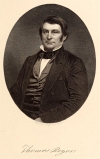
Thomas Rogers
Zum Vergrößern Bild anklicken
| Name | Thomas Rogers |
| Ortssitz | Paterson (N.J.) |
| Art des Unternehmens | Lokomotivkonstrukteur |
| Anmerkungen | ca. 1792-1856. Gelernter Modellmacher; gründete 1852 die Firma "Rogers, Ketchum & Grosvenor", die späteren "Rogers Locomotive Works" in Paterson. Rogers gilt als der Urheber des 1850 erstmals gebauten Wagontop-Kessels. Auch die erste amerikanische 2C-Lokomotive wurde von ihm 1846 gebaut. |
| Quellenangaben | [Metzeltin: Die Lokomotive (1971)] [Ry. & Loc. Engg. (1904) 3 (m. Bild)] [Bull. Ry. & Loc. Hist. Soc. Nr. 35, S. 15] [Morrell: Evolution of the Rogers Locomotive Co.] |
| Zeit |
Ereignis |
| 16.03.1792 |
Geburt von Thomas Rogers in Groton, Connecticut, als Sohn von Jason Rogers. - Er lernt das Zimmerei- und Schmiedehandwerk. |
| 1812 |
Thomas Rogers kommt nach Paterson und wird Teilhaber in einer Maschinenfabrik und Baumwollspinnerei |
| 1831 |
Thomas Rogers verkauft seinen Anteil an einer Maschinenfabrik und Baumwollspinnerei in Paterson für 36.000 und 38.000 und macht sein eigenes Unternehmen, in dem er die Jefferson Works gründet. |
| 1832 |
Gründung von "Rogers, Ketchum & Grosvenor" als Schmiede mit Eisen- und Metallgießerei durch Thomas Rogers gemeinsam mit Morris Ketchum und Jasper Grosvenor. - Im selben Jahr werden ca. $50.000 investiert |
| 1836 |
Die "Paterson and Hudson Railroad" kauft eine englische Lokomotive und bringt sie in die USA. Die Lokomtivfabrik nimmt sie vorsichtig auseinander, und Thoas Rogers studiert die Teile und macht vollständige Zeichnungen und Muster |
| 06.10.1837 |
Die Fabrik stellt die erste Lokomotive, die "Sandusky" (Achsfolge 2A), innerhalb von 16 Monaten her. Sie beweist ihre Qualität auf der Probefahrt von Paterson nach Jersey City und New Brunswick am 6. Oktober. |
| 1846 |
Bau der ersten amerikanischen 2C-Lokomotive durch Th. Rogers |
| 19.04.1856 |
Tod von Thomas Rogers vmtl. in Paterson. Er wird auf dem Cedar Lawn Cemetry in Paterson begraben |
| Tätig |
ab |
Bem. |
bis |
Bem. |
Kommentar |
| Neuerungen an Lokomotiven |
|
|
|
|
|
Zeit = 1: Zeitpunkt unbekannt
| ZEIT | 1882 |
| THEMA | Biographie |
| TEXT | Thomas Rogers, the founder of the locomotive-building establishment which bears his uame, the productions of which vast industry have achieved a world-wide renown, was born March 16th, 1792, in the town of Groton, Connecticut. This is in New London County, and lies on the opposite side of the Thames river from the city of New London. Mr. Rogers served in the war of 1812 with much distinction. He was a lineal descendant of Thomas Rogers, one of the Pilgrim Fathers, who came over in the Mayflower. At the age of sixteen he was apprenticed to learn the trade of house carpenter, and four years later, or in the Summer of 1812, he came to Paterson, then a small village, but prosperous on account of the demand for American manufactures brought about by the war with Great Britain. Upon this, the nucleus of the future industrial centre, the sturdy New Englander was destined to leave the impress of his wonderful skill and indomitable energy. The collapse of 1815, elsewhere alluded to in this work, followed very soon, however, and Mr. Rogers did not find the opening a very brilliant one. For a time he was employed as a journeyman carpenter, during which he was noted
for his constant application to his work, his good judgment and extraordinary force of character. Later he associated himself with Paul Rutan, and the two together are said to have been possessed of a capital amounting to at least 50. They built the woodwork of the residence of the late Judge Dickerson, on Broadway, corner of Straight street; also the residence on the Northwest corner of Broadway and Paterson street, known as the "Bibby House." The former, now the property of John Gould, a son-in-law of Judge Dickerson, is among the oldest houses in Paterson. After Mr. Rogers had been working in Paterson a few years, Captain Ward, a somewhat famous character in that day, who had been travelling in Europe, where he had witnessed the power-loom in operation, came to Paterson for the purpose of engaging in the manufacture of cotton duck. Mr. Rogers, whose natural ability and acquired skill were at once recognized by Captain Ward, was employed by him in making the patterns for his looms, and in the end, being fascinated with the idea, he purchased from Captain Ward the right of making the looms, a business which he afterward prosecuted with great success. Next we find Mr. Rogers in the machine shop of John Clark, the elder, where he applied for and was given work. The introduction of power-looms was just then attracting much attention, and as the looms were largely built of wood the builders were, so to speak, a sort of machine-carpenters, and skill and originality were excellent qualities in a workman. Mr. Rogers was noted for making more shavings and turning off more work than any of his fellows, and, what was still more important, his inventive genius enabled him to make many valuable improvements. After the retirement of John Clark, Sr., about 1816, John Clark, Jr., and Mr. Rogers became partners, and engaged in the manufacture of machinery, at first in a very small way, at the same location. Afterward General Abraham Godwin, Jr., his father's successor as host of the "Old Godwin House," and who was also one of the earliest storekeepers in Paterson, was admitted, and the style of the firm was "Godwin, Rogers & Co.". While the firm consisted of Messrs. Clark and Rogers only they continued to occupy the "Little Beaver Mill," and Mr. Rogers visited Mexico and other distant countries and received quite large orders, for that day, for looms and other machinery. After their association with Mr. Godwin the works were removed to Market, then Congress, street, the site of the present Danforth Works, occupying a building erected by Robert Collett for a cotton mill. The firm of "Clark & Rogers" was not very well supplied with capital, but when the third partner was taken into the concern it was financially strong. Prior to the formation of the first partnership John Clark, Sr., was the head and front of all the machinery business in Paterson; from the partnership dates the commencement of the great Rogers enterprise, which a few years later resulted in building the first locomotive in Paterson, the inauguration of one of its grandest industries. The Collett Mill, still standing in the rear of the Danforth lot, was soon found to be too small, and the Danforth machine shop and foundry (as existing before the destructive fires of quite recent date) were built, half size. In April, 1823, the firm bought out the foundry and moulding shop, the entire plant, of William Jacobs, located on the rear of what was since known as the Van Winkle lot, Van Houten street, now included in the premises of the Phoenix Manufacturing Company. This plant was removed the following month to the foundry of the firm
in Market street, and thus nearly a quarter of a century from the humble beginning of the elder Clark all branches of the iron industry connected with the building of machinery were united under one management. Subsequent to the establishment of the company with all their works complete "Godwin, Rogers & Co." experienced about eight years of successful operation, when, in 1831, the firm dissolved, Mr. Rogers retiring. According to the record found on the old books of the company, the date was June 27, 1831, the entire stock at that time being valued at 150.382,86. Mr. Rogers judging, and with reason, that the property of the firm was overvalued, sold his interest for 36.266,05 in hand. This
was a sad blow to the remaining partners, and Mr. Rogers was wont to remark of the transaction: "They gave me about 10.000 to go out, and they haven't much Left." The fact was he was the backbone of the establishment, so far as active operations were concerned. All the partners, together with the other leading men of Paterson in that day, were in the habit of spending their evenings at the great rendezvous of the time, the "Godwin House", afterward the Passaic Hotel, and most of them frequently prolonged their sittings to a late hour. Mr. Rogers, on the contrary, rarely overstayed ten o'clock; when that hour struck he would arise and, making some remark implying that he had work on the morrow, betake himself to his home. Next morning, when the others were feeling dull and indisposed to business, he would be abroad with the earliest of the men, alert, tireless and full of resources. Upon the withdrawal of Mr. Rogers from Godwin, Rogers & Co. he proceeded to erect the Jefferson Works, or Mill, having purchased a site on the back raceway, the location being next adjoining the present Ivanhoe Mill. The building was erected for the manufacture of cotton, wool and flax machinery and the spinning of cotton yarn; the latter idea, however, was never carried out, at least not to any great extent, in consequence of the increasing demand for machinery. The original design was to occupy only the lower stories in the making of machinery, devoting the upper to the cotton manufacture. On the upper raceway there were at this time no factories except two little cotton mills and a small machine shop, the latter owned by "Paul & Beggs". The Jefferson Works were literally an encroachment on the forest between Mill and Spruce streets. All was swamp, covered with pines and, so says the tradition, as populous with snakes as it has since become with human beings The new building being completed, Mr. Rogers, in the early part of 1832, associated with himself Messrs. Morris Ketchum and Jasper Grosvenor, both of New York, and both men of capital, but totally ignorant of manufacturing operations, and the business was thenceforth carried on under the firm name of "Rogers, Ketchum & Grosvenor". This title remained unchanged until Mr. Rogers' death, which occurred in New York city, April 19th, 1856. |
| QUELLE | [Trumbull: History of industrial Paterson (1882) 111] |
|