|
|
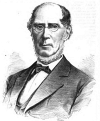
William S. Hudson
Zum Vergrößern Bild anklicken
| Name | William S. Hudson |
| Ortssitz | Paterson (N.J.) |
| Art des Unternehmens | Lokomotivingenieur |
| Anmerkungen | 1810 - 1881. War ab 1852 Chefingenieur in den "Rogers Locomotive Works" in Paterson (N.J.); Überhitzer-Erfinder. |
| Quellenangaben | [Brückmann: Lokomotiven 2,1 (1920) 584] [Leo: Examination of the technology that evolved from the Rogers Locomotive & Machine Company, Paterson, NJ (1975)] [American machinist, 20.08.1881, S. 5, Portr.] |
| Hinweise | [Trumbull: History of industrial Paterson (1882) 125, Portr.] |
| Zeit |
Ereignis |
| 1810 |
Geburt von William S. Hudson in einem Vorort von Derby (Endland) als Sohn eines Bauern. Er besucht die Quäker-Schule und lernt auf Wunsch seiner Eltern den Beruf des Lebensmittelhändlers. - Später lernt er Maschinenbau in Nottingham |
| um 1835 |
William S. Hudson wandert in die USA aus und wird für kurze Zeit Lokomotivführer bei der "Troy and Saratoga Railroad" und geht dann zur Eienbahn zwischen Rochester und Buffalo |
| 1838 - 1849 |
Tätigkeit von W. S. Hudson als "Engineer" beim Auburn State Prison. Während dieser Zeit ist er auch Chefingenieur bei der Firma "Dennis, Wood % Russell" in Auburn, die einige Lokomotiven bauen |
| 1849 |
W. S. Hudson wird Maschinenmeister bei der "Attica & Buffalo Railroad" |
| 1850 |
William S. Hudson, mechanischer Leiter der "Attica and Buffalo Railroad", entwickelt ein Verfahren zur Reparatur undichter Kesselrohre. Daher zieht er das Interesse von Rogers auf sich, wohin er zwei Jahre später wechselt |
| 1852 |
Der in England geborene William S. Hudson wird Leiter der Lokomotivfabrik von Rogers, genau in der Zeit, seit moderne Lokomotiven gebaut (Achsfolge 2'B) werden |
| Dez. 1855 |
Fertigstellung der Lokomotive "General" bei "Rogers, Ketchum & Grosvenor", entworfen von Thomas Rogers, zusammen mit William Hudson dem Leiter der Werkstätten. Achsfolge 2'B, Spurweite: 5 ft. = 1524 mm. Sie wird für $8,850 an die im Staatseigentum befindliche "Georgia's Western & Atlantic Railroad" (Strecke Atlanta - Chattanooga) verkauft. - Sie wird am 12. Mai 1862 im Zezessionskrieg entführt, was den Stoff für die Filme "Der General" von Buster Keaton (1926) und "The Gerat Locomotive Chase" (1956) liefert |
| 1856 |
Nach dem Tode von Thomas Rogers wird William S. Hudson Betriebsleiter |
| 1859 |
Hudson experimentiert bei Rogers mit Speisewasservorwärmern zur Brennstoffersparnis |
| 05.04.1864 |
William S. Hudson erhält das U.S.-Patent 42.193 "Improved mode of connecting trucks to locomotives" (Lokomotivdrehgestelle) |
| 1871 |
Hudson entwirft ein Bohrwerk, das bei "William Sellers & Co." hergestellt und von Rogers 1871 erworben wird. Es kann einen 16 x 14"-Zylinder in acht Stunden ausbohren |
| 11.03.1873 |
Hudson erhält das amerikanische Patent Nr. 129.233 auf "Improvement in Locomotives". Dieser Patentschrift nach handelt es sich um einen in der Rauchkammer gelagerten Verbinder-Überhitzer, durch den der Dampf mehrfach auf und nieder geleitet wird, während ihn die Heizgase umspülen, indem sie durch ein Bündel von den Heizrohren gegenüber liegenden Rohren ziehen. Die Patentschrift gibt an, daß der Erfinder den Kesseldampf der Sparsamkeit wegen nur in einen Zylinder einläßt, und den Abdampf dann in den Überhitzer und aus diesem in trockenem oder mehr oder weniger überhitzem Zustande in den zweiten Zylinder übertreten läßt. Bei diesem zieht er einen um 30% größeren Durchmesser vor. |
| 20.07.1881 |
Tod von William S. Hudson, bisher Betriebsleiter (superintendent) bei Rogers in seinem Wohnsitz in Haledon bei Paterson. Er wird auf dem Cedar Lawn Cemetery beigesetzt |
Zeit = 1: Zeitpunkt unbekannt
| ZEIT | 1882 |
| THEMA | Biographie |
| TEXT | William S. Hudson, who died July 20th, 1881, aged seventy-two years, was from about 1852 to 1856 the efficient and valued assistant of the late Thomas Rogers in the important enterprises undertaken during that period, and from the last-named date to the time of his death his career of usefulness was continued under the presidency of the present head of the establishment, Jacob S. Rogers, by whom, as by the elder Mr. Rogers, Mr. Hudson's services were regarded as invaluable. For a space of nearly thirty years Mr. Hudson's was a familiar figure about the works, and his ripe experience and thorough knowledge of machinery contributed to an almost incalculable degree to the excellent character of the locomotive product of the establishment during all these years. Since the death of Thomas Rogers, in 1856, Mr. Hudson had held the position of Master Mechanic and Superintendent; virtually, he had been in charge of the details of manufacture since the date of his connection with the works, in 1852, when he succeeded the late John Cooke, who retired to enter the firm of "Danforth, Cooke & Co.". Mr. Hudson was regarded by the pioneer locomotive builder as
"his right hand man", and he possessed the confidence of his employer in the highest degree, his large experience, great natural talent, acquired skill and inventive powers being fully appreciated. So greatly was he esteemed that in the closing years of his connection with the works the company refused to fill his place, other than temporarily, so long as there was any hope of his recovery to health, although he was unable to perform any service for a space of nearly two years before his death. A brief sketch of the earlier career of this eminent Anglo-American mechanic may not be uninteresting in this connection: William S. Hudson was born in Derbyshire, near the town of Derby, England, and came to this country with his wife when still in his early manhood. He had been an apprentice of the great Robert Stephenson, of R. Stephenson & Co., who built the "Rocket", the first successful locomotive engine in England, which was put on the Liverpool and Manchester Railway in 1829. After having served his apprenticeship Mr. Hudson continued still at the Stephenson Works until he came to America. Upon his arrival his great talent was soon recognized, and he was given the position of Master Mechanic on the Attica & Buffalo Railway, and in pursuance of his duties connected therewith he was frequently at the Rogers Works supervising the building of locomotives for his company. Messrs. Rogers and Hudson used to have long talks on these occasions, both being enthusiasts on locomotive-building, and when the late John Cooke resigned the Superintendency of the Rogers Works Mr. Hudson was, most naturally, invited to succeed him.
During the long period in which Mr. Hudson was identified with the establishment he produced many valuable inventions and improvements, some of which have been generally adopted in locomotive-building, and for them the inventor has received the highest encomiums in works on mechanics, until his reputation has become not only national but world-wide. Among his most important improvements, perhaps, were those in connection with the swing-truck and the double-ender locomotive. He has been credited with the original invention of the swing-truck, but this is wrong; it was the invention of Levi Bissell, at one time a mechanic employed at the Danforth Works, and A. F. Smith, Superintendent of the Hudson River Railroad. The object of the swing-truck is to enable a locomotive the better to pass around a curve and with greater safety from derailment, the engine being so swung that it is lifted and maintained in its position in reference to the train behind while the truck rounds the curve. But this was at first found to result in a lift of weight from the engine drivers and a consequent lack of adhesion. To overcome this Mr. Hudson introduced an improvement that consisted in placing an arrangement of equalizing levers between the two-wheeled truck and the front driving wheels, whereby both truck and driving wheels sustain their proper portion of the weight and accommodate themselves to the vertical as well as to the lateral motion required to enable the engine to pass over inequalities on the track and
around curves with ease and safety. This invention was patented. Mr. Hudson also introduced a double-ender locomotive with two pairs of drivers, one pair at each end. One improvement of Mr. Hudson's, invented when he was still Master Mechanic of the Attica and Buffalo Railway, is highly spoken of. A great deal of trouble was experienced with leaky flues, and every few days someone had to go into the furnace of the engine to hammer or caulk up the ends of the flues and thimbles, the flues being then of copper or brass and the thimbles of wrought iron. In 1850 Mr. Hudson conceived the idea of substituting cast iron for wrought iron thimbles, as being more subject to expansion, which would result in correcting the evil, preventing leakage. He took a thimble of each kind, turned them accurately to a gauge, then heated them red hot, measured them and noted the expansion, then cooled them and measured again. This Avas repeated twelve times, when the wrought iron thimble was found to be appreciably smaller and the cast one larger, which solved the problem. Cast iron thimbles have since been in general use. Many other improvements might be noted, in the action of pistons, fire-boxes, grate-bars, ash-pans, safety-valves, etc., but the above is sufficient to show that Mr. Hudson was one of the most accomplished mechanics in the line of locomotive-building of his day; and he had thus been long regarded. About the time of his death a lengthy article in the Railroad Gazette was devoted to a sketch of his career and inventions; and in this a due meed of praise was awarded him as one most eminent among American mechanics. In social life Mr. Hudson was of a retiring disposition and, like most men of his stamp, somewhat exclusive in his associations. He was usually found at his place of business or at his home. He was singularly pure in his domestic life and was idolized by his family and the comparatively few who became his intimate friends. Joppa Lodge, No. 29, F. & A. M., and Cataract City Chapter, No. 10, Royal Arch Masons, of which deceased had been a prominent member for over twenty years, being among the earliest to join, attended his funeral, the interment rites being conducted after the Masonic ceremonial. |
| QUELLE | [Trumbull: History of industrial Paterson (1882) 125] |
|