|
|
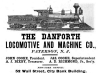
Danforth Locomotive and Machine Company
Zum Vergrößern Bild anklicken
| Name | Danforth Locomotive and Machine Company |
| Ortssitz | Paterson (N.J.) |
| Art des Unternehmens | Lokomotivfabrik |
| Anmerkungen | 1874: John Cooke, Präsident; Jas. Cooke, Leiter; J. Edwards, Vizepräsident; A. J. Bixby, Leiter der Finanzen. 1852 - 1865: "Danforth, Cooke & Co." (s.d.) als Locomotive an Machine Works. Ab 1882: "Cooke Locomotive & Machine Works". Um 1871: Inhaber Charles Danforth (bei [Boyd] fälschlich ohne "h"). |
| Quellenangaben | [Metzeltin: Die Lokomotive (1972)] [Boyd's business directory ... New York state (1870) 41] [Wiley: American iron trade manual (1874) 63] [Bishop: History of American manufacturers 3 (1868) 225] |
| Hinweise | [Manual of the Railroads of the United States (1873/74), Anzeige] [Trumbull: History of industrial Paterson (1882) 132] |
| Zeit |
Ereignis |
| 1800 |
Gründung durch John Clark, senior, einem Schotten, nahe der Beaver Mill um 1800 als vielleicht erste Maschinenfabrik in New Jersey |
| 1812 |
Die Produktion wird zur Zeit des Krieges für ein oder zwei Jahre eingestellt. |
| 1812 |
Die Firma geht zu dieser Zeit auf John Clark, Jr., über. |
| 1822 |
General Abram Godwin wird Teilhaber, und die Firma "Godwin, Rogers & Co." wird gegründet. |
| 1826 |
Major John Edwards tritt in die Firma ein. - Er wird für viele Jahre Vorarbeiter. |
| 1828 |
Bau eines Ziegegebäudes für die Maschinenwerkstatt. |
| 1828 |
Charles Danforth, ein Bürger aus Massachusetts, der in Ramapo, Rockland County, New York, viele Jahre lebte, Erfinder der berühmten Kapselspinnmaschine, kommt nach Paterson und vereinbart mit der Firma, seine Maschine dort herzustellen. Große Aufträge werden von Spinnern zu zufriedenstellenden Preisen übernommen, und es wird ein erfolgreiches Geschäft abgewickelt. |
| Frühjahr 1830 |
Danforth geht nach England und führt seine Spinnmaschine dort ein, wo er auf ziemlichen Erfolg stößt, und er wäre noch größer, wenn nicht zu dieser Zeit nicht gerade der Selfaktor eingeführt würde. |
| Herbst 1831 |
Danforth kehrt aus England zurück, gerade bevor die Firma "Godwin, Rogers & Co.aufgelöst wird. |
| Herbst 1831 |
Rogers verläßt die Firma und verbindet sich mit "Ketchum & Grosveneur" und bildet die Firma "Rogers, Ketchum & Grosveneur" (später: "The Rogers Locomotive and Machine Company"). |
| Herbst 1831 |
Danforth übernimmt die Stelle des ausgeschiendenen Rogers in der alten Firma, die das Geschäft unter dem name "Godwin, Clark & Co." weiter betreibt und ihr Werk vergrößert. |
| 1839 |
Edwin T. Prall wird Hauptbuchhalter. |
| 1840 |
"Godwin, Clark & Co." wird aufgelöst. Die Maschinenwerkstätte wird durch Mr. Danforth und die Baumwollfabrik durch General Godwin weitergeführt. |
| 1842 |
Mr. Danforth kauft den gesamten Konzern (d.h. einschl. der Textilfabrik, die seit 1840 durch General Godwin geleitet wurde. |
| 1848 |
Major John Edwards übernimmt einen anteil an der Firma, jetzt als "Charles Danforth & Co.". |
| 1852 |
John Cooke tritt als Managing Director in die Maschinenfabrik von Danforth in Paterson ein, um dort den Lokomotivbau einzuführen |
| 1852 |
Edwin T. Prall wird zusammen mit John Cooke Teilhaber bei "Charles Danforth & Co.". - John Cooke war seit ca. 1844 Vorarbeiter in "Rogers Locomotive Shop" und hatte viel zur Konstruktion der Lokomotiven dieser Gesellschaft beigetragen. |
| 1852 |
Bau einer Lokomotivwerkstätte |
| 1852 |
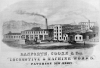
Umfirmierung aus "Charles Danforth & Co." in "Danforth, Cooke & Co." |
| 1865 |
Umwandlung von "Danforth, Cooke & Co." in eine Aktiengesellschaft unter der Firma "Danforth Locomotive and Machine Company" die alten Teilhaber werden Hauptaktionäre. |
| 1882 |
Umbenennung in "Cooke Locomotive Works", |
| Produkt |
ab |
Bem. |
bis |
Bem. |
Kommentar |
| Dampflokomotiven |
1852 |
Eintritt von J. Cooke |
1882 |
Ende (--> Cooke) |
|
| Eisenbahn-Schneepflüge |
|
|
|
|
|
| Zeit |
gesamt |
Arbeiter |
Angest. |
Lehrl. |
männl. |
weibl. |
Kommentar |
| 1874 |
750 |
|
|
|
|
|
|
| von |
bis |
Produkt |
im Jahr |
am Tag |
Einheit |
Kommentar |
| 1865 |
1865 |
Lokomotiven |
66 |
|
|
|
| 1866 |
1866 |
Lokomotiven |
62 |
|
|
|
| 1867 |
1867 |
Lokomotiven |
49 |
|
|
|
| 1868 |
1868 |
Lokomotiven |
32 |
|
|
|
| 1869 |
1869 |
Lokomotiven |
53 |
|
|
|
| 1870 |
1870 |
Lokomotiven |
76 |
|
|
|
| 1871 |
1871 |
Lokomotiven |
65 |
|
|
|
| 1872 |
1872 |
Lokomotiven |
72 |
|
|
|
| 1873 |
1873 |
Lokomotiven |
82 |
|
|
|
| 1874 |
1874 |
Lokomotiven |
33 |
|
|
|
| 1875 |
1875 |
Lokomotiven |
28 |
|
|
|
| 1876 |
1876 |
Lokomotiven |
39 |
|
|
|
| 1877 |
1877 |
Lokomotiven |
9 |
|
|
|
| 1878 |
1878 |
Lokomotiven |
12 |
|
|
|
| 1879 |
1879 |
Lokomotiven |
17 |
|
|
|
| 1880 |
1880 |
Lokomotiven |
65 |
|
|
|
| 1881 |
1881 |
Lokomotiven |
106 |
|
|
|
Zeit = 1: Zeitpunkt unbekannt
| ZEIT | 1872 |
| THEMA | Firmenbeschreibung |
| TEXT | The firm of "Charles Danforth & Co.", which remained unchanged from 1818 to 1852, was composed of the late Charles Danforth and John Edwards. It has already been shown how this, which is now among the largest and most important locomotive and machine-building establishments in the United States, originated in a small machine shop erected by John Clark, the elder - the first machine shop in Paterson and, probably, the first in New Jersey - about the year 1800, on the site of the old Bachmann Mill; also, how, in subsequent years, the enterprise grew in importance, and that, one after another, Thomas Kogers, Abraham Godwin and Charles Danforth were connected with it and directed its operations
with the remarkable skill, energy and executive ability which promoted its continued success. In 1852 the business was extended and the building of locomotives was commenced in addition to that of machinery and the cotton manufacture. At this date two new partners were admitted, Edwin T. Prall, who had been principal bookkeeper since 1839, and John Cooke, who had been Superintendent of the Rogers Locomotive Works for six or seven years, succeeding William Swinburne, as before noted. The firm was re-organized under the name of "Danforth, Cooke & Co.", which was continued until 1865, when, a charter having been obtained, the "Danforth Locomotive and Machine Company" was incorporated, the old partners being the principal stockholders A brief sketch of the general situation and the circumstances under which the business of locomotive-building was commenced at these works may not be out of place just here; also of the enterprising and capable men associated for this purpose. It has been shown how John Cooke had worked his way upward from a poor boy by the force of intelligence, industry and integrity until he occupied a prominent position as director of one of the very first among American industries. He is conceded by historians and others (see Bishop's History of American Manufactures, Vol. Ill, page 226) to have contributed greatly toward perfecting and giving character to the magnificent engines turned out by Rogers, Ketchum A: Grosvenor, and now we find his great ability and remarkable business talent transferred to the firm wherein lie became partner, the productions of which - as of the company into which it afterward merged - have borne his impress, as to character and excellence, even to the latest locomotive engine and the latest piece of machinery completed at this vast establishment. John Cooke was born at Montreal, Canada, whence his parents removed while he was yet very young to Albany, N.Y., and from tbence, about five years later, to Matteawan, Dutchess County, N.Y. Here, while he was still but a small lad, John was accustomed to visit the cotton mills and watch the workings of the machinery with curious and critical interest. He was scarcely fifteen years of age when his parents removed from Matteawan to Paterson, where his father, Watts Cooke, Sr., found employment as head pattern maker at the locomotive and machine works of Rogers, Ketchum A: Grosvenor. A year or two later he was taken into the shop and spent several years in learning the trade, devoting his evenings to hard study. His early educational advantages had been superior, for that period, but he was thirsting for knowledge and during many years spared not the midnight oil. He was especially fond of mathematics and was also a great student of history. Continuing his studious habits even far into manhood, he garnered up a store of valuable information on practical subjects such as few possessed, even of those who were favored with all the advantages of ample leisure and abundant instruction. It is related elsewhere how he rose from one position to another in the Rogers establishment until, when scarcely of age, he was intrusted with the entire superintendency, succeeding Mr. Swinburne upon his retirement therefrom. This position he retained until, in 1852, he became one of the firm of "Danforth, Cooke & Co.". Of his after career in the direction of this great industry the details will be found inseparably connected with the prosecution of the business in succeeding years. This is more especially a digressive personal sketch. After devoting himself very closely to business, almost day and night, until
about 1866 Mr. Cooke felt the need of a period of rest. He had long desired to visit Europe and other countries, and he now decided to gratify this reasonable longing His entire family accompanied him, and his children were placed in an
excellent school on the Continent. The family spent three years abroad and during that time not only visited all the countries in Europe, but also paid a visit to Palestine and took a trip up the Nile. Having satiated the desire for travel they returned, and upon the retirement of the late Charles Danforth from the presidency of the Danforth Locomotive and Machine Company Mr. Cooke was chosen to succeed him, remaining in the position until his death, February 20th, 1882, at the age of fifty-eight. At the age of eighteen Mr. Cooke became a member of the Congregational Society, but subsequently united with the Second Presbyterian Church, in which he remained an active and consistent member until his death, holding offices of trust and responsibility therein for many years. He was, besides, most active in promoting the growth and advancement of Presbyterianism, and of religion generally, in the city, his being an especially catholic spirit. In politics he was a Republican, and, being of strong convictions on this as on other subjects of importance, he was active and zealous, though never, in the common acceptation of that term, a politician. In dying he left a wife, the daughter of City Comptroller William Swinburne, and five children, two married daughters and three unmarried sons, the two youngest still at school. The general sentiment throughout the city in reference to his demise was that there was no other citizen whose death would have left so large a void and whose place in the various departments of social life and business activities it would he so difficult to fill. Charles Danforth was not at any time especially active in the locomotive-building department; his forte was cotton and other machinery. Mr. Danforth was accounted the most accomplished manufacturer of cotton machinery living, his experience having been wide in all branches of the industry, so that he had mastered every detail and was thoroughly conversant with everything relating to cotton-spinning and the building of machinery for that purpose. Since his invention of the spinning frame with which his name has ever since been associated he had made many improvements on it, until it was at this date regarded as the most effective throstle spinner extant and would produce, it is claimed, fully thirty per cent, more yarn, "spindle for spindle", than any other. Mr. Danforth was a deep thinker and reasoner. He had a wonderfully retentive rnemoiy. When he undertook to study a subject or examine a piece of mechanism he did not abandon it until he had mastered it in fullest detail. He was slow in coming to a decision, but his conclusions were generally correct. Scrupulously exacting in business matters, demanding and paying every cent, among prominent business men of New York, with whom he had large dealings, he was held in high esteem lor his probity. He died in 1875, aged seventy-nine years. The late John Edwards was in special charge of the cotton machinery manufacture of the concern, his duties being mainly in connection with that branch. The cotton mill on the race, a portion of the walls of which still remain, and which was, and is still, known as the old Collett Mill, the same building wherein "Godwin, Rogers & Co." commenced business, was superintended by Mr. Prall. The first floor was occupied as a machine shop, the three upper floors as a cotton factory, for prior to 1852 the business of the concern was confined almost or quite exclusively to cotton and cotton machinery, these two departments of manufacture being naturally combined in those days. John Edwards was born in England and came to this country when a boy. His mother and step-father settled in Bloomfield, N. J. John, while still young, came to Paterson. He worked for a Mr. Van Bussum, who kept the Franklin House, where he gained the notice of John Clark, who took him as an apprentice to the machine business. He was a faithful apprentice. Messrs. Rogers and Clark thought very highly of him, ultimately making him foreman of the shop, which position he retained under Mr. Danforth, whose partner he finally became. He was very orderly and systematic in all his business, having a place for everything and everything in its place. In his intercourse with the men under him he was firm, always just and liberal, and commanded and retained their highest respect and esteem. In early manhood he was fond of military matters and held a major's commission from the State. He died in 1878, aged about seventy-two, leaving as the only surviving partner of the original firm of "Danforth, Cooke & Co.". John Cooke, the oldest locomotive builder actively engaged in the business from that date until his death in 1882. During the partnership of Messrs. Danforth and Edwards the former held a nine-tenths' interest, the latter one-tenth. Although the business as carried on by "Charles Danforth & Co." up to 1852 was very remunerative and the concern prosperous, there were periods of great stagnation, when there was little or no demand for the product. Edwin T. Prall, a gentleman of remarkable energy and invaluable to the firm, not only served as bookkeeper and superintendent of the cotton factory there, but had a partnership with Mortimer Hall, and together they ran a cotton mill at or near Godwinville, and Mr. Prall used to walk up to this village and return every Aveek, to look after the business and make up the accounts. His uncle, the late Abram Prall, had been partner with Abraham H. Godwin, a nephew of Gen. Abraham Godwin, of Godwin, Clark & Co., and the firm carried on the cotton manufacture in a portion of the old Gun Mill from about 1845 to 1852-53. Here, also, Edwin T. Prall, the indefatigable, found employment in writing up the books at odd hours. Mr. Prall was aged about thirty at this time, and his capacity for work seemed
well nigh illimitable; in fact anything like idleness wore upon and fretted him. Mr. Prall came from Staten Island and was of good old-fashioned Knickerbocker-Moravian ancestry. Left an orphan when young, lie was thrown on his own
resources. While a boy he found employment with his cousin, David Prall, an importer of drugs in New York city. He was at another time employed by his uncles, Peter and Henry Prall, cotton manufacturers at Haverstraw, N. Y. Later he came to Paterson to take a place in "Charles Danforth & Co."'s office, under his uncle, "Abe" Prall, who was bookkeeper for the company, and after his death he succeeded to his place. Mr. Prall was very social in his disposition, made many friends among railroad men and had no superior in looking up orders. At twenty-four years of age he married Kachel Thompson, a young lady of excellent family. In the later years of his life he was among the most prominent citizens of Paterson socially, politically and otherwise. He was twice Mayor of the city, being elected first in 1860; at the expiration of his term of office, his name was placed on the tickets of both political parties, there being no opposition to his re-election. He was commissioned Colonel of the Second Regiment of the Passaic Brigade, General T. D. Hoxsey commanding, early in the war of the Rebellion, and tendered the services of his command to Governor Olden for the war, who declined in a letter couched in the most flattering terms, the quota from the State being at the time
complete. He died in 1869, at about forty-nine years of age. It was during a period of semi-depression in the business of "Charles Danforth & Co.", in 1852, that this active bookkeeper and general factotum - for he made himself busy in any department where he could find vent for his superabundant vitality - became restive, and one day he declared that he would resign. He was promptly told that he must do no such thing, and, when he persisted, a partnership was offered him. "No," said he, thoughtfully, "there's no money in it." Afterward a sudden idea struck him and he said to the partners: " If you'll go into the locomotive business I'm with you." To this two very natural objections were made; there did not seem to be any one capable of directing the work, and there might be a difficulty in obtaining orders. The energetic bookkeeper declared confidently his ability to find both the man and the work. The partners took a brief space for consideration, and then Mr. Prall was told to "go ahead." He went ahead at once and after his characteristic manner. John Cooke was superintending the locomotive department for "Rogers, Ketchum & Grosvenor", where he was receiving the then very liberal salary of $1.800 per annum. He was invited to meet Messrs. Danforth, Edwards and Prall at the house of the latter, and when he came a proposition was made to him to become a partner, with Mr. Prall, in the
concern. He could not readily make up his mind. He had so identified himself with the Rogers Works as a builder of locomotives that it seemed difficult to wrench himself from his place. However, regarding it as time for him to make some advancement, he laid the matter frankly before Mr. Rogers, who declared in his impetuous way that he should not go. He could have a partnership there. Mr. Grosvenor also said very emphatically he must not think of it; he was regarded as one of the fixtures of the establishment. Pending any further action Mr. Rogers went away for a considerable space, and in his absence the to-be rival establishment pressed Mr. Cooke to enter into the copartnership and, the other matter being still in doubt, he committed himself. After it was done he was greatly disturbed over it. When Mr. Rogers returned he laid some papers before the Superintendent, saving, "Now look these over and sign. These give you an interest with 'Rogers, Ketchum & Grosvenor'." Mr. Cooke ran his eye along as far as, " This indenture," and then stopped, saying he would read no further. He had already decided; he had joined the other firm. "Oh, very well; very well," was the irritable reply; "it can't be helped, I suppose." Mr. Rogers did not like to lose his efficient Superintendent but said little more about it. The new company organized July 19th, 1852, and they broke ground for their new r shops about the first of August following. It had been the intention of "Danforth, Cooke & Co." to merely supplement their machine-building with the locomotive business, utilizing as far as practicable their old shop and tools in the new enterprise. The works at this date included the brick machine shop, end facing on Market nearly opposite Jersey street, 30x134 feet, four stories high; the old Collett Mill, on the rear of the lot, 50x72 feet, four stories, three of which were being used by the company as a cotton factory; a blacksmith shop, 24x105 feet, on the same lot, adjoining the Hamil Mill lot; also, on the opposite side of Market street, a frame foundry, 50x75 feet, about one-quarter the size of the present one. In addition to these there was in use a building on the rear of the lot adjoining the machine shop, known as the "Munson Godwin lot." This building was 40x75 feet, three stories. It was built fully sixty years ago by the late Aaron King, who brought the material, trap rock, in a, scow on the middle canal from the hill back of the Ivanhoe Paper Mill; this was used as a millwright and pattern shop. It was intended to build the new locomotive shop on the Munson Godwin lot, which had a frontage of 100 feet on Market street and extended back to the middle canal, joining on the West the property of James Shepherd, the veteran cotton-bleacher, which had a 200 feet frontage on Market street, extending to the line of the present Grant Works. Shepherd had leased one-half of this lot, known afterward as the Jaffray Mill lot, to Thomas Rogers, who was running a cotton mill on the rear of the lot. It was found when the Munson Godwin lot was surveyed that Shepherd's building was over the line about three feet. The new firm purchased the entire property for 11.000; two feet of water, one on each lot, at a rent of 500 per foot per annum, went with the property, and it was considered very cheap, but Mr. Shepherd had referred the firm to his counsel, the late Daniel S. Barkalow, and that was the price he fixed on it. This lot was a very important addition to the property of the new firm, enabling them to put up buildings for what at that day was considered a large works. Their main building, for an erection shop, was 100x50 feet, with a wing running back 60x45 feet. Both were two stories. Connected to this building was a one-story blacksmith and boiler shop in the form of an L, with a frontage on Market street of
75 feet and extending back to the middle of the canal about 150 feet, with a width of 48 feet. The buildings on both sides of Jersey street were afterwards added, one of them within a year or two after starting the works, as it was found that the blacksmith and boiler shop was too small to accommodate both branches. These buildings were erected by Cornelius Vreeland, mason, and Andrew Derroin, carpenter, and were considered the best adapted for a locomotive works of any in the city. The large chimney, over one hundred feet high, was built in connection with underground flues in the blacksmith shop for carrying up all the smoke and sulphur from the shop. The buildings were heated by steam and had, wheu complete, a capacity of from four to six engines per month. Early in August Mr. Cooke left the employment of "Rogers, Ketchum & Grosvenor" and devoted his whole time and energy to the building up of the new enterprise. Special tools had to be made under his supervision, as the manufacture of tools for locomotive work was not then largely a specialty as now. Those not made by the company were ordered from Lowell, Worcester and other places East; nearly
all of these were destroyed in the great fire in 1879. By early Winter the buildings and tools were ready to commence work. The first order was for five locomotives from "Seymour & Co.", for the Ohio & Mississippi road. Seymour had been Chief Engineer on the New York & Erie road and had a contract to build the Ohio and Mississippi road from Cincinnati to St. Louis. The first engine finished was named "Vincennes." This was an unfortunate contract for the new beginners. The bankers of "Seymour & Co.", "Page & Bacon", of St. Louis, failed and were not able to meet their notes given in payment for these engines, but ultimately the company received bonds for the notes, which bonds many years afterward appreciated in value so that the loss was not a total one. But the first locomotive actually delivered was completed in March, 1853, and was for the Junction road in Ohio. The name, by a singular coincidence, was the "Sandusky," the same as that of the first engine turned out from the Rogers Works. There was then, as there is at this date, a friendly rivalry between the shops, and care was taken not to induce the hands to leave one shop for the other. John Cooke says it was uphill work to collect hands acquainted with locomotive work. A younger brother, William, since engaged in business in New York city, took charge of the draughting at the new works; Watts, now President of the Passaic Rolling
Mill Co., who was then a little over nineteen years of age and a bound apprentice to Thomas Rogers, had been sent to Cincinnati to put up three new engines for the Cincinnati, Hamilton & Dayton road. When he came home and found the change that had been made, he had a great desire to cast in his lot with his brother John and proposed to Mr. Rogers to buy the balance of his time. Mr. Rogers consented, taking the young man's note, to be paid in a year, which note, by his advanced pay, he was able to take up long before it came due. He was installed as foreman of the erecting shop, in which capacity he remained until 1854, when he was sent to Scranton to look after a coal-burner engine that had been sent to the Delaware, Lackawanna and Western road, and the Superintendent of that road, being pleased with him, engaged him as master mechanic, at a salary that his brother's firm did not feel able to pay. James Ayres, a fellow apprentice with Watts Cooke, was given his place, which position he has occupied for nearly thirty years. Prior to 1857 the railroad business was very prosperous and work flowed in so that the new concern was taxed to its utmost to fill the orders received. These orders were largely from the immediate vicinity and included a number secured through E. & A. Stevens of Hoboken, for the Camden & Amboy road; from John P. Jackson, President of the New Jersey road; through Judge Vail, for the Morris & Essex road and through Director Sprague, a relative of Mr. Prall, for the Delaware, Lackawanna & Western, for engines to be used on their road from Scran ton to Great Bend on the line of the Erie, the idea then being that other lines of transportation would supply the East with coal from the Pennsylvania coal-fields, the Delaware, Lackawanna & Western aspiring to transport the mineral product of the Scranton region to the West, where it was thought there would be an excellent market. Since that time the greater number of engines used on his road have been built at these works. Orders were received at the works from Mexico also. The first engine was sent out with Col. Talcott, an American engineer who had surve3 T ed the Vera Cruz and Mexico Railway. He took some Paterson workmen along to assist him with the engine, which was taken to pieces and hauled over the mountains to the City of Mexico, to be used on that end of the road. The work of building the road dragged along slowly, as most enterprises did in that countiy, and finally fell into English hands. Under the rule of Maximilian two more engines were sent to a road near the City of Mexico. One was called "Carlotta", after the unfortunate Empress. A man named Ferry was engaged to go out with and to set them up and to run them. A section of the road was to be opened with a great fete, at which the Emperor and Empress were to be present in state. But the locomotives were on the other side of the mountains and it was considered impossible to have them over in time. Ferry, however, was equal to the emergency. Making a strong wagon and impressing all the oxen he needed he brought the engines over and had them both in order for the opening of the road. The Emperor and Empress publicly thanked Ferry and his men for what they had done. The engines were smothered with garlands and after consecration by the priests proceeded to take their respective trains. Ferry was unfortunate in the end. His wife died in Mexico, and when the Emperor was executed lie had to leave, making his escape from the country on board a small sailing vessel, leaving behind everything he had. Among the early productions of "Danforth, Cooke & Co." were locomotives for Texas, probably the first sent into that State. They were ordered by James Wells, a brother of Mr. Wells of "Muzzy & Wells", at that time lumber dealers in Paterson. Several were sent to Texas in 1860, and fell into the hands of the Confederates, and were destroyed and were never paid for. An American company undertook to build a road in Venezuela from Laguayra to Caracas, when, through some revolutionary movement, such as are chronic there, the company failed, leaving the locomotive on the beach, where it had been tossed from the vessel, the Danforth Company losing all they had invested and the men sent out to set it up getting away with their lives barely. During the seven years which followed the organization of "Danforth, Cooke & Co." over 1G0 locomotive engines were turned out for various roads. In 1859 the concern comprised, in addition to the cotton factory, a foundry wherein 100 Lands were employed; a machine shop, employing 175 hands; also a locomotive, boiler and blacksmith shop, wherein about 250 skilled and muscular workmen, begrimed with the smoke and dust of remunerative labor, daily contributed in making the vicinity about the terminus of Market street a place of deafening clangor caused by steel smiting steel, and filling the atmosphere with metallic particles, the ears with a metallic din. The capacity of the locomotive shop at that date was rated at 35 engines per annum. The foundry cast about five tons daily. This was in addition to the machine-building department, except as to the product of the foundry, which cast for both. The entire sales of the establishment had averaged over a half million annually for several years. In 1867, two years after the incorporation of the "Danforth Locomotive and Machine Company" with Charles Danforth as President, the works covered nearly two acres of ground and included a cotton factory, a foundry, a new boiler shop, 200 feet in length, a large blacksmith shop and pattern shop, 110x35 feet, in which valuable patterns were stored, costing originally over 8150,000, a machine shop and a locomotive shop. The product at this time had reached as high as 300,000 worth of cotton machinery and seventy locomotives in a single year, and the establishment employed as many as 700 men in the various departments. From that date until 1873 there was a steady increase in prosperity ; then the reaction which came to all American industries and to all business struck this establishment also, and a death-like quiet reigned throughout the vast works, not only of this company but of the others, at the head of Market street. A blow had been struck from which the iron, in common with other industries, was slow to recover, and it was not until about 1879 80 that a return of something like the good old times was welcomed with joy by the skilled artisans employed in this department of labor. About the year 1851 the question of coal-burning engines was for the first time being discussed at Paterson; in Pennsylvania and Maryland they had been in use for a short time. The "Delaware, Lackawanna & Western Company", having a terminus at the coal-fields, desired to burn coal. The only engine that had been built for the purpose anywhere in this section, so far as there is any record, was a queer-looking nondescript, bearing much the appearance of a steamboat on wheels, built by one Tripp, at Trenton, and run on the Camden & Amboy road. It was not a success. "Danforth, Cooke & Co." had built four wood-burning engines for the Delaware, Lackawanna and Western, and they then received an order for and turned out a coal-burner, and dubbed it the "Anthracite." When completed there was a competitive test at Scranton, between the "Anthracite" and one of what were known as the "camel-back" coal-burning engines sent up by Eoss Winans, from Baltimore. Winans' engine was a trifle heavier, and was a very good engine, The test was a close one, including the feature as to economy in fuel. The men in charge burned everything clean, even to an ounce of coal dust and the last cinder, as the fuel was carefully weighed out to them. When the test was concluded a decision was reached as to the best coal-burner, and it was not a "camel-back." The "Anthracite" was the first coal-burning engine ever built in Paterson, and many locomotive builders and others had no faith inthem. In England coal was first coked before using it in their locomotives, and it seemed to be the general impression in this country that it could not be used ; that it would be fatally destructive to the fire-boxes On the day of a trial trip on the New York & Erie of the first coal-burner made at the works of "Danforth, Cooke & Co.", at which were present George D. Phelps, President, and some directors of the "Delaware, Lackawanna & Western Company", a prominent locomotive builder of Paterson was met at the hotel and invited to be present. "It'll never do," said the pioneer engine builder; "coal will burn out all the fire-boxes. Better stick to Avood." But it did do, and coal-burning engines are now in general use. The coal-burning engines turned out at Danforth's were a success, and the style adopted later is still in use. The "Anthracite" had been turned out and was on her trial at the very date of the greatest flood ever known in Paterson, in 1854, and the same day when the disaster occurred to the "Ericson" steamer, driven by caloric, in New York harbor. The mining of coal involved a great deal of shifting of cars, the hauling away of full and replacing them with empty ones in making up of coal trains ready for starting from stations. For this work an engine of the usual construction is too cumbersome, which led to the planning by Mr. Cooke, in 1855, for the Delaware, Lackawanna & Western road, of a special engine for that purpose. It was without a tender, water and fuel being carried on the engine. It was dubbed by some one a "bobtail", by which name this style is still known on the road. It answered the purpose so well that ten more were ordered during the year, and many others afterward. Many roads passing through a thinly settled country, with but little business, failed to pay any profits; sometimes hardly the expenses of running. A great expense was caused by the heavy locomotives destroying the light, cheap tracks in use. This led to the construction of an engine and tender combined, with one pair of drivers and a truck front and rear. This style, with but two pairs of drivers, was afterward patented. About 1855 two of these light engines were sent to the Macon & Western road, Georgia. Another, the "Reindeer", went to Cleveland, and received most favorable notice for its speed, efficiency and economy. Two were sent to the Troy & Greenbush, a branch of the Hudson River road. Many other short roads received thern. They were a success, just suited to a road iu its infancy. There is hardly a style or size of engine known to this country, from eight to fifty tons weight, from two to eight drivers, from a 30-inch to a 72-inch gauge, that this firm have not made; wood, coal and culm, or coal-dust, burners. Every State in the Union except a few of the New England States; every country on this continent, and nearly every State in Central and South America have received the locomotives of this company. Among the novel engines made by the company were the dummies used for hauling freight cars from the Yanderbilt or Central freight depot in Hudson street to Thirtieth street, New York. These were made about 1863 and are on the Fontaine principle reversed, the engines driving a friction wheel which reduces the speed, and increases the power. After nearly twenty years' experience they have proven to be a success for the purpose for which they were made. About 1857-58 Messrs. A. L. Holly and J. H. Fisher, the former now a scientific
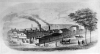
adviser in the manufacture of Bessemer steel, and both at that time men of great scientific attainments (the latter being an artist and a monomaniac on the subject of steam-carriages), came to "Danforth, Cooke & Co." to have built a steam road-wagon, or a peculiar kind of passenger "dummy" for use cm a common highway. If successful, this wonderful invention was to sweep from the streets of New York all her omnibuses, and, perhaps, what comparatively few street cars were already running. It was also intended to establish a line of steam-wagons across the Isthmus of Tehuantepec, each to carry twenty-four passengers at least. The drawings were furnished and all needed instructions given, and a specimen wagon was turned out. It was run up Market street one night about 10 o'clock to test it, and demolished pretty nearly every tree-box and awning-post on its way. Turning down Main street, the steam-wagon ran directly into the front of Lockwood's tailoring establishment, smashing things right aud left. Miss Lockwood, who was about to retire, drew the curtains of an upper window, peered out cautiously upon hearing a strange noise, and saw what filled her with affright — a terrible looking monster bearing down directly on the house. She looked again and then ran down stairs shrieking, " Father; father; here's a locomotive run away and it's coming straight in the house!" A few days later the steam-wagon was taken to Jersey City ferry, where it crossed to New York, arriving about midnight. Mr. Fisher and the men in charge steamed up and started up West street in gallant style, but in essaying to turn into Fulton street at Washington Market, a sharp corner, being an acute angle, the steam road-wagon came to grief; it "missed stays," couldn't "luff," or wouldn't answer to the helm, and in consequence Avent crashing into the corner of the market, and was reduced to a wreck. It was never a success. It is interesting to note some of the improvements made in locomotive construction during the thirteen years' service of John Cooke at the Rogers Works. Wooden frames gave way to iron; cabs for the engineers, cow-catchers, steam gauges, heater-cocks and pipes for heating the water in winter, sand-boxes and head-lights - all these, if required, were for a long time specified in the orders and were paid for as extras. Four and six drivers were adopted, instead of but one pair. But the greatest of all improvements was made in the valve motion, by reason of which great economy in fuel and increased speed were obtained. Up to about 1844 a simple slide-valve was used for the admission and exit of the steam to the cylinder, and this could be made to answer very well on level roads and with light trains, but on undulating grades, of which there are many in this country, it was found necessary to have some plan to regulate the admission of steam to the cylinders while the locomotive was in motion, to suit the changes of grade and load. This was first accomplished by the adoption of what was known as the "cut-off," a device by which the steam was cut off from the piston during a partial stroke, allowing it to complete the stroke by the expansion of the steam, the whole to be thrown in or out of gear at the pleasure of the engineer. The result was a wonderful economy in fuel and a capacity for speed almost unlimited. This plan was generally adopted, although it added much to the complication of the machinery. In 1842 the "link-motion" was brought out by Robert Stephenson, of Newcastle, England, on one of his locomotives. Although called the Stephenson link, it was claimed by a man named Williams, a gentleman apprentice of that establishment, as his invention. About 1847 Mr. Hodge, who has been referred to in a chapter in connection with the building of the "Sandusky," at the Rogers Works, sent over from England a drawing of this link. Mr. Rogers brought the drawing to Mr. Cooke, who produced a model so that the movements of the valve affected by it could be exactly defined. Mr. Cooke said that Mr. Rogers and himself stayed in the shop until "the sma' hours" night after night, studying and working the model, which in time was applied by Mr. Rogers to a locomotive for the Eastern Railway, of Maine, about 1848 or 1849; also, about the same time, to an engine for the Hudson River road, which was just opened to Poughkeepsie. But it met with decided opposition from the master mechanics of the roads; they were used to the "cut-off" and did not understand the " link;" did not believe it was a "cut-off anyhow". While theoretically not as perfect as the independent "cut-off", yet this device, by reason of its extreme simplicity and the facility by which the amount of steam is regulated to the work to be done, has come into general use. It is at this date practically what it was when first brought out forty years ago; the same device, without any improvement. Although so necessary to the success of the locomotive, this, in common with the tubular boiler, equally important, has never been the subject of a patent, but Las always been public property. There is a remarkable system in the arrangement of the tools and machinery at the Danforth Works, and the orderly appearance of everything about the vast establishment strikes the visitor with amazement. Here are tools costing thousands of dollars each, the best in the world for the work to be done with them. The templets in use are a marvel to all skilled machinists who understand their wonderful perfection and true value. The arrangement in the various departments is such that there is a regular progress of the material from bench to bench, from point to point, until each separate part is finished in its course and all portions are brought together and the result is a completed engine. The Danforth Works enjoyed a remarkable immunity from disastrous fires the only fire of consequence being that which burned the attic off the cotton mill, in 1841 - until March 6th, 1880, when a fire occurred tliat destroyed the locomotive erecting shop, the blacksmith shop and the shop where the driving wheels of locomotives were made. The loss aggregated 100.000, the insurance 70.000. The burned buildings were soon rebuilt, so that all departments were in full operation again in an incredibly short space - which was largely owing to the tireless diligence and remarkable energy of Superintendent James Cooke, a brother of President John Cooke, whose health unfortunately was quite broken down under the great strain he subjected it to, so that he has been more or less of an invalid from that date. Not only were the burned buildings replaced, but large additions were
made, so that the establishment was soon in better condition than before the fire. Bridges over the streets at the second stories were constructed, connecting the most important of the different departments. These obviate the necessity of conveying pieces of work down to the street and across and hoisting them to the place where wanted. Besides, a great deal of time is saved to workmen in crossing from one building to another. It is in contemplation to build largely in the near future, among other additions projected being a large front building of brick, on the site
of the present frame office, about 100x30 feet, two and three stories, for offices, drawing rooms, etc.; also, a large building East of the last-named, toward the Hamil Mill, and extending back toward the blacksmith shop; this to be three or four stories in height and to be occupied, in part at least, for working in wood, pattern-making, etc. Other improvements and additions also are planned, which will when completed greatly facilitate operations, increase the capacity of the establishment and render the works among the most extensive and complete of any in the United States. Thirty-one distinct buildings are now occupied in the vast operations carried on, with a total area of 110.000 square feet of flooring space. As may be seen by the subjoined table, the tide of prosperity touched high water mark in 1873, when 82 engines were turned out; when 780 hands were employed, 120.000 was disbursed in wages, and the total value of the product, locomotives and machinery, was 1.569.000. From this point the tide receded, the production falling to 33 locomotives in 1874, 28 in 1875, 30 in 1876, until 1877 was reached; in this year but nine locomotives were built and but little machinery. The number of hands had decreased to 235; the pay roll was but 100,000 for the twelvemonth, though many old attaches were retained when there was positively nothing for them to do; the total value of the product was 277,000. Very slowly the recovery came. In 1878 but three more engines were built, in 1879 there were only seventeen turned out, but in 1880 the production was increased to 65, 730 hands were employed, but 50 less than in the palmy days before the panic; 300.000 was disbursed in wages, and the value of the total product was 800.000. The status at the close of 1881 was: hands employed: 755; wages paid during the year: 380,000; locomotives built: 106; in addition to silk, cotton and other machinery; total value of product, 1.350.000. The production may be estimated at three-fourths locomotives and one-fourth machinery. The officers of the company at this date were: President, John Cooke; Vice President and Superintendent of machinery department, Jacob T. Blauvelt; Secretary and Treasurer, William Berdan; Superintendent of locomotive construction, James Cooke; Assistant Superintendent in this department, John S. Cooke. At the election in April, 1882, the following were chosen: President, James Cooke; General Manager, John S. Cooke; Secretary and Treasurer, William Berdan. Jacob T. Blauvelt, whose resignation as Superintendent of the machinery department, with which he had been connected since 1838, was tendered and accepted, received the thanks of the Board of Directors and many wishes for long life, health and happiness. Thus John S. Cooke, who is still a very young man but who has shown a wonderful ability in the performance of his duties at the works, succeeds to the superiutendency of both the locomotive construction and the building of machinery. The Directors are James, Watts and John S. Cooke, W. O. Fayerweather and Robert Barbour. The nominal capital of the company is 400.000, which is represented by 4.000 shares, of which the Messrs. Cooke (including the late John Cooke's estate) hold 3.250 shares and Robert Barbour 750 shares. This gives a total of 1.286 engines built in the twenty-nine years, representing, if estimated as in a former chapter, 19.290.000 in value. To this must, of course, be added the value of the machinery product, which would give a grand total of about 25.000.000 - a princely record. |
| QUELLE | Trumbull: History of industrial Paterson (1882) 132] |
|