|
|
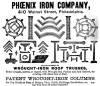
Phoenix Iron Co.
Zum Vergrößern Bild anklicken
| Name | Phoenix Iron Co. |
| Ortssitz | Philadelphia (Penns.) |
| Straße | Walnut Street 410 |
| Art des Unternehmens | Eisenwerks-Unternehmen |
| Anmerkungen | 1874/76: Samuel J. Reeves, President; John Griffen, Superintendent; Geo. Gerry White, Secretary, and James O. Pease, Treasurer. Werk in Phoenixville, Pennsylvania. |
| Quellenangaben | [Ironworks of the United States (1876) 79+19] [Philadelphia and popular Philadelphians (1891) 109] |
| Hinweise | [Manual of the Railroads of the United States (1873/74) Anzeige] |
| Produkt |
ab |
Bem. |
bis |
Bem. |
Kommentar |
| Betrieb von Eisenhüttenwerken |
1876 |
[Ironworks of the U.S. (1876)] |
1876 |
[Ironworks of the U.S. (1876)] |
Siehe betriebene Werke! |
Zeit = 1: Zeitpunkt unbekannt
| Zeit |
Bezug |
Abfolge |
andere Firma |
Kommentar |
| 1876 |
Nebenwerk |
danach |
Phoenix Iron Works |
Stand: 1876 |
| ZEIT | 1891 |
| THEMA | Beschreibung |
| TEXT | The Phoenix Iron Company was established in 1790, and therefore celebrated its "Centennial" year in 1890. In 1790, the works consisted simply of a rolling mill amd nail factory. The power for driving was derived from the damming of French Creek just above the present foundry, the old site of the rolling mill. In 1809, the property was known as the French Creek Works, and it was not until 1813 that the name of "The Phoenix Works" was substituted. Lewis Wernwag, the builder of the Fairmount wooden bridge over the Schuylkill at Philadelphia, became interested in the enterprise and added a number of improvements. In 1821, the rolling mill had but one pair of rolls and one pair of rotary slitters. In 1832, new works were erected including fifty-four nail machines and a merchant mill. In 1824, the works are descriDed as "the first and largest nail factory of its kind in the United States." In 1825, the first successful attempt to generate steam with anthracite coal was made with a one hundred horse power Stackhouse engine. Puddling was introduced in 1827, and a new rolling mill was built. In 1837, a new blast furnace was built for using anthracite for smelting iron. In this year the Philadelphia & Reading Railroad was opened, and the use of anthracite increased. In 1841, six puddling furnaces, a Burden rotary squeezer and a train of rolls were added to the mill. In 1845-46, three blast furnaces were built and in the latter year other extensive improvements were made - a new rolling mill, puddling and reheating mill, smithshops, pattern shops, foundry, machine shops, offices, warehouses, etc. In this mill were rolled a large portion of the rails used in the construction of the first railroads in the country. In 1847, the large nail factory was destroyed by fire. In 1853, the "East Mill" was built. The Pheenix Iron Company was incorporated in 1855, and merged into a stock company, the capacity of all the departments was increased and the manufacture of beams, channels and tees begun, and the construction of bridges and other varieties of structural iron work undertaken. In 1861, the manufacture of wrought iron rifled cannon was commenced and upwards of 1300 guns were made for the United States, which were highly commended by the military authorities. One of the principal specialties of the company is the Phoenix column which was introduced in 1862. It is made of rolled segments having flanges united by rivets, forming a tubular column. The manufacture of eye bars by hydraulic pressure for bridge links, was begun in 1866, and these with the Phoenix column largely led to the development of the American type of bridges. In 1870, the works occupied an area of thirty acres; in 1871, forty acres were added and a new mill building covering six and a quarter acres under a single roof was erected with so many improvements that it served as a model for the Centennial Exhibition Buildings in Philadelphia in 1876. The valuable patterns belonging to the works are stored in a fire-proof building. The additions and improvements from 1871 to 1891 are too numerous to mention in detail. Open hearth steel furnaces, blooming mills, boilers, pumps and other auxiliaries have been erected, in fact everything necessary has been done for the formation of a complete establishment for manufacturing iron and steel from the ore into a large variety of finished structures of the most modern and improved types. The works of the Phoenix Iron Company are located at Phoenixville, Pennsylvania, and are most conveniently situated with respect to the ore beds and coal fields of the eastern part of the State. They are within quick reach of the markets of the country by the Philadelphia oc Reading and the Pennsylvania Railroads. Among the additional products manufactured, are I-beams, deck-beams, channels, angles, zee-bars, bulbs and other shapes, and round, flat and square bars of all sizes, especially adapted for bridge and ship builders and fire proof buildings. Phoenix columns and upset eye-bars, of all sizes, roof trusses, girders, joists and built up shapes of every
description, are made to order upon their own or the designs of architects and engineers. The officers are, David Reeves, President; Geo. Gerry White, Secretary; James O. Pease, Treasurer; and Wm. H. Reeves, General Superintendent. The main office of the Company is located at No. 410 Walnut street, Philadelphia, and there are agencies in New
York, Boston and Chicago. |
| QUELLE | [Philadelphia and popular Philadelphians (1891) 109] |
|