|
|
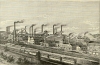
Pennsylvania Steel Co., Werk Steelton
Zum Vergrößern Bild anklicken
|
| Name | Pennsylvania Steel Co., Werk Steelton |
| Ortssitz | Steelton (Penn.) |
| Art des Unternehmens | Eisen- und Walzwerk |
| Anmerkungen | Lage: Pennsylvania Canal und Pennsylvania Railroad (Susquehanna River); Ortname auch "Baldwin". Auch bezeichnet als "Pennsylvania Steel Works". Ortsame noch "Baldwin Station". Verwaltung: Philadelphia. Bessemer steel works built in 1865-7; two 5-ton converters. 1890 bezeichnet als "Pennsylvania Steel Co.'s Works & Steelton Flouring Mills Co." (s.d., stellt auch Weizenmehl her). Herstellung von Eisenbahnschienen, Draht- und Kesselstahl. 1896: Hochöfen No. 1, 60 x 14 (1872-73); No. 2,80 x 20 (1874-76); Nos. 3 and 4, each 70 x 18; No. 3 (1884), each has three Whitwell stoves. Fuel, anthracite coal and coke; ores, foreign and domestic hematite and magnetite; product, Bessemer pig iron and spiegeleisen; total annual capacity (zusammen mit Harrisburg), 300.000 gross tons. Seit 1916 Teil von "Bethlehem Steel". |
| Quellenangaben | [Ironworks of the United States (1876) 85+114+117+124] [Hexamer General Surveys, Plates 978+1447-1448+2085-2086+2382-2383 (1875+1880+1887+1890)] [Philadelphia and popular Philadelphians (1891) 154] |
| Hinweise | [Directory to the iron and steel works of the U.S. (1896) 16]; [Philadelphia and popular Philadelphians (1891) 154]: Werksansicht |
| Zeit |
Ereignis |
| 1865 |
Errichtung der ersten Bauten |
| Juni 1865 |
Gründung und Baubeginn des Bessemerstahlwerks |
| 1867/1868 |
Bau des Walzwerks |
| 1867 |
Fertigstellung des Bessemerstahlwerks |
| 05.05.1867 |
Erster Hochofenabstich. Das Eisen wird in Johnstown bei der "Cambria Iron Co." gewalzt |
| Mai 1868 |
Fertigstellung des Schienenwalzwerks |
| 1869 |
Bau eines 15-ton-Hammers. Es ist der größte im Lande |
| 1872/73 |
Bau des Hochofens Nr. 1 |
| Okt. 1873 |
Der Hochofen Nr. 1 wird angeblasen. |
| 1874/76 |
Bau des Hochofens Nr. 2 |
| Juni 1876 |
Der Hochofen Nr. 2 wird angeblasen |
| 1877 |
Rekonstruktion des Hochofens Nr. 2 und Ausstattung mit drei Whithwell-Winderhitzern |
| 1883 |
Rekonstruktion des Hochofens Nr. 1 und Ausstattung mit Whithwell-Winderhitzern |
| Febr. 1884 |
Hochofen Nr. 3 geht in Betrieb |
| Apr. 1884 |
Hochofen Nr. 4 geht in Betrieb |
| Produkt |
ab |
Bem. |
bis |
Bem. |
Kommentar |
| Draht-Stahl |
1875 |
[Hexamer Surveys] |
1890 |
[Hexamer Surveys] |
|
| Eisenbahnschinen |
1875 |
[Hexamer Surveys] |
1890 |
[Hexamer Surveys] |
|
| Walzprofile |
1876 |
[Ironworks of U.S. (1876)] |
1876 |
[Ironworks of U.S. (1876)] |
|
| Bezeichnung |
Bauzeit |
Hersteller |
| Dampfmaschine |
1885 |
Westinghouse Machine Company |
| Dampfpumpe |
1879 |
Worthington Pump and Machinery Corporation |
| Zeit |
Objekt |
Anz. |
Betriebsteil |
Hersteller |
Kennwert |
Wert |
[...] |
Beschreibung |
Verwendung |
| ab ? |
Dampfkessel |
4 |
|
Babcock & Wilcox Co. |
Heizfläche ges. |
1070 |
qm |
Wasserrohrkessel |
|
| ab 1867? |
Dampfkessel |
7 |
|
Babcock & Wilcox Co. |
Heizfläche ges. |
1600 |
qm |
Wasserrohrkessel |
|
| ab 1887-1891 |
Dampfkessel |
75 |
|
Babcock & Wilcox Co. |
Heizfläche ges. |
18920 |
qm |
Wasserrohrkessel |
|
| Zeit |
gesamt |
Arbeiter |
Angest. |
Lehrl. |
männl. |
weibl. |
Kommentar |
| 1875 |
1000 |
|
|
|
|
|
1000 - 1200 Arbeiter (alles Männer, bis auf 25 Jungen) |
| 1880 |
1000 |
|
|
|
|
|
1000 - 1200 Arbeiter (alles Männer, bis auf 25 Jungen). |
| 1887 |
3500 |
|
|
|
|
|
durchschnittlich 3000 Arbeiter, 50 Jungen, Rest Männer) |
| 1890 |
3500 |
|
|
|
|
|
durchschnittlich 3000 Arbeiter, 50 Jungen, Rest Männer |
Zeit = 1: Zeitpunkt unbekannt
| ZEIT | 1876 |
| THEMA | Beschreibung |
| TEXT | Auch bezeichnet als "Pennsylvania Steel Works". Ortsame noch "Baldwin Station". Verwaltung: Philadelphia. Bessemer steel works built in 1865-7; two 5-ton converters; capacity, 220 net tons steel every 24 hours. Rolling mill built in 1867-8, and since enlarged; daily capacity, single turn, 100 tons steel rails. Hammer mill contains 6 and 12-ton hammers, the larger turning out 75 to 80 tons of blooms and forgings every 24 hours. 2 Siemens openhearth steel furnaces. Product, steel ingots, forgings, rails of heavy sections, street rails, and railroad axles, crossings, frogs, and switches. Capacity, 45.000 net tons ingots per annum. See Lower Susquehanna Furnaces. |
| QUELLE | [Ironworks of the United States (1876)] |
| |
| ZEIT | 1891 |
| THEMA | Beschreibung |
| TEXT | The Pennsylvania Steel Company, Steelton, Pa., and Sparrow's Point, Md., was the first company organized in this country for the manufacture of steel by the pneumatic process. On May 5, 1867, the first blow was made in the works at Steelton, Pa. The ingots were sent to Johnstown, rolled in the iron rail mills of the Cambria Iron Company, and the rails delivered to the Pennsylvania Railroad Company. Before this date, one or two iron works had experimented with the new process and some metal had been produced, but these were the first steel rails ever manufactured in this country, on an order in regular course of business. A rail mill was finished in May, 1868, and rolled rails directly from 7-inch ingots. In 1869 a 15-ton hammer was built which at the time was the largest in the country. All ingots were then made twelve inches square and hammered into blooms for the rail mill. Since that time the works have progressed in equipment, capacity and specialization by the improvement of the old plant and the building of the following new departments:
1872: Frog Shop.
1873: No. 1 Blast Furnace, 16x65 feet.
1875: No. 2 Blast Furnace, 20x80 feet, and an Open Hearth Department of two 5-ton furnaces, which have since been demolished.
1876: No. 1 Blooming Mill, three high.
1881: No. 2 Bessemer, three 7 ton converters.
1882: New Frog, Switch and Signal Department. Merchant Mill with 20" and 13" trains. During this year a school-house
costing about 170,000 was built by the Company and presented to the borough of Steelton.
1883: The No. 1 Bessemer was run for six months with basic linings, this being the first regular basic Bessemer practice ever carried on in this country.
1S84: No. 1 Open Hearth, two 25-ton furnaces. Nos. 3 & No. 4 Blast Furnaces, 18x70 feet.
1885: Universal Mill.
1886: No. 2 Blooming Mill, two high.
1888: Billet Mill. No. 2 Open Hearth, one 5-ton rotary furnace.
1890: Steel Foundry. Bridge and Construction Department. No. 3 Open Hearth, two 15-ton basic tilting furnaces.
In addition to the above, a forge department of three hammers, a foundry, machine shop, boiler shop and other auxiliary repair shops have been gradually supplied. The works now have a capacity of about 30,000 tons of steel ingots per month, which is rolled into rails (heavy, light and street), Open Hearth and Bessemer slabs and ingots for plates of all kinds, miscellaneous merchant steel, special steel billets and forgings. The Bridge and General Construction Department is ready to enter actively into business, while the production of the Frog, Switch and Signal Department stands second to none in the country In 1S83 the Company, in partnership with the Bethlehem Iron Company, purchased extensive ore lands in southeastern Cuba. About 30.000 tons of ore per mouth are imported from this source. To bring the manufacture into more direct connection with the raw material, the Company is building a new and extensive works
on tide water, at Sparrow's Point, near Baltimore, Md. Four blast furnaces, 85x22 feet, are already built, two of them having been put in operation in 1889. A ship yard is already engaged in building vessels, and a Bessemer plant and rail mill will start in the summer of 1891. The works at Steeltou cover an area of 180 acres and employ about 4.200 men, the monthly pay roll amounting to $175.000. The lands of the Company at Sparrow's Point cover about 1,000 acres. The number of workmen at present is 1.400, and the monthly pay roll 165.000. Philadelphia office, 208 South Fourth street. Officers: Luther S. Bent, president; Eben F. Barker, vice-president; Edmund N. Smith, secretary and treasurer; F. W. Wood, general manager; E. C. Felton, superintendent. |
| QUELLE | [Philadelphia and popular Philadelphians (1891) 154] |
|


