|
|
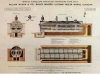
William Wilson & Co., Lilybank Boiler Works
Zum Vergrößern Bild anklicken
| Name | William Wilson & Co., Lilybank Boiler Works |
| Ortssitz | Glasgow |
| Ortsteil | Lilybank |
| Straße | Eglington Street |
| Art des Unternehmens | Kesselschmiede |
| Anmerkungen | Lage um 1888: Eglinton Street, Lilybank Road und Pollokshaws Road. |
| Quellenangaben | [Maver: Glasgow 1830 to 1912 (1994) 120] [English Heritage / Roberts: Heating & Ventilation (2008) mit Abb.] |
| Zeit |
Ereignis |
| 1852 |
Gründung |
| 1893 |
Tod von William Wilson. Zwei seiner Söhne, die schon mehrere Jahre zuvor seine Partner waren, setzen das Unternehmen fort. |
| Produkt |
ab |
Bem. |
bis |
Bem. |
Kommentar |
| Dampfkessel |
1852 |
Beginn vmtl. ab Gründung |
|
|
|
| ZEIT | 1888 |
| THEMA | Beschreibung |
| TEXT | There are few industries in the Scottish commercial metropolis which have received better or more creditable development of late years than that of boiler-making ; and prominent among the great representative firms of Glasgow engaged in this highly important department of constructive manufacture stands that of Messrs. William Wilson & Co., controlling the well-known Lilybank Boiler Works. This notable house was founded in 1852 by its present principal, Mr. William Wilson, and its industry has from the first been centred at the present location. The works here occupy a triangular area of ground about 2,500 square yards in superficial extent, and constitute one of the largest and most important centres of the boiler-making industry in or near Glasgow.
Messrs. Wilson are very extensive makers of Cornish, Lancashire, Adamson, Galloway, multitubular, and every other type of boilers in iron or steel, and have developed a special feature in land boilers of all classes. Within the last four years they have laid down at the Lilybank Works a complete plant of new machinery, a step necessitated by the introduction of steel into the construction of steam boilers, and in connection with the same they brought out machinery for drilling instead of punching the rivet-holes in the plates. By this new method, which has entirely superseded the punching process at Lilybank, Messrs. Wilson are enabled to get a considerably cleaner and truer hole.
Among the other improvements now embodied in their productions, in the matter of actual construction, are the planing of the edges of plates, and the boring out of Galloway tube-holes in flues and flue-holes, also turning the edges of end-plates, together with many other noteworthy points and features in manufacture, all accomplished by the most perfect machinery, and all tending in some measure to enhance the worth of the completed boiler. All boilers are tested and guaranteed sound and tight at double their working pressure, and are mounted complete to the requirements of the boiler insurance companies.
Messrs. Wilson have supplied some of the most important works in Scotland, and in the East and West Indies, &c., with boilers of all kinds and descriptions, and have at present a set of boilers, with all the latest improvements, at 110 lbs. working pressure, used in driving the heavy machinery at the Glasgow International Exhibition. The firm, who employ about fifty hands, have an international reputation as boiler-makers, and their productions are known, esteemed, and in constant use in practically every quarter of the globe.
The works at Lilybank are conducted under the personal supervision of Mr. Wm. Wilson himself, ably assisted by one of his sons, who, like his father, is possessed of a thorough practical acquaintance with every detail of the industry; and the excellent facilities and improved appliances at command are turned to the best and fullest account by the greatest care and precaution being taken to produce the most satisfactory and perfect boilers that can be constructed by the combined efforts of skilled manual labour and the best mechanical service. |
| QUELLE | http://www.glasgowwestaddress.co.uk/1888_Book/Wilson_Wm_&_Co.htm |
| |
| ZEIT | 1901 |
| THEMA | Beschreibung |
| TEXT | The works are situated in the South Side of Glasgow, about a mile from the Royal Exchange, have frontages to Eglinton Street, Pollok shaws Road, and Lilybank Street, and are equipped with modern machinery for the production of land boilers, to which class of work Messrs. Wm. Wilson & Co. devote their whole attention. The type of boiler chiefly built by this firm is the Lancashire or double-flued boiler, up to the largest sizes and for the heaviest pressures. They also make various smaller types of boilers, such as Cornish or single-flued, multitubular, vertical, etc.
Messrs. Wilson's boilers not only find a market in the mills, collieries, public works, and institutions throughout the United Kingdom, but are also largely exported to India, China, Australia, South America, and other foreign markets.
Water-tube Boilers. During recent years water-tube boilers have been very largely adopted for the generation of steam for almost all kinds of purposes, and especially for electric light and electric tramway stations, iron and steel works, and for all the new ships of the royal navy. This type of boiler has not yet been largely adopted in the mercantile marine, but there are indications that, as experience is gained in the management of these boilers, they will gradually supersede the ordinary marine type in most of the important vessels in the mercantile marine.
The main reasons in favour of the adoption of water-tube boilers are: (a) The ease with which they can be got into confined boiler rooms; (b) the smaller floor space required for a given power; (c) the greater rapidity with which steam can be raised, owing to the much smaller quantity of water contained in these boilers; (d) the facility with which repairs can be effected and the fact that when a repair has been effected the boiler is practically as good as a new one on this acoonnt the safe working pressure does not require to be reduced as it does iit shell boilers after they have been in use a number of years; (e) owing to the circulation of the water within these boilers being more rapid and systematic than in ordinary boilers there is less deposit of scale on the heating surfaces, and this tends to the maintenance of the efficiency of the boilers during longer periods; (f) the greater ease with which these boilers can be constructed for the higher steain pressures which are now being adopted; (g) the greater safety under all conditions of working. With these boilers disastrous and widespread explosions are practically impossible, owing mainly to the small quantity of water and steam which they contain. In warships their main advantages ard due to the rapidity with which they can be got into action; and the ease with which the parts can be got into and out of the boiler rooms. Without the water-tube type of boilers have been the modern high-speed torpedo boat destroyer wou impossible. |
| QUELLE | [McLean: Local industries of Glasgow and the west of Scotland (1901) 42] |
|