|
|
R. D. Wood & Co.
Zum Vergrößern Bild anklicken
| Name | R. D. Wood & Co. |
| Ortssitz | Philadelphia (Penns.) |
| Straße | Chestnut Street 400 |
| Art des Unternehmens | Maschinenfabrik und Eisengießerei |
| Anmerkungen | Hier nur Verwaltung, Büro: 400 Chestnut Street (1874/90). Werke (1874): Florence and Millville (s.d.), New Jersey. Melting capacity of both works, 25,000 tons per annum. The Jonval turbine wheels made at these works are supplied generally to water works, those at Fairmount, Philadelphia, having been entirely from here. Gießereien und Werke (1890): Florence, Florence und Millville, alle in New Jersey; bezeichnet sich als "Engineers, Iron Founders and Machinists". |
| Quellenangaben | [Wiley: American iron trade manual (1874) 147+146] [Brown's directory of American gas companies (1890) II: Anzeige] [Philadelphia and popular Philadelphians (1891) 169] |
| Zeit |
Ereignis |
| 1803 |
David C. Wood beginnt mit einem Holzkohle-Hochofen in Millville, N.J. |
| 1847 |
R. D. Wood tritt in die Firma ein, die nun als "R. D. Wood & Co." firmiert |
| 1847 |
MIt dem Eintritt von R. D. Wood Umfirmierung in "R. D. Wood & Co." |
| Produkt |
ab |
Bem. |
bis |
Bem. |
Kommentar |
| Eisenböden und -dächer |
1890 |
[Brown's directory of gas comp.] |
1890 |
[Brown's directory of gas comp.] |
|
| Eisendächer |
1890 |
[Brown's directory of gas comp.] |
1890 |
[Brown's directory of gas comp.] |
|
| Gasbehälter |
1890 |
[Brown's directory of gas comp.] |
1890 |
[Brown's directory of gas comp.] |
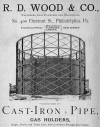
mit Abb. eines Teleskopbehälters |
| Gasreiniger |
1890 |
[Brown's directory of gas comp.] |
1890 |
[Brown's directory of gas comp.] |
purifier |
| Gußeisen |
1874 |
[Wiley: American iron trade (1874)] |
1874 |
[Wiley: American iron trade (1874)] |
Vorgabe: "foundry for cotton mills of firm" |
| Hydranten |
1874 |
[Wiley: American iron trade (1874)] |
1874 |
[Wiley: American iron trade (1874)] |
Vorgabe: hydrants |
| Kondensatoren |
1890 |
[Brown's directory of gas comp.] |
1890 |
[Brown's directory of gas comp.] |
für Gaswerke |
| Laternenpfosten |
1874 |
[Wiley: American iron trade (1874)] |
1890 |
[Brown's directory of gas comp.] |
Vorgabe: Lamp-posts |
| Maschinerie |
1874 |
[Wiley: American iron trade (1874)] |
1874 |
[Wiley: American iron trade (1874)] |
Vorgabe: Machinery |
| Rohre |
1874 |
[Wiley: American iron trade (1874)] |
1890 |
[Brown's directory of gas comp.] |
Vorgabe: Pipes |
| schwere Gußstücke |
1874 |
[Wiley: American iron trade (1874)] |
1890 |
[Brown's directory of gas comp.] |
Vorgabe 1874: heavy castings; 1890: heavy loam castings |
| Scrubber |
1890 |
[Brown's directory of gas comp.] |
1890 |
[Brown's directory of gas comp.] |
|
| Turbinenräder |
1874 |
[Wiley: American iron trade (1874)] |
1874 |
[Wiley: American iron trade (1874)] |
Vorgabe: turbine wheels |
| Zeit |
Objekt |
Anz. |
Betriebsteil |
Hersteller |
Kennwert |
Wert |
[...] |
Beschreibung |
Verwendung |
| ab Aug. 1881 |
Dampfkessel |
2 |
|
Babcock & Wilcox Co. |
Heizfläche ges. |
107 |
qm |
Wasserrohrkessel |
|
| Zeit |
gesamt |
Arbeiter |
Angest. |
Lehrl. |
männl. |
weibl. |
Kommentar |
| 1874 |
500 |
|
|
|
|
|
|
Zeit = 1: Zeitpunkt unbekannt
| ZEIT | 1891 |
| THEMA | Beschreibung |
| TEXT | The history of the rise and progress of the iron trade in this country is so closely associated with the interests of this extensive manufacturing plant that any reference to the iron trade must needs make mention of Messrs. R. D. Wood & Co. The inception was at Millville, N. J., in 1S03, when David C. Wood first started his charcoal iron furnace, making a fine grade of pig iron. After some success here the business became unprofitable, and he devoted his energies to the manufacture of iron pipe. This plant has been in active operation almost continuously since that time. In 1847 the capacity was greatly enlarged, and Mr. R. D. Wood became a member of the firm, under the style of R. D. Wood & Co. They manufacture all kinds of iron castings, stoves, pipe, lamp posts, railings, and in fact everything in this line, much of the iron work in the older portions of the city being the product of this house. In 1867 the capacity was again increased through the purchase of a foundry at Florence, N. J., which was the outgrowth of the charcoal furnace operated by Mr. Richard Jones at Hanover, N. Y. In 1867 Mr. Richard D. Wood died, and he was succeeded by his sons, Messrs. Richard, George, Walter and Stuart Wood. Since that time it has been entirely under their management, and the success has been largely due to their careful and conservative business methods. In 1883 the plant was again increased by the purchase of the works formerly operated by Jesse W. Starr, at Camden, N. J. These latter are one of the largest of the kind in the country, and are in every way fitted with the newest and best machinery. Their manufactories are now located at three different places, Camden, Florence and Millville. During the past quarter of a century the business has largely increased, and has indeed built up a national reputation, and every effort is made to keep the product fully eqinl, both in quality and quantity, to the demands of this progressive country. Their patent fire-plug is now in use in more than two hundred cities in the United States. It is a most important invention, and is of great help to
firemen in extinguishing fires. Notable among their productions is their patent "gas holder," built for any required capacity, which they have supplied to gas companies in nearly every large city. The features of the holder are that it stands unrivalled for security, durability aud economy. Another department of manufacturing to which much attention has been paid is the erection of water works for the supply of cities. In the Fairmount Water Works of this city they have placed seven turbines, three of which are the largest in existence. In addition to the lines already mentioned, the manufacture of iron pipe is carried on to a large extent. At the present time, they have on hand a large contract to supply all the pipe necessary in the city of Seattle, Wash. Their trade has no boundary limits, extending all over the country, besides a large export business to Central and Sonth America, Mexico and Canada. |
| QUELLE | [Philadelphia and popular Philadelphians (1891) 169] |
|