|
|
A. Whitney & Sons
Zum Vergrößern Bild anklicken
| Name | A. Whitney & Sons |
| Ortssitz | Philadelphia (Penns.) |
| Straße | 16th Street |
| Art des Unternehmens | Eisengießerei |
| Anmerkungen | Adresse (1868/74): Sixteenth and Callowhill Streets. 1893 als "Car Wheel Works" bezeichnet, zur Herstellung von "chilled cast iron car wheels". Unternehmensleitung 1893: John R. Whitney und Janes S. Whitney. |
| Quellenangaben | [Wiley: American iron trade manual (1874) 147] [Bishop: History of American manufacturers 3 (1868) 38] [Poor's Manual of Railroads 26 (1893) Anzeige] |
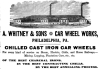
| Hinweise | [Poor's Manual of Railroads 26 (1893)] Anzeige mit Firmenansicht |
| Zeit |
Ereignis |
| 1847 |
Gründung vonn "A. Whitney & Sons" |
| 1847 |
Asa Whitney nimmt ein Patent auf die Herstellung von Eisenbahnrädern mit gewellten Scheiben |
| 1848 |
Asa Whitney erfindet ein Verfahren zum Kühlen der Räder (chilled cast-iron wheels) |
| 1848 |
Asa Whitney erhält ein Patent auf das Glühen von Eisenbahnrädern in einem Glühofen mit Steigerung der Temperatur und langsamer Abkühlung innerhalb von drei Tagen |
| Produkt |
ab |
Bem. |
bis |
Bem. |
Kommentar |
| Eisenbahnräder |
1893 |
[Poor's Manual of Railroads 26 (1893)] |
1893 |
[Poor's Manual of Railroads 26 (1893)] |
"chilled cast iron car wheels" |
| Gußeisen |
1874 |
[Wiley: American iron trade (1874)] |
1874 |
[Wiley: American iron trade (1874)] |
Vorgabe: Iron foundry |
| Wagen |
1874 |
[Wiley: American iron trade (1874)] |
1874 |
[Wiley: American iron trade (1874)] |
Vorgabe: Cars |
Zeit = 1: Zeitpunkt unbekannt
| Zeit |
Bezug |
Abfolge |
andere Firma |
Kommentar |
| |
dort tätig |
danach |
Asa Whitney |
|
| ZEIT | 1868 |
| THEMA | Firmenbeschreibung |
| TEXT | Is possibly the largest establishment in the United States devoted exclusively to the manufacture of Car Wheels. The works are located on Callowhill street and Sixteenth, and have a capacity for making seventy-five thousand wheels per annum. The moulding room is four hundred feet long and sixty wide, and we know of none larger in the country. Two railways extend its entire length, on which carriage cranes are propelled and used for removing the molten iron from the furnaces to the moulds, and the wheels from the moulds to the cooling-pits. There are five large furnaces, three of which communicate by tubes with an immense caldron for containing melted iron. There are thirty-six cooling-pits, having a capacity for holding at a time two hundred and fifty wheels. In 1848, Mr. Asa Whitney, as we have elsewhere stated, patented a process for cooling wheels, which secures results of the greatest importance. It has been described as follows : The wheels are taken from the moulds as soon after they are cast as they have become cool enough to bear moving without changing their form. In this state I they are put into a circular furnace or chamber, which has been pre-viously heated to a dark red heat. As soon as they are deposited in this furnace or chamber, the opening through which they have been passed is closed, and the temperature of the furnace and its contents is gradually raised about as high as that of the hottest part of the wheel when taken from the mould. All the avenues to and from the interior of the furnace are then closed, and the whole mass is left to cool as slowly as the heat will pass off by permeating through the exterior wall of the furnace, composed of brick four and a half inches thick, enclosed in a sheet-iron case one eighth of an inch thick. By this process every part of each wheel is raised to the same temperature before cooling in the furnace commences, and as the heat can only pass off through the medium of the wall and case enclosing it, all; parts of the wheel cool and contract simultaneously. The time required to cool wheels in this way is three days. In this manner wheels of any form can be made with a solid hub, free from all inherent strain, and without the hardness of the chill being in the least impaired. The furnaces used in performing this process of prolonged cooling are so constructed that the combustion of fuel used in heating them may be rendered more or less active at pleasure. This firm employs one hundred and seventy hands, and manufactures over two hundred car wheels per day. |
| QUELLE | [Bishop: History of American manufacturers 3 (1868) 38] |
|