|
|
Hoopes & Townsend
Zum Vergrößern Bild anklicken
| Name | Hoopes & Townsend |
| Ortssitz | Philadelphia (Penns.) |
| Straße | Broad Street |
| Art des Unternehmens | Schraubenfabrik |
| Anmerkungen | Herstellung von Schrauben, Muttern und Nägeln. Vergl. "Star Bolt Works, Townsend, Wilson & Hubbard". [Hexamer] mit dem Zusatz "Bolt und Nut Works". Lage: Broad Street, Noble Street, Hamilton Street, Buttonwood Street und 13th Street (Nordost-Ecke). |
| Quellenangaben | [Wiley: American iron trade manual (1874) 138+149] [Philadelphia and popular Philadelphians (1891) 129] |
| Hinweise | [Philadelphia and popular Philadelphians (1891) 129]: Werke in Wilmington (1849) und Philadelphia (1853); Werke in Wilmington und Philadelphia (1891) |
| Zeit |
Ereignis |
| 1848 |
Gründung der Firma "Hoopes & Brother" in Wilmington, Delaware |
| 1850 |
S. Sharpless Townsend wird Teilhaber von Barton Hoopes, und die Firma wird in "Hoopes & Townsend" geändert |
| 1852 |
Das Geschäft ist so gewachsen, daß man sich nach einem größeren und weiteren Produktionsfeld umsieht |
| 1852 |
Edward Hoopes wird Teilhaber |
| 1853 |
Kauf eines Grundstücks an der Buttonwood Street unterhalb der Broad Street in Philadelphia |
| 1872 |
Bau der südöstlichen Gebäude: Nieten- und Schraubenwerkstatt sowie Schmiede |
| 1875 |
Edward Hoopes scheidet als Teilhaber aus |
| 1876 |
Eneute Gründung eines Werks von "Hoopes & Townsend" in Wilmington, Delaware |
| 1878 |
Auszeichnung durch eine Goldmedaille auf der Weltausstellung Paris |
| Jan. 1879 |
Tod des Telhabers S. Sharpless Townsend |
| 1879 |
Nach dem Tod von S. Sharpless Townsend kauft Barton Hoopes dessen Anteil und nimmt seine Söhne Clement R. Hoopes und Barton Hoopes Jr. als Teilhaber auf |
| 1882 |
Bau der Kesselnieten-Fertigung und der Versandabteilung (beide nördlich der Buttonwood Street) 1881 |
| 1890 |
Bau der Versandabteilung (zwischen Buttonwood und Hamilton Street) |
| 1893 |
Errichtung der meisten Gebäude zwischen Noble und Hamilton Street: die Nietenwerkstatt, das südliche Kesselhaus, die Eisenkonstruktionswerkstätte und die Maschinenwerkstatt |
| Produkt |
ab |
Bem. |
bis |
Bem. |
Kommentar |
| Bolzen |
1874 |
[Wiley: American iron trade (1874)] |
1874 |
[Wiley: American iron trade (1874)] |
Vorgabe: Bolts |
| Muttern |
1874 |
[Wiley: American iron trade (1874)] |
1874 |
[Wiley: American iron trade (1874)] |
Vorgabe: nuts |
| Zeit |
Objekt |
Anz. |
Betriebsteil |
Hersteller |
Kennwert |
Wert |
[...] |
Beschreibung |
Verwendung |
| 1872 |
Dampfkessel |
7 |
|
unbekannt |
|
|
|
|
|
| 1880 |
Dampfkessel |
5 |
|
unbekannt |
|
|
|
|
|
| 1891 |
Dampfkessel |
8 |
|
unbekannt |
|
|
|
|
|
| Zeit |
gesamt |
Arbeiter |
Angest. |
Lehrl. |
männl. |
weibl. |
Kommentar |
| 1872 |
250 |
|
|
|
|
|
230 Männer, 20 Jungen) |
| 1880 |
350 |
|
|
|
|
|
300 Männer, 50 Jungen) |
| 1883 |
525 |
|
|
|
|
|
Anzahl der Jungen nicht mitgeteilt) |
| 1891 |
700 |
|
|
|
|
|
Anzahl der Männer und Jungen nicht angegeben) |
| 1894 |
900 |
|
|
|
|
|
Anzahl der Jungen nicht genannt |
| ZEIT | 1891 |
| THEMA | Beschreibung |
| TEXT | No industry has made such rapid and sturdy strides to success, and no firm has deserved prosperity more than Messrs. Hoopes & Townsend, manufacturers of bolts, rivets, cold-punched nuts, bridge rods, wood screws and kindred articles. This business was founded at Wilmington, Delaware, by Barton Hoopes in 1849. Early in the year 1850, S. Sharpless Townsend was admitted a partner, and the firm took its present title of Hoopes & Townsend. In 1852, the business had so increased that it was found necessary to procure a larger and wider field of operation. In 1853, a lot on Button wood street below Broad, Philadelphia, was purchased, since which date the factory has been enlarged until it now covers
an area of more than twelve times the original site. It occupies nearly two blocks, and is located on Broad street, and on Buttonwood, Hamilton and Whitehall streets, between Broad and Thirteenth streets. Edward Hoopes was admitted as a partner in 1852, and retired in 1875. The original partners continued the business until January, 1879, when the death of Mr. Townsend caused a dissolution of the partnership. Barton Hoopes purchased the interest of his late partner and admitted his sons, Clement R. Hoopes and Barton Hoopes, Jr., as members of the firm under the old style of Hoopes S: Townsend. James M. Hibbs was assigned to the position of business manager. Subsequently, Dawson Hoopes, a younger son of Barton Hoopes, was admitted to the firm. Hoopes & Townsend had persistently advocated the advantages and the superiority of cold-punched nuts, and in 1876, during a competitive test of the merits of cold-punched and hot-pressed
nuts, they proved the correctness of their arguments, and established the superiority of this class of nut, and fixed their prominence as the leading makers of cold-punched nuts. The conflicting claims of rival houses made at the Centennial Exposition in 1876, drew out the argument of cold-punched and hot-pressed nuts. An article was published in the Polytechnic Review, which stated that the leading objections to the use of cold-punched nuts were that the holes were ragged, unless re-punched or drilled; that in punching iron cold the fibres were disintegrated; that in cutting the threads in a cold-punched nut the taps frequently loosened the broken fibres, leaving a weak and imperfect thread; and finally, that cold-punched nuts were generally unreliable. To this article Messrs. Hoopes & Townsend replied, and in strong but temperate language endeavored to prove the superiority of the cold-punched nut. To this reply, a maker of hot-pressed nuts, strong in the conviction of the greater strength and fitness of hot-pressed nuts, proposed a competitive test. Messrs. Hoopes & Townsend promptly agreed, and Professor R. H. Thurston, of the Stevens Institute of Technology, was chosen to make the tests. This gentleman, who was famed as an expert in all test cases of the relative merits of iron and steel, was eminently fitted for the task assigned to him, and his decision was to silence all dispute. The conditions were agreed upon by the contending parties. Early in 1877, a series of tests were made at the Mechanical Institute at Hoboken, N. J. A most thorough and elaborate trial of the rival nuts was made, and as a whole conclusively proved: 1st. That the cold-punched nuts possessed a greater average of strength, combined with greater rigidity and slightly greater uniformity than were exhibited by the hot-pressed nuts, and that the superiority was most strongly manifested in the trials bv stripping stress. 2d. That the cold-punched nuts exhibited a strength never attained by the hot-pressed nuts, but that such variations in the strength of both styles occurred as to have caused the hot-pressed nuts to equal and occasionally excel in strength to the weakest specimens of cold-punched nuts.
This practically decided the controversy in favor of Messrs. Hoopes & Townsend, and the cold-punched nut took its place as the stronger and the best article for all work of good class and superior finish, or for any purpose for which nuts are required. Messrs. Hoopes & Townsend owe their success to no outside influences, but to their indefatigable labor, to their persistent efforts to overcome every obstacle that obstructed the introduction of goods of first quality, and to their upright dealings with their patrons. It has always been the aim of the firm to produce goods of excellent
quality and finish, and to sell them at a moderate advance of their cost by the use of improved machinery, and to give their customers the benefit of the saying. But they have not reduced the cost at the expense of the quality. The larger portion of the iron used in their manufactures is made expressly for them, while the remainder is carefully and judiciously selected from the stocks of first-class makers. They personally supervise the manufacture of tin ducts, and nothing defective is permitted to go from the factory. Notwithstanding the number of labor-saving machines used in the
manufacture of the various products of the firm, over seven hundred hands find constant employment in the shops, and the demand for their goods is constantly increasing. The manufacturing departments are under the management of the junior partners, the financial department being controlled by the elder son, Clement R. Hoopes. The senior partner has a general oversight of the manufacturing department, but is not actively engaged in the business. The business department is managed by James M. Hibbs, who has been promoted at various stages of his service to his present position. As is well known, the nuts made at this establishment are cold-punched. The holes are smooth, accurate anil uniform in size, and correctly centered. They are free from scale or crust, and present an easy cutting surface for the tap. The bolts have solid, uniform heads, finished points, that the nuts may be easily started, and are fitted with chamfered and trimmed nuts, thoroughly interchangeable and threaded to United States standard gauges. The products embrace bridge, truck, car, machine, plow, and every variety of bolts in use. They produce wood or lag screws, rivets of all required dimensions, and a variety of articles for kindred uses. If the term "specialty" as applied to products means that special care is taken in their production, then all the products of this firm are "specialties." A distinctive product of the factory is a chamfered and trimmed nut, used by locomotive and stationary engine builders, which is adapted to the finest work, and which is largely used with no other finish than that produced by the machines on which they are made. They are serviceable for lathe and tool work, and in the construction of the highest class of machinery. The "Keystone" boiler rivets, of which this firm is sole maker, are in high repute among leading boiler makers. These have been subjected to the most severe tests, both experimentally and in absolute use, and have proved equal to the requirements. These are made in solid dies, and the body has no fin or uneven surface. Made of the best
quality of iron, they may be relied upon as a standard article of excellent quality and finish. The trade-mark, a "Keystone," is stamped on the head of each rivet. The business of the firm is not confined to local or domestic trade. Their manufactures are shipped to the West India Islands, to the Hawaiian Islands, to South America and to Australia.
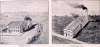
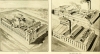
Wherever the products of the firm have been exhibited Messrs. Hoopes & Townsend have carried off the highest honors. They hold diplomas of honor and medals of excellence for almost every industrial exhibition in the world, and at the Paris Exposition of 1878 they were awarded a gold medal, the highest premium and the only gold medal awarded for their class of goods. But it is not to these honors that the firm looks for an appreciation of their goods; it is to the more convincing proof of superiority in the demand for their manufactures, which is increasing, and which has enlarged their establishment to its present proportions from an humble inception. The engravings mi the opposite side are illustrations of the rapid advance of this industry. The original factory at Wilmington, Delaware, was abandoned when the firm removed to Philadelphia, but the increase of business after 1876 prompted the firm to establish an additional plant at Wilmington. A site was selected at Second and Lombard streets, and the works enlarged and new buildings erected. Here are employed one hundred and fifty hands, and the business is carried on under the corporate title of The Hoopes & Townsend Co., which is a distinct firm, though the "personnel" is the same as at the Philadelphia works. The Wilmington works are under the management of Dawson Hoopes. No industry in the Quaker City has been more successful. It is due to persistent pushing of superior goods, honesty and integrity in the conduct of the business, and untiring energy in the production of the best articles in their line of manufacture. Messrs. Hoopes & Townsend have achieved success in their business, aud deserve it. |
| QUELLE | [Philadelphia and popular Philadelphians (1891) 129] |
|