|
|
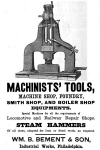
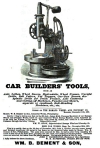
Wm. B. Bement & Son, The Industrial Works, Philadelphia
Zum Vergrößern Bild anklicken
| Name | Wm. B. Bement & Son, The Industrial Works, Philadelphia |
| Ortssitz | Philadelphia (Penns.) |
| Straße | 20th Street |
| Art des Unternehmens | Maschinenfabrik und Eisengießerei |
| Anmerkungen | Wm. B. Bement & Son, Eigentümer. Firmenareal: fast die gesamte, von der Twentieth, Twenty-first und Callowhill Street und der Philadelphia and Reading Railroad begrenzte Fläche. Stellt auch Dampfhämmer her. Vergl. 1886: "Machine Toool Works, Bement, Miles & Co." in der 24th / Wood Street. Um 1888/90 auch die Firma 20th / Callowhill / 21th Street als "Bement, Miles & Co." genannt. |
| Quellenangaben | [Wiley: American iron trade manual (1874) 133] [Hexamer General Surveys, Plates 885+886+2142-2143+2427-2428 (1875+1888+1890)] |
| Hinweise | [Manual of the Railroads of the United States (1873/74) Anzeige]: 2x |
| Zeit |
Ereignis |
| 1845 |
Erbaut |
| 1851 |
Gründung |
| 1865 |
Erweitert |
| 1874 |
Erweitert |
| Produkt |
ab |
Bem. |
bis |
Bem. |
Kommentar |
| Dampfhämmer |
|
[Hexamer (1875-1890)] |
|
|
|
| Gußeisen |
1874 |
[Wiley: American iron trade (1874)] |
1874 |
[Wiley: American iron trade (1874)] |
Vorgabe: Iron foundry |
| Maschinerie |
1874 |
[Wiley: American iron trade (1874)] |
1874 |
[Wiley: American iron trade (1874)] |
Vorgabe: machinery |
| Schmiedewaren |
1874 |
[Wiley: American iron trade (1874)] |
1874 |
[Wiley: American iron trade (1874)] |
Vorgabe: forged iron |
| Zeit |
Objekt |
Anz. |
Betriebsteil |
Hersteller |
Kennwert |
Wert |
[...] |
Beschreibung |
Verwendung |
| 1875 |
Dampfkessel |
1 |
|
unbekannt |
|
|
|
|
|
| 1888 |
Dampfkessel |
4 |
|
unbekannt |
|
|
|
|
|
| 1890 |
Dampfkessel |
7 |
|
unbekannt |
|
|
|
|
|
| Zeit |
gesamt |
Arbeiter |
Angest. |
Lehrl. |
männl. |
weibl. |
Kommentar |
| 1875 |
240 |
|
|
|
|
|
210 Männer, 30 Jungen; beschäftigt bei vollem Betrieb 400 Arbeiter |
| 1888 |
600 |
|
|
|
|
|
2/3 Männer, 1/3 Jungen |
| 1890 |
700 |
|
|
|
|
|
2/3 Männer, 1/3 Jungen |
| ZEIT | 1874 |
| THEMA | Angaben zum Unternehmen |
| TEXT | This establishment occupies nearly the whole square bounded by Twentieth, Twenty-first, and Callowhill Streets, and the Philadelphia and Reading Railroad. The senior member of the present firm has been prominently connected with the business ever since its commencement, in 1851. In that year Marshall, Bement & Colby established the manufacture of machinists' tools in a building which yet stands near the centre of the premises, and which had three floors of about 90 by 45 feet each. Even of this small amount of room a considerable portion was at that time leased to other parties. The firm has successively been Bement, Colby, Dougherty Co.; Bement, Dougherty & Thomas; and Bement & Dougherty, until, in 1870, Mr. Dougherty, who had been connected with the business for some 17 years, retired and gave place to Mr. Clarence S. Bement, of the present firm. Meanwhile, the modest manufactory of 1851 has steadily and rapidly increased, until it has established an enviable reputation in North and South America and Europe, and has placed its productions in many portions of those countries. Its buildings present a continuous front on Callowhill Street of 372 feet, and on Twenty-first Street of 265 feet; and contain a floor space of nearly 2 1/2 acres, or the equivalent of a two-story building 50 feet wide and more than 1,000 feet long. Branches of the Philadelphia & Reading Railroad enter the premises, and deliver coal and iron at convenient points. The pattern store-house is a fire-proof structure nearly 200 feet long by 40 feet wide, containing on its three floors the patterns for more than one hundred and eighty machines. These represent pretty thoroughly the best practice of the present day in the various operations of the machine shop, smith shop, boiler shop, and foundry, from the formation of the most delicate parts of rifles or sewing machines, to the turning, planing, and fitting of the parts of the largest engines and machinery. Many of the designs embodied in this large collection have originated at these works; and many others have here received such improvement as have added much to their usefulness. The drawings representing them will be found compactly and conveniently arranged in the drawing-room, a light and airy apartment 50 feet square, occupying the entire second floor of the office building. Here are also drawings of designs which belong to the past. Each of these has in its time been considered valuable - has indeed been so, but has been superseded by something better, or been rendered unnecessary by some of the many changes constantly taking place in the mechanic arts. The parts of a superannuated locomotive or steamboat can be made useful again as material, but a superannuated design can only be of use as a matter of history or curiosity. And it is instructive to trace the stages of improvement as developed in the successive drawings of the same machine, and it gives a new insight into one of the great sources of expense attending the manufacture of machinery. It is to be borne in mind, also, that the desired change is not completed when the new drawing has been made, but that it still remains to remake or remodel the pattern, which is in many cases a tedious operation. This we shall see more fully if we visit the pattern shop. We are accustomed to see wood wrought very rapidly by the familiar processes of turning, sawing, and planing by power. And not many years since, it was considered good engineering to adopt such outlines for the parts of machinery as would admit of the construction of patterns mainly by means of those processes. Consequently, right lines and sharp angles were the rule, as to forms; and any curves, except such as could be made by the turning lathe, the exception. This construction involved many faults. Sharp angles afforded great probability of breakage in the castings, even by their own internal strains; any proper distribution of metal was nearly impossible; convenience was sadly sacrificed; while gracefulness or beauty of outline must be entirely disregarded. It is not strange, therefore, that some leading constructors soon became dissatisfied with such forms; and in their practice made the first cost of patterns a secondary, instead of primary, consideration. Prominent among these was Mr. Bement, whose designs have for years possessed a sort of individuality, and occupied a front rank for combined massiveness, elegance, and adaptation to their various purposes. We are therefore not surprised to find, that while the pattern shop of the Industrial Works is well equipped with the various kinds of wood working machinery, the shaping and finishing of the patterns is very largely done by hand. We shall also discover that care and skill are required in the work, and that none but a high class of skilled labor can be made available in this department of the business. Another feature in the construction of machinery has become much more general within the past few years, for which the mechanical world is largely indebted to the Industrial Works. The same general ideas which displayed them selves in harsh and crude outlines, found further expression in making the frames of machines as plain and bare as possible, and attaching all necessary projecting parts by bolts. |
| QUELLE | [Wigley: Iron industry (1874)] |
|