|
|
Paterson Iron Co.
Zum Vergrößern Bild anklicken
| Name | Paterson Iron Co. |
| Ortssitz | Paterson (N.J.) |
| Art des Unternehmens | Schmiedewerk |
| Anmerkungen | F. C. Beckwith, Leiter der Finanzen; C. D. Beckwith, Sekretär; J. A. Beckwith, Leiter. |
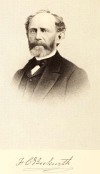
| Quellenangaben | [Wiley: American iron trade manual (1874) 63] [Bishop: History of American manufacturers 3 (1868) 228] [Trumbull: History of industrial Paterson (1882) 101: Portrait u. Ansicht] |
| Zeit |
Ereignis |
| 09.03.1853 |
Gründung durch Gesetz vom 09. März. Die Aktivitäten beginnen mit der Errichtung einer Schmiede, einer Schweißerei und einem Radreifenwalzwerk. |
| 1855 |
Nach Erwerbung des Patentrechts für den Staat New Jersey, wird einer von Watts' 1000-Pfund-Dampfhämmern aufgestellt. |
| 1861 |
Bisher werden fast ständig Lokomotiv-Schmiedeteile und Radreifen für Lokomotivwerkstätten in Paterson und Jersey City hergestellt. |
| Produkt |
ab |
Bem. |
bis |
Bem. |
Kommentar |
| schwere Schmiedestücke |
1874 |
[Wiley: American iron trade (1874)] |
1874 |
[Wiley: American iron trade (1874)] |
Vorgabe: Heavy forgings |
| ZEIT | 1868 |
| THEMA | Firmenbeschreibung |
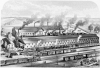
| TEXT | Whose Works are located within a short distance from the depot of the Erie Railway Company, was incorporated by an Act of the Legislature of the State, passed March 9th, 1853, and commenced operations by erecting a Forge, one hundred and thirty feet long by eighty-six feet wide; a Blacksmith and Welding shop, seventy-five feet long by fifty feet wide; and a Tire Rolling Shop, forty-three feet long, and thirty-six feet wide. This shop is equipped with machinery, by which the Tire, after having been laid on a horizontal face plate, and run between a pair of running rolls and two guide rolls, is taken out so perfect, as to require no boring or turning to fit the wheel centre. In 1855, having purchased the patent right for the State of New Jersey, they put in one of Watts' one-thousand-pound Steam Hammers, and, from that time until 1861, they were almost constantly employed in manufacturing Locomotive Forgings and Tires for the Locomotive shops in Paterson and Jersey City, and a large amount of repair and renewal work for the railroads in the vicinity. The entire machinery of the forge and tire mill is driven by an engine of seventy-five horse-power, built by Wm. Burdon, of Brooklyn. The machine shop is driven by an engine of thirty horse-power, built by Todd and Rafferty of Paterson, New Jersey. The strength and durability of the Paterson Locomotives is no doubt due in no small degree to the skill and care of the managers of this establishment, and their reputation for superior workmanship has become so well established that they are called upon for forgings and tire from every State in the Union. The Forge and Machine shop is now four hundred and eighty feet long by eighty-six feet wide, the Blacksmith and Welding shop one hundred by fifty feet, and the Tire Rolling and Bending shop eighty by thirty-six feet. There are thirteen Heating Furnaces, eight of Watt's patent Steam Hammers (six of one thousand and two of fifteen hundred pounds), two of Nasmyth's Upright Steam Hammers (one of three and one of ten tons), eight Lathes, five Planers, two Slotting Machines, etc. They employ about two hundred men, and turn out from three thousand to four thousand tons of finished work per annum. The Treasurer of the Company is F. C. Beckwith, of Paterson. Paterson, besides her extensive Locomotive shops and Iron-works, is the principal seat in the United States of the manufacture of Silks. In 1860, according to the census returns, there were but four Silk manufactories, whose aggregate capital was 153.000; now there are probably a dozen of these establishments, large and small, which employ nearly two thousand operatives, and produce Sewing and other Silks of a value approximating 2.000.000. |
| QUELLE | [Bishop: History of American manufacturers 3 (1868) 228] |
| |
| ZEIT | 1882 |
| THEMA | Firmenbeschreibung |
| TEXT | The business of this last-named establishment grew out of the demand existing about thirty years ago for axles, tires and shapes for locomotives and other heavy engine work. The company, which was chartered and began business in the fall of 1852, was composed mainly, almost wholly, of New Hampshire capitalists, two of them, named Gillies, being cotton manufacturers. There was also a Mr. Dane, who was the first President, and a Mr. Tarbell, who was Secretary and Treasurer, both from New Hampshire. Sherman Jaqua, one of the most energetic and successful of Paterson's iron manufacturers of that period, was really at the head and front of the business and first Superintendent of the works. In 1853 Franklin C. Beckwith, whose remarkable business talent, energy and ability were destined to be impressed on the future of the establishment for the space of about twenty years, purchased Mr. Tarbell' s interest and soon advanced to the head of the business, which he directed until near the date of his death, in 1875. Mr. Beckwith was a fair type of the enterprising and capable men of the period. He was born in the old town of Saratoga, Saratoga County, near Schuylerville, Northern New York, July 2nd, 1817, being one of the nine stalwart sons of Jedediah and Huldah (Coleman) Beckwith, well-to-do farming people. Franklin C. received only a common school education, working with his father on the farm until he attained the age of nineteen, when he left home to fill a position as foreman of construction on the Boston and Albany Railroad, on which line his elder brother was chief engineer and contractor 1 Afterward he, also, became a contractor on the same road, with headquarters at Chatham Four Corners, Columbia County. His next engagement was with the Troy and Albany Railway Company, who, recognising his ability, gave him the position of Superintendent of freight and tracks. At this time his residence was at Troy. About 1845 Mr. Beckwith engaged for a brief space in iron smelting in Pennsylvania. In 1850 he was principal contractor on the Delaware Division of the New York and Erie Railway and had a heavy contract for laying the track between Port Jervis and Susquehanna. He was afterward employed in laying the track of the road from Niagara Falls to Lockport, N. Y., with headquarters at the Suspension Bridge. After the old Paterson and Hudson River Railroad was absorbed by the New York and Erie Mr. Beckwith directed the laying of the double track between Paterson and Jersey City. He was also employed in building the great bridge at Susquehanna on the line of the New York and Erie Railway. This was about the last important work in which he was engaged before coming to Paterson to enter upon the iron manufacture, in 1853. Mr. Beckwith never sought for nor would he accept any office in the city or other local government. He was "all business", so far as related to his secular pursuits. He was a consistent member of and regular attendant at the First Baptist Church and was first President of the Cedar Lawn Cemetery Company, of which corporation he was a founder. He married Esther A. Clark, a daughter of Thomas and Esther (Carmichael) Clark, of Easton, Washington County, N. Y, and the fruits of this union were three children, Charles D., Joseph A., and Julia Frances, the wife of John H. Hopper. The first-named, Charles Duvall Beckwith, succeeded his father in the direction of the vast industry the success of which he so greatly promoted, which responsible position the son still holds. The production of the company has greatly changed since the date of its formation. Of late years locomotive builders have added hammers to their equipment and now make their own axles and shapes, and the old-time wrought iron tires have given place to steel. In consequence of these changes the Paterson Iron Company have of late years directed their attention more particularly to steamboat work and all manner of heavy forgings, in which they have done a very large business. Some of the most stupendous masses of manufactured iron, in the form of shafts for ocean steamers, and others, have been turned out at these works. About 1857, during the panic of that period, Messrs. Jaqua and Beckwith purchased the entire balance of stock owned by the New Hampshire men, and in 1861 Mr. Beckwith purchased Mr. Jaqua's interest for 20,000 cash. Mr. Jaqua soon after erected a portion of the original building afterward occupied by the Passaic Rolling Mill Company. Up to 1860 the Paterson Iron Company furnished nearly 7,000 tires and manufactured forgings for 1,700 locomotives. The works had facilities for turning out annually 1,800 tires and forgings in proportion. In the rolling of tires a machine had been invented by the Superintendent, Mr. Jaqua, which made them perfectly round and true, so that they required no boring before being put on the wheels. The number of men employed at this date was about 40; annual consumption of coal, 2,500 tons. The works were driven by an engine of forty horse-power and furnished with three powerful trip-hammers, two of them of Kirk's patent. The record for 1873 shows that the company turned out 1,600 tons of forgings that year, but soon after and during the panic the production was decreased, this establishment suffering in common with other industries of like character throughout the entire country. At the lowest ebb but 60 men were employed. But for the past few years the lost ground has been fully recovered, and this is now among the most thriving iron-working concerns in the country and with a reputation second to none for excellence of product and capacity to turn out the most difficult and ponderous forgings demanded by the marked advance in marine architecture. The equipment has been added to from time to time until the facilities of the works are unrivaled by any other of the same class in the United States. Fourteen steam hammers in all, several of them the most powerful used by any establishment of the kind (one, a marine hammer of twelve and another, of three tons, were added in 1881); four slotting machines, three of them extra heavy; five planers, eight lathes, two very large, besides boring and drilling machines, etc., are included in the equipment. The main building occupied is 530x90 feet; a blacksmith shop and steel-casting wing is 125x75 feet; there is a main blacksmith shop recently erected, 250x00 feet, besides which there are various minor buildings. The extreme length of the main group of buildings is nearly 700 feet. The output of the
establishment for 1881 was 7,500,000 lbs, or 3.750 tons, of forgings, etc. About 200 men find constant employment ; at times many more. The amount disbursed for wages in 1881 exceeded 150,000. The officers of the company are: Charles D. Beekwith, President and Treasurer; J. A. Beckwith, Secretary; James Johntson, Superintendent. |
| QUELLE | [Trumbull: History of industrial Paterson (1882) 101] |
|