|
|
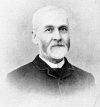
William Augustus Church
Zum Vergrößern Bild anklicken
| Name | William Augustus Church |
| Ortssitz | Philadelphia (Penns.) |
| Art des Unternehmens | Eisenbahnbeamter |
| Anmerkungen | *1834. Finanzleiter der "Philadelphia and Reading Railroad Company". |
| Quellenangaben | [Philadelphia and popular Philadelphians (1891) 243] |
| Hinweise | [Philadelphia and popular Philadelphians (1891) 244] |
| Zeit |
Ereignis |
| 16.02.1834 |
Geburt von William Augustus Church in Albany, N.Y. |
| Juni 1857 |
William Augustus Church tritt in die Dienste der "Philadelphia and Reading Railroad Company" |
| 1871 |
William Augustus Church wird assistierender Finanzleiter der "Philadelphia and Reading Railroad Company" |
| 1884 |
Nach dem Ausscheiden von Samuel Bradford als Finanzleiter wird William Augustus Church dessen Nachfolger bei der "Philadelphia and Reading Railroad Company" |
Zeit = 1: Zeitpunkt unbekannt
| ZEIT | 1891 |
| THEMA | Biographie |
| TEXT | William Augustus Church, the Treasurer of the Philadelphia and Reading Railroad Company, was born at Albany, N. Y, February 16, 1834. He is of English lineage, being a descendant in the seventh generation of Richard Church, one of the original settlers of Hartford, Connecticut, who came from England to that place in 1636. Hon. Sanford E. Church, the noted jurist, and Frederick E. Church, the well-known artist, are descended from the same progenitor. Mr. Church was very young when his father came to Philadelphia as agent for a large New York dry goods house, and he received his education here, principally under the tuition of his brother-in law, Dr. A. T. W. Wright, to whom the city of Philadelphia is largely indebted for the establishment of the Girls' Normal School. The Rev. Thos. K. Beecher was also at one time one of his instructors. But the greater part of his acquirements have been the result of reading and study since he began his business career. Mr. Church entered the service of the Philadelphia and Reading Railroad Company in June, 1857, as one of the coal traffic accountants. He was some time afterwards made assistant to the Treasurer, and in 1871 was appointed Assistant Treasurer, which position he held until 1884, when Treasurer Samuel Bradford, who had held the office about forty-six years, having retired because of advanced age, he was elected Treasurer of the company. Upon Mr. Corbin assuming control of affairs he was made Treasurer of the Coal and Iron Company, as well as of many of the affiliated companies. Mr. Church's association with the company has extended over the most interesting period of its history. When he first entered its employ the business of the general office was so small as to have ample accommodation upon one floor of the building at No. 227 South Fourth street, then but about one-third its present size, and the force consisted of but ten or twelve persons; while at the present time the large building, which is entirely occupied by the offices of the company, is not spacious enough for the employes engaged in the work of the general office, who number at least six hundred; and the miles of track controlled by the company have increased from a very moderate figure to a quantity well nigh sufficient to span the continent. The period of his service with the company covers the war of the Rebellion, with its large returns for the coal carriers (before and during which, as well as long after, the English firm of McCalmout Bros. & Co. held enough stock to virtually control the company); the presidencies of Mr. Cullen (who was sent out by the McCalmonts to protect their interests), Mr. Whitney, Mr. Smith, Mr. Gowen, Mr. Bond (during a contest), Mr. Keim, Mr. Corbin and Mr. McLeod, and the terms of the two receiverships with their almost interminable law proceedings. He has been with it through good and evil report, and now, by the building of the Terminal at Twelfth and Market streets, and the assertive yet conservative administration of the present discerning and able management, he believes a new era of prosperity has dawned upon the great corporation to whose interests he is devoted. Mr. Church has been connected with various boards and associations of a public and benevolent nature, but his duties not permitting him to give to them the time which he deemed necessary, he has severed his relations with most of them. The only connections he now holds of such a nature being those of a Manager of the American Sunday School Union and one of its Committee of Publication, and the Presidency of the Board of Trustees of St. Stephen's Methodist Episcopal Church, of Germantown. Mr. Church married Miss Elizabeth Inskeep Barker, who is of English Quaker descent. They have four sons and a daughter. The latter is the wife of William Morris Longstreth. Two of the sons are married and arc engaged in business, the other two are students, the elder at the University of Pennsylvania and the younger at the Penn Charter School. |
| QUELLE | [Philadelphia and popular Philadelphians (1891) 243] |
|