|
|
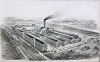
Fayette R. Plumb
Zum Vergrößern Bild anklicken
| Name | Fayette R. Plumb |
| Ortssitz | Philadelphia (Penns.) |
| Straße | Church Street |
| Art des Unternehmens | Werkzeugfabrik |
| Anmerkungen | 1869 bis 1887 unter der Firma "Yerkes & Plumb". Ab 1881 an der New York Division der Pennsylvania Railroad (Straßenname unbekannt). [B&W] als Messerfabrik. |
| Quellenangaben | [Philadelphia and popular Philadelphians (1891) 141] [Babcock: Dampf, dessen Erzeugung und Verwendung (1893) 144] |
| Hinweise | [Philadelphia and popular Philadelphians (1891) 140]: Werksansicht |
| Zeit |
Ereignis |
| 02.05.1848 |
Geburt von Fayette R. Plumb in Gowanda, New York |
| 1856 |
Jonathan Yerkes ist seitdem mit der Herstellung von Hämmern befaßt |
| 1869 |
Fayette R. Plumb gründet zusammen mit Jonathan Yerkes die Firma "Yerkes & Plumb" an der Ecke Church Street und der Pennsylvania Railroad |
| 1876 |
Auszeichnung durch eine Medaille auf Weltausstellung in Philadelphia |
| 1879 |
Auszeichnung durch eine Medaille auf der International Exhibition in Sydney. N.S.W. |
| 1881 |
Umzug von der Church Street zur Oststeite der New York Division der Pennsylvania Railroad, zwischen den Bahnhöfen Frankford und Bridesburg |
| 1883 |
Auszeichnung durch eine Medaille auf der World's International Cotton Exhibition in New Orleans |
| April 1886 |
Jonathal Yerkes scheidet als Teilhaber aus. Die Firma bleibt vorerst unverändert |
| 01.07.1887 |
Änderung der Firma aus "Yerkes & Plumb" in die jetzige |
| 1888 |
Bau einer neuen Maschinenwerkstatt |
| 1889 |
Bau einer neuen Schmiede |
| 1890 |
Bau von neuen Holzbearbeitungs- und Malerwerkstätten |
| Produkt |
ab |
Bem. |
bis |
Bem. |
Kommentar |
| Hämmer |
1869 |
Beginn |
1891 |
[Philadelphia] |
|
| schneidende Werkzeuge |
1891 |
[Philadelphia] |
1891 |
[Philadelphia] |
"edge tools" |
| Werkzeuge |
1891 |
[Philadelphia] |
1891 |
[Philadelphia] |
|
| Zeit |
Objekt |
Anz. |
Betriebsteil |
Hersteller |
Kennwert |
Wert |
[...] |
Beschreibung |
Verwendung |
| ab 1881-1889 |
Dampfkessel |
3 |
|
Babcock & Wilcox Co. |
Heizfläche ges. |
295 |
qm |
Wasserrohrkessel |
|
| ZEIT | 1891 |
| THEMA | Beschreibung |
| TEXT | Fayette R. Plumb, the subject of our present sketch, was born in Gowanda, Erie County, New York, May 2, 1848, His father, Col. Joseph H. Plumb, is one of the most prominent citizens of Western New York, having retired from active business life some years ago, with ample wealth to devote his attention to unremunerative work. His grandfather,
Ralph Plumb, was one of the pioneers of Erie county, and was prominently connected with the mercantile interests of Buffalo during the War of 1812. Mr. Plumb's early childhood was spent at Gowanda, his native village, but upon his attaining the age of fourteen his parents thought it advisable to give him greater educational advantages than those available near home, and he was forthwith sent to the FYedonia Academy, Chautauqua county, New York. Here he remained but one year, when the Model School, of Trenton, N. J., attracted his attention, and he continued his studies there. Two years were spent at this place, when he again changed his course and became a student at Williston Seminary, East Hampton, Mass. Here he graduated in the class of 1867, as a full student of the English Department. Upon leaving school he became anxious to enter business immediately, and coming to this city in the following summer, he entered the employ of the well known firm of Lloyd, Supplee & Walton (now Supplee Hardware Company), for the purpose of learning the hardware business. After remaining with this firm for two years he formed a partnership with Jonathan Yerkes, who since 1856 had been engaged in building up a business for the manufacture of hammers. This partnership was formed in the spring of 1869, and the new business, under the name of Yerkes & Plumb, started in a complete new works erected at the corner of Church street and the Pennsylvania Railroad. These works were considered of ample capacity, and being provided with all the facilities for conducting an increased business, it was thought sufficient for the demand for years to come. The business continued to grow rapidly, however, and in 1881 another removal took place, the present site of the works being selected from its easy railroad connections. Although the business was, at its founding, devoted exclusively to hammer making, it gradually broadened its field, and now includes an extensive output of hammers and sledges, also edge tools, picks, mattocks and grub hoes, and quite a line of railroad, blacksmiths' and miners' tools. The raw materials are chiefly iron, steel and hickory, the latter being delivered in rough pieces, split out to length, as all the handles are turned and finished at the works. Mr. Jonathan Yerkes retired trom the business in April, 1886, but the same firm name was continued until July 1, 1887, when it became that of the proprietor, Fayette R. Plumb. The present works occupy four acres of ground on the east side of the Xew York Division of the Pennsylvania Railroad, between Frankford and Bridesburg stations, and are connected with the railroad by a siding 400 feet long, running directly through the warehouse, which is 180 by 60 feet, and is used for storing raw material. There are three buildings in the main works, viz., forge shop, grinding and polishing shop, and storehouse. The grinding and polishing
shop, 30 by 175 feet, two stories, is connected with the store rooms and offices, a building of the same size and appearance, by a building 50 by 68 feet, two stories, containing the engine and boilers, and a portion of the finishing department. The forge shop, 50 by 200 feet, is connected with the grinding shop by a storage room, 40 by 60 feet. The new machine shop, 30 by 72 feet, and new tempering room, 24 by 72 feet, were added during 1888, while in 1889 the forge shop, 50 by 60 feet, for the manufacture of picks, mattocks and grub hoes, was erected parallel to the main forge shop. Early in the year 1890, finding that the quarters for the wood working and finishing departments were becoming crowded, a new building, 75 by 28 feet, two stories, was also added, while during the present year additions to the grinding and tempering departments have just been completed. All buildings are constructed with the best material, consisting of hard brick walls, finished with slate roofs, which gives a pleasing uniformity of appearance. Since the retirement of Mr. Yerkes the annual output of the works has been increased nearly 100 per cent., and now constitutes the largest business in the United States in this particular line. The trade is not confined to any special locality, but extends to all parts of the United States; in fact, there is not a market of any prominence in the country where these goods
are not well and favorably known, while the export trade includes Canada, South America, Australia, Germany and the
west coast of Africa. Although these works already take the lead among others of the same class, Mr. Plumb lately made the statement that during the next ten years he hopes to double their present production. He never received what could be called a special education to prepare him for the manufacturing business, but has grown up and developed with the establishment he now controls. Much of his time for the first fifteen years was given to building up the business by traveling, while Mr. Yerkes looked after the manufacturing department. All of his spare time, however, was devoted to making himself thoroughly familiar with the methods and practical details of the work, so that when it become necessary to assume entire charge of all the departments of the business, he found himself fully prepared to do so. Mr. Plumb has an agent at Sydney, who looks after the Australian trade, and during the past five years has been employed in a thorough canvass of that trade, as Mr. Plumb considered it one of the best of all foreign markets for American tools. His action had been justified, owing to the fact that nearly all of the tools now used in that country are American made, our patterns being very superior to the English. Mr. Plumb has issued a very completely illustrated catalogue of the goods he manufactures, which is considered the finest work of the kind ever issued to the hardware trade. Medals have been awarded him for his displays made at the Centennial Exhibition in 1876, International Exhibition at Sydney. N.S.W., in 1879, also at tne World's International Cotton Exhibition held at New Orleans in 1883. |
| QUELLE | [Philadelphia and popular Philadelphians (1891) 141] |
|