|
|
H. Muhr's Son
Zum Vergrößern Bild anklicken
| Name | H. Muhr's Son |
| Ortssitz | Philadelphia (Penns.) |
| Straße | Broad Street |
| Art des Unternehmens | Uhren- und Schmuckfabrik |
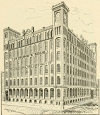
| Anmerkungen | Lage: Südwestecke von Broad Street und Race Street. |
| Quellenangaben | [Philadelphia and popular Philadelphians (1891) 131] |
| Hinweise | [Philadelphia and popular Philadelphians (1891) 131]: Fabrikgebäude |
| Zeit |
Ereignis |
| 1853 |
Simon Muhr kommt aus Bayern in die USA |
| 1866 |
Simon Muhr wird Teilhaber seines Vaters |
| 1885 |
Errichtung des Fabrikgebäudes an der Südwestecke von Broad Street und Race Street |
| Produkt |
ab |
Bem. |
bis |
Bem. |
Kommentar |
| Schmuck |
1885 |
Fabrikbau |
1891 |
[Philadelphia] |
|
| Uhren |
1885 |
Fabrikbau |
1891 |
[Philadelphia] |
|
| ZEIT | 1891 |
| THEMA | Beschreibung |
| TEXT | Philadelphia has long been noted as a leading centre for the manufacture of fine jewelry, and in the establishment of
H. Muhr's Sons it has one of the most extensive and important concerns of its class in the United States. This manufactory is located at the southwest corner of Broad and Race streets, having a frontage on Broad street of 100 feet, and on Race street of 140 feet, and is seven stories in height. Architecturally, it is an ornament to the splendid avenue of Philadelphia on which it is located, while the interior is fitted up with all the modern mechanical devices for saving labor, known to the trade. In the room where the watch cases are engraved, there are presses which give, in a few minutes, designs that would formerly have taken the most skillful workman an entire day to accomplish, and engine lathes are employed to produce the peculiar roughened honeycombed surfaces that are desired. Some of the dies used cost 500 a set. Probably the most curious of the many novel appliances is an electrical engraving apparatus, worked by one man. A plate on which there is an enlarged design to be produced is placed in the machine, which is then
started, the watch case being in position below. In a short time the design on the large plate, whether a bird, a flower, a scroll, or whatever it may be, is reproduced beautifully on a smaller scale on the watch case. No artist's hand could do it more cunningly, yet no hand has ever touched it. Notwithstanding the multiplicity of labor-saving devices in this manufactory, nearly 700 persons - 680 at the present time - are furnished constant and profitable employment in it. Watch cases, which are a leading specialty, are turned out at the rate of about 1500 a week; these
are both of solid gold and gold filled. The firm claim to have been the first to engage in the manufacture of gold filled cases, and that these are finished and engraved by the same workmen who make the 18-karat solid gold work. Their best filled cases, known to the market as "Crown No. 1" are of 14-karat gold and guaranteed to wear for 25 years, whilst the least expensive case they make is guaranteed for 20 years. All their filled cases are made in special designs, such as raised ornamentation, monograms raised or engraved, inlaid with diamonds or other precious stones the same as solid gold, and so extraordinary are the facilities of this firm for manufacturing elegant watches cheaply, that they are now exporting watches, not only to South America, Japan and China, but to various parts of Europe, even to the home of the watch, Switzerland itself. Besides watch cases, Messrs. Muhr's Sons produce an immense quantity of rings of all sorts, from the silver finger ring for the colored plantation laborer to the finest, and gold and silver thimbles, which they send to all parts of the country. Thimbles costing 50 each are not at all uncommon, and they have made thimbles to order, studded with precious stones, as presents, which have cost as high as 150 each. The manufactory, of which an extensive view is given on this page, reas built by Simon Muhr in 1885 and is owned by him. He is the eldest son of Mr. H. Muhr, a skillful watch-maker, who came to this country from Bavaria in 1853, and settled in Philadelphia, where he is still living. Mr. Simon Muhr, whose connection with the business dates from 1866, when he was taken into partnership with his father on obtaining his majority, is in many respects a remarkable man. His friend, Mayer Sulzberger, Esq., says of him in abiographical sketch, written for "Deacon's Biographical Album of Prominent Pennsylvanians," "Mr. Muhr is small in stature, but of such pleasing presence and affable manners, that his geniality
has become proverbial, while his personal popularity is of the strongest character. He is paternally solicitous for the welfare of his employees, taking great interest in their affairs and never, when in trouble, do any of them hesitate to confide in him, or to depend upon his advice and assistance. Mr. Muhr is likewise deeply interested in charities and
much of his time is taken up in hearing appeals for aid from individuals and societies. He is an active member of numerous benevolent and charitable associations, to all of which he is a liberal contributor; but, if satisfied of the worthiness of the case or cause, no appeal is made to him in vain; yet he does not confine his benefactions to any sect, society or creed, but is most catholic in his giving. He is an ardent Democrat, but with so many demands upon his time he has naturally little leisure for politics, although his fellow-citizens have nevertheless called upon him to represent them in conventions of his party and to serve as a school director; other offices tendered him he has declined." We may add that he is credited with being one of the best authorities in the United States on gems, and his good taste is so generally conceded and recognized, that it is an ordinary occurrence for purchasers of gems to leave their setting entirely to his individual judgment. Besides their manufactory, Messrs. H. Muhr's Sons have salesrooms at 629 Chestnut street, 20 John street, New York, 39 State street, Chicago, and a branch establishment at Antwerp, where most of the purchases of rough diamonds are made and the cutting is done. They are large importers of precious stones and some of the largest and finest diamonds, sapphires, opals and pearls worn by the fashionable people of Philadelphia, have been supplied by them. We do not know the amount of capital they employ in this business, but we
notice one of the mercantile agencies places it at 750.000, and this is probably under-estimated. Their annual sales
have been for some years about a million of dollars. |
| QUELLE | [Philadelphia and popular Philadelphians (1891) 131] |
|