|
|
Arthur W. Hulson
Zum Vergrößern Bild anklicken
| Name | Arthur W. Hulson |
| Ortssitz | Keokuk (Iowa) |
| Straße | North First Street 218 |
| Art des Unternehmens | Erfinder |
| Anmerkungen | 1869 - 1958. Erfinder des Hulson-Rosts ("Hulson Shaking Dump Grate" oder "The Hulson Locomotive Grate with Tuyere Type Grate Surface"), insbesondere für Lignit-Verfeuerung, auch für Lokomotiven, und Inhaber der "Hulson Grate Company". Um 1958 vmtl. Adresse: High Street 613. |
| Quellenangaben | https://patents.google.com/patent/US998247 [Keokuk Daily Gate City, 13.01.1958] [Locomotive cyclopedia of American practice (1922) 363] [Condensed catalogues of mechanical equipment (1920) 134] |
| Zeit |
Ereignis |
| 04.01.1869 |
Geburt |
| 28.07.1908 |
Hulson beantragt das US-Patent 998247 für einen beweglichen Rost mit um ihre Längsachse schwingenden Roststäben |
| 18.07.1911 |
Erteilung des US-Patents 998.247 an Hulson für einen beweglichen Rost mit um ihre Längsachse schwingenden Roststäben |
| 1927 |
Es wurden bisher 152 Lokomotiven bei 26 Bahngesellschaften mit Hulson-Rosten ausgerüstet, und es gibt einen weiteren Auftrag für 35 Roste. |
| 1930 |
Einbau von Hulson Tuyere Type Rosten in Lokomotiven der Wabash and Burlington Railroad. 1931 sind Hulson-Roste bei 24 Eisenbahngesellschaften im Einsatz |
| 02.05.1933 |
Erteilung des US-Patents 1.905.228 an Hulson für einen beweglichen Rost "Finger plate locking means" |
| 31.03.1942 |
Veröffentlichung des US-Patents Mr.3.254.404 an die "Hulson Grate Company" für eine Rostkonstruktion |
| ca. 13.01.1958 |
Tod von A. W. Hulson vmtl. in Keokuk |
| Tätig |
ab |
Bem. |
bis |
Bem. |
Kommentar |
| bewegliche Lokomotivroste |
1920 |
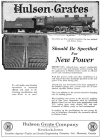
Anzeige |
1931 |
Anzeige |
|
| Schwingrostfeuerungen |
1920 |
Anzeige |
1931 |
Anzeige |
|
| ZEIT | 1920 |
| THEMA | Beschreibung des Hulson-Rosts |
| TEXT | Manufacturers of the Hulson Grate for Stationary Boilers, Locomotives and Kilns
AIR SPACE: 55% with openings, 72% with 1/2" openings. Large percentage of air space permits more perfect combustion.
SHAKING: The journals of the finger bars are located low in the bearing bars, the tops of the fingers are curved, so that when the grate is shaken lightly its surface moves in a principally horizontal direction. This light action shreds away the fine ash without stirring or agitating the fire. The Hulson Grate can remove the
fine ash from beneath a three or four inch slack fire without disturbing the fire bed, and without loss of live fire or green fuel. The removal of the fine ash as soon as it is formed tends to eliminate clinker formation. However, should the fire be allowed to get heavy the full throw of the grate will work all dead
matter through. The full throw brings the tips of the fingers up into the dead matter, a distance of approximately two inches; they have a double cut, forwards and back which produces a tearing action on the bottom of the fire. No large opening is made to allow the fire to avalanche into the ash pit, all dead matter must be worked through the Hulson Grate. Clinkers are broken up and crushed before reaching the ash pit.
REPAIRS: The fingers are loose on the bar held on by a key moulded on the bar. The fingers being loose, all expansion and contraction are taken care of at this point. The finger bars are so far below the fire that they are not affected by the heat. Owing to its large percentage of air space and the large amount of air travel
the Hulson Grate is less liable to overheating. The illustrations show the method of making repairs. The damaged finger is broken completely away from the finger bar. The remaining fingers arc pushed over to fill the gap and the new castings applied to the shaker-arm end of the finger bar. The fingers can be applied with the finger bar in position. The top of the journal and the key on the shaker-arm end of the finger bar are cut away on an oblique. The finger must be tapped lightly past the key. It assumes a vertical position. The last finger cannot be removed as it is partially engaged by the key. In a grate with a solid finger bar, should a portion of it become damaged the whole bar is lost, weighing from 50 to 150 lbs., depending on the size of the
grate. With the Hulson Grate only those parts that are damaged need be replaced. The 3/9" size fingers weigh
pproximately one and one-half pounds, the 1/2" size, one and three-quarters pounds. Should any accident damages the finger bar proper, the bar only is lost, and none of the fingers. The Hulson Grate rests in the furnace the same as does the old style bar grate, the front on the lip of the dead plate, the rear on the bridge-wall rest. It is made to fit present furnace measurements, the only condition being that the length over all, including rests, be a multiple of seven inches. It is made any number of sections wide to accommodate firing doors. In making replacements the only change in brick work necessary is on the bridge wall to adjust the length measurement. The only machine work necessary is the drilling and tapping the boiler front for shaker brackets. Grates over 70 inches in length are equipped with double shaker connections so as to shake in a front and rear sections. Further information will he gladly furnished on request. |
| QUELLE | [Condensed Catalogues of Mechanical Equipment (1920) 134] |
|