|
|
Hawksley, Wild and Co., Brightside Boiler and Engine Works
Zum Vergrößern Bild anklicken
| Name | Hawksley, Wild and Co., Brightside Boiler and Engine Works |
| Ortssitz | Sheffield (England) |
| Straße | Brightside Lane |
| Art des Unternehmens | Kesselschmiede |
| Anmerkungen | Adresse um 1890: Saville Street East. Maschinenbau unsicher, werben aber 1876 für "engines of the best designs, horzontal & vertical, compund or single cylinder with the latest improvements"; 1899: Werbung nur für DampfKESSEL. |
| Quellenangaben | [Kelly's directory of West Riding (1881)] [Engineer 1909/12/10] [Iron and Steel Institute: Obituaries] |
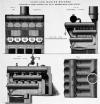
| Hinweise | [Engineer (1870) 246]: Ansicht eines Batteriekessels |
| Zeit |
Ereignis |
| ca. 1836 |
Geburt von George William Hawksley. - Er macht eine Lehre bei seinem Onkel in Owlerton, Sheffield, einem Mühlenbauer und geht dann zu den "Hyde Boiler Works" von Daniel Adamson; dort lernt er Matthew Wild, den Vorarbeiter der Kesselschmiede, kennen. |
| 1860 |
Gründung durch George William Hawksley und Matthew Wild |
| 30.11.1909 |
Tod von George William Hawksley |
| Produkt |
ab |
Bem. |
bis |
Bem. |
Kommentar |
| Dampfkessel |
1881 |
[Kelly' directory] |
1881 |
[Kelly' directory] |
|
| ZEIT | 1890 |
| THEMA | Beschreibung |
| TEXT | The manufacture comprises boilers of all kinds with the necessary fittings, feed-water heaters, and apparatus for heating large quantities of water for baths, breweries, &c.
The flanged flued boilers here manufactured have the flues built up in rings of plates of alternate larger and smaller diameter, the difference in diameter being about 4 inches; the ends of the smaller rings are expanded out to fit inside the ends of the larger, which are plain cylindrical rings. The circular seams thus made afford great resistance against collapse, and provide amply for free expansion and contraction; at the same time with the addition of cross tubes they ensure a thorough mixture of the gases passing through the flue. Large numbers of boilers fitted with these flues are working with satisfactory results. The rings forming the flues are each made from a single plate, bent into a cylindrical form by horizontal plate-rolls of forged steel, which will bend cold steel plates 10 feet wide and 1 inch thick. The ring when rolled envelopes the top roll; and for enabling the ring to be removed from the rolls, the bearings of the top roll are so arranged that one of them can take the weight of the roll, while the other can be screwed back and swung out of the way, so as to release the ring endways. The rivet holes are drilled in position after the plates have been bent to shape. For the circumferential seams there is a three-standard vertical drilling machine by Messrs. Smith and Coventry of Manchester. For the longitudinal seams another vertical drilling machine is employed, having two saddles on a single standard, and two drill spindles to each saddle; the spindles are adjustable so as to drill two rows of holes at suitable pitch. A machine with several motions has a revolving table enabling a circle of 10 feet diameter to be cut by this motion; it has also a revolving head fitted with a massive steel spindle 8 inches diameter, by means of which a very steady cut of 4 feet diameter can be taken. A new boiler shop in course of erection will contain a flanging press capable of flanging at one operation plates 11 feet diameter. It will have four rams, so as to be suitable for lighter work without loss of power; the two centre rams will work concentrically one within the other, whilst the two others will be placed at the sides, thereby affording a considerable range of power, from the single small ram in the centre to the whole four. The first steel boiler made at the starting of the works about thirty years ago was used here until replaced by a larger, and is still working in Sheffield at a pressure of 80 lbs. per square inch. It is of the flued type, fitted with the flanged rings above described; as each ring is made from a single plate, there is no longitudinal line of rivets exposed to the fire.
The feed-water heater manufactured at these works consists of a horizontal or vertical cylindrical casing containing tubes. Exhaust steam from the engine is admitted to the casing, while the feed-water is pumped through the inside of the tubes, and thence direct to the boiler. The heater is divided in two longitudinally, and the water passes first through the tubes in one half, and then returns through those in the other; the steam travels through the casing in the opposite direction. Tho same kind of heater is constructed for breweries, dye works, and similar purposes. For a dye works a special filtering apparatus has recently been constructed, which is now satisfactorily filtering 40,000 gallons per hour of impure river water. |
| QUELLE | [Institution of Mechanical Engineers: Visits to Works (1890)] = Grace's Guide |
|