|
|
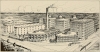
P. Lorillard & Company
Zum Vergrößern Bild anklicken
| Name | P. Lorillard & Company |
| Ortssitz | Jersey City (N.J.) |
| Straße | West Newark Avenue |
| Art des Unternehmens | Tabakfabrik |
| Anmerkungen | Vergl. "P. & G. Lorillard" in New York als Schnupftabakfabrik. Lage der neuen Fabrik (um 1909): West Newark Avenue, New York, Susquehanna and Western Railroad, Dey Street und Senate Place. |
| Quellenangaben | [Jersey City of to-day (1907) 100] |
| Zeit |
Ereignis |
| 1760 |
Gründung durch Pierre Lorillard, einem französischen Hugenotten, der sein Geschäft in der Chatham Street, zu dieser Zeit als "High Road to Boston," nahe der Tryon Row in New York City beginnt. |
| 1832 |
Tod von George Lorillard, Sohn des Gründers Pierre Lorillard, und sein Bruder Peter führt das Unternehmen eine Zeit allein. Dann übergibt er es für rd. 30 Jahre an seinen Sohn. |
| 1868 |
George Lorillard scheidet aus, und der frühere Bürgermeister von Jersey City, Charles Siedler, wird Teilhaber. |
| 1870 |
Umfirmierung in "P. Lorillard & Co." |
| 1891 |
Eintragung, mit P. Lorillard, Jr. als Präsident, G. D. Findlay als Vizepräsident und Finanzleiter sowie Ethan Allen als Sekretär |
| Produkt |
ab |
Bem. |
bis |
Bem. |
Kommentar |
| Tabak |
1760 |
Beginn in New York |
1909 |
bekannt |
|
| ZEIT | um 1907 |
| THEMA | Beschreibung |
| TEXT | Jersey City is justly noted as the home of P. Lorillard & Company. There is no name connected with the tobacco
business more widely or more favorably known than that of Lorillard - widely known because identified with the trade longer than any other in this country, and favorably because it has always been attached to goods of the finest quality and has never been identified with inferior articles. The house was founded in 1760 by Pierre Lorillard, a French Huguenot, who began the business on Chatham Street, then known as the "High Road to Boston," near Tryon Row, New York City. His skill and enterprise insured success to his undertaking from the start. After his death the business was conducted by his widow, who bequeathed it to her sons, Peter and George. In 1832 George died, and Peter, after managing the already extensive property alone for a time, give it up to his son and namesake, who successfully conducted the business alone for nearly thirty years. He then relinquished it to his sons, Peter Jr. and George. It was the aim of each generation to produce the best goods that were in the market, and as the fame of their tobacco grew wider the business of the house rapidly increased. In 1868 George retired from the firm, and
Charles Siedler, once mayor of Jersey City, was admitted as a partner. In 1870 the firm name of P. Lorillard & Co. was adopted. At that time the firm consisted of Peter Lorillard, P. Lorillard, Jr., N. Griswold Lorillard and Charles Siedler. The steady and well directed efforts of a century and a quarter had aided in raising the house to a commanding position, and by that time Lorillard had become a household word and the old snuff mill on the Bronx had passed into history. The business was incorporated in 1891, with P. Lorillard, Jr. as president, G. D. Findlay, vice-president and treasurer and Ethan Allen, secretary. In 1899 there was elected the present executive board, of which Thomas J. Maloney is president, William B. Rhett, vice-president and secretary and W. G. Hellmer, treasurer. Mr. Maloney, who is the representative of the company in the Board of Trade of Jersey City, has resided in Jersey City since 1885. He was general manager of the company from 1885 to 1899, when he accepted the presidency of the company. The company has completed its plans for the new factory to be erected on the old Thompson estate in Marion. The factory is to occupy 170 city lots and will be six stories high. It will be a fireproof building constructed
of steel and brick, and it is expected that between 4,000 and 5,000 hands will be employed in the plant. The site for the new factory is bounded by West Newark Avenue, the New York, Susquehanna and Western Railroad, Dey Street and Senate Place. At the request of the company Cherry Lane from Senate Place to the Susquehanna Railroad has been vacated by the city. The location of this plant in Marion will no doubt cause a big boom in real estate in that section and as a consequence owners of property are much pleased. Of course many of the employees of the factory will look for homes near by their work. There are not many vacant houses or apartments in that section now, and if the factory employees are to be accommodated new houses will have to be built. There is plenty of vacant property in that section. The site selected for the new plant is an admirable one. It will practically have the benefit of four railroads - the Pennsylvania, the Lackawanna, the Susquehanna and the Erie. This means facilities for the shipping of the products to all parts of the country. The growth of tobacco culture in the United States is especially interesting, and includes the improvement of domestic filled tobacco through the introduction of the Cuban seed-leaf industry into the Southern States and into Ohio; the introduction and supervision of the bulk fermentation process of Ohio ; the completion of the experiment for producing a shade-grown wrapper tobacco in Connecticut which will meet trade requirements; improving the fire-cured types of shipping tobacco in Virginia, and extensive improvements in the culture in New York, Pennsylvania, Maryland, Wisconsin, Kentucky, and Tennessee. Tobacco farms are most paying investments for the farmers, and statistics show that they are growing in value at the rate of $75,000,000 annually. This increased value is invested better than in bank deposits or even in gilt-edged bonds of private
corporations. The growth of tobacco is becoming a great study with the farmers of the United States. In 1893, the first year of the state system of farmer's institutes in Maryland, the officers of the state experiment station advocated the use of crimson clover as a preparatory crop for tobacco, and the general opinion held with regard to such a practice was that it was ruinous to the crop. The station teaching, however, took root, and in addition to crimson clover, which is now quite frequently grown in this connection, cowpeas are also used as a preparatory crop for tobacco. In Connecticut the growers have generally adopted the methods of fertilization for tobacco which the station tested and advocated. |
| QUELLE | [Jersey City of to-day (1907) 100] |
|