|
|
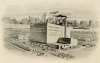
Union Terminal Cold Storage Company
Zum Vergrößern Bild anklicken
| Name | Union Terminal Cold Storage Company |
| Ortssitz | Jersey City (N.J.) |
| Straße | Provost Street |
| Art des Unternehmens | Kühlhaus |
| Anmerkungen | Lage: Provost Street, Häuserblock von der Twelfth bis zur Thirteenth Street. Hat Gleisanschlüsse mit der Erie und der Delaware, Lackawanna and Western Railroad, ferner mit den Pennsylvania, Baltimore and Ohio und den West Shore Railroads. |
| Quellenangaben | [Jersey City of to-day (1906) 72] |
| Zeit |
Ereignis |
| Aug. 1904 |
Eingetragen |
| Produkt |
ab |
Bem. |
bis |
Bem. |
Kommentar |
| Kühlhaus-Lagerung |
1904 |
Beginn |
|
|
|
| ZEIT | um 1906 |
| THEMA | Beschreibung |
| TEXT | The Union Terminal Cold Storage Company occupies its own plant located on Provost Street, taking in the entire block front from Twelfth to Thirteenth Streets, Jersey City. It is directly connected with two lines of railroads, the Erie and the Delaware, Lackawanna and Western. The company also has switching arrangements with the Pennsylvania, the Baltimore and Ohio and the West Shore Railroads. Its location is an ideal one for the purpose, by reason of the
exceptional railroad facilities and the low fire insurance rate. Products from the West shipped in care of the warehouse can be stored and later reloaded into cars and sent by floats to any part of New York Harbor without any additional charges. The company has made a step in advance in the science of refrigerating by being able to control the humidities as well as the temperatures of the rooms in its warehouse to a fraction of a degree of variation, as well as carrying its freezing temperatures much lower than those carried by other warehouses. In some of its rooms it carries as low as eighteen degrees below zero. The building is classed by the New York Fire Insurance Exchange and the New England Mutuals as one of the finest warehouses ever constructed from an insurance standpoint and the
company therefore has an insurance rate of thirty-one and three-tenths cents per hundred or the lowest rate of any cold storage warehouse in the United States, their competitors' rates ranging from fifty to a hundred and fifty per cent higher. This rate is also six cents a case lower than Chicago houses. The management of the company is vested in Mr. T. Albeus Adams W. Taliaferro, vice-president, and Mr. treasurer and general manager. They make liberal advances to responsible parties and have never called a lean. Eggs stored in their warehouse have always commanded a
premium. Free delivery is made by their five-ton rubber-tired, enclosed automobile trucks. The Adams Brothers were formerly in the beef, provision and poultry business, operating branches in nearly all of the Eastern States, and doing a business of over $700,000,000 annually. In 1904 they sold this business to the National Packing Company. They have also been interested in the banking business in New York City, owning a controlling interest in one bank, of which Mr. T. A. Adams was president. They have a warehouse in New York City, the Manhattan Refrigerating Company, located on West Street from Horatio to Gansevoort Street, at the Gansevoort Stores. The Union Terminal Cold Storage Company is conservatively managed and is successful. It counts among its stockholders a number of influential business men in Jersey City, and is largely owned a controlled by residents of the State of New Jersey who are taxpayers. None of its stock-holders or officers have been the owners of or interested in the sale of any products that have ever been stored in its warehouse. The capacity of the warehouse is 3,000,000 cubic feet. The company is a member of the Board of Trade of Jersey City and the American Warehousemens' Association. The advantages of the cold storage warehouse are so numerous that they should be recognized by all. Cold storage lowers the average cost of food products to the consumer by adding to the supply of wholesome food. It enables consumers to obtain at a reasonable rate at all times of the year food products produced at certain seasons only. It prevents speculators from controlling the price of any article of food, as food products are stored during the plentiful or producing season by the many thousand wholesale retailers and consumers. Cold storage is a necessity that is increasing with the population. Owing to the climate of the United States nearly the total supply of food for consumption during the whole year must be produced during about six months. None of this production should be allowed to go to waste as was the case before the cold storage warhouses were used, if the cost to the consumer is to be kept at as low a price as it is to-day. Increase of population decreases the area of food producing land. Cold storage is an encouragement
to the producer, as it provides a place where his production can be stored and kept in a wholesome condition. Should any article of food be produced at a time when the consumers do not require it, such perishable products can, by cold storage, be kept in good condition ready to supply the consumer when it is demanded. Large cities or non-producing communities whose main food supplies come from a distance are by means of cold storage safeguarded against famine and the paying of fabulous prices. Before the use of cold storage it was a common occurrence for food supplies to be temporarily cut off owing to heavy storms or transportation difficulties, and often in one day the market would advance twenty-five to fifty per cent. There is scarcely ever an exception, possibly one case in
fifty thousand, where any particular line of goods would be stored in the heavy producing season and carried past the non-producing season. This regulates itself, as not only the supply and demand but the cost of carrying, and the fact that the goods that had been carried for nearly a year, would come in competition with the new production when it is cheap. It is not practical, it is not customary, it is not good business ; it does not need legislation to prevent it, notwithstanding Dr. Grimley's statement, "I maintain that under proper cold storage meats do not undergo any chemical changes that can be detected by the most approved method of analysis known to-day." Cold storage is a necessity of modern times. |
| QUELLE | [Jersey City of to-day (1906) 72] |
|