|
|
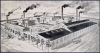
Stove & Hollow Ware Foundry, Thomas, Roberts, Stevenson & Co.
Zum Vergrößern Bild anklicken
| Name | Stove & Hollow Ware Foundry, Thomas, Roberts, Stevenson & Co. |
| Ortssitz | Philadelphia (Penns.) |
| Straße | 2nd Street |
| Art des Unternehmens | Ofenfabrik |
| Anmerkungen | Lage: 2nd Street , Mifflin Street und Moyamensing Avenue (Südwest-Ecke). Die selben Inhaber betreiben um 1879 auch die "Quakertown Stove Works". Eisengießerei mit zwei Kupolöfen. Auch Schreibweise "Stephenson" (mit "ph"). |
| Quellenangaben | [Hexamer General Surveys, Plate 1794-1795 (1883)] [Philadelphia and popular Philadelphians (1891) 161] |
| Hinweise | [Philadelphia and popular Philadelphians (1891) 161]: Werksansicht |
| Zeit |
Ereignis |
| 1856 |
Erbaut |
| 1865 |
Gründung |
| 1870 |
Bau der Gebäude im Innern des Fabrikareals |
| 1887 |
Eintragung (incorporated) |
| Produkt |
ab |
Bem. |
bis |
Bem. |
Kommentar |
| Herde |
1865 |
Gründung |
1883 |
[Hexamer] |
|
| Öfen |
1865 |
Gründung |
1883 |
[Hexamer] |
|
| Zeit |
Objekt |
Anz. |
Betriebsteil |
Hersteller |
Kennwert |
Wert |
[...] |
Beschreibung |
Verwendung |
| 1883 |
Dampfkessel |
3 |
|
unbekannt |
|
|
|
|
|
| ZEIT | 1891 |
| THEMA | Beschreibung |
| TEXT | Was established in 1865, and incorporated in 1887. Walter S. Stevenson, president; Lewis E. Roberts, vice-president; David H. Thomas, secretary; Jonas Snyder, treasurer; Levi H. Clymer, superintendent. The foundries are located in the southern part of the city, covering an entire block bounded by Second, Mifflin and McKean streets, and Moyamensing avenue, and covering a plot of ground 400 feet by 490 feet, about six acres. The number of employees is something over two hundred, distributed in the various departments of the works, which comprise the moulding, cleaning, finishing, patterns, shipping and storage, and the clerical departments. The annual output consists of about thirty thousand ranges, stoves and furnaces, which are distributed throughout all parts of the United States, and a number are exported; have had recent orders from different parts of South America and Japan, also from Norway, Sweden, and other parts of Europe. In addition to the foundry plant, the Company occupies the fine five-story store and warehouse at 250 Water street, New York City, which is equipped with a thoroughly efficient corps for the transaction of their business in all its departments. The goods manufactured by this company are of many hundred different patterns, necessitating the use of 300 pages of descriptive catalogue. Their manufactures are suitable for use in all parts of the world, being arranged to burn the different kinds of fuel that are found in the different sections. In speaking of the manufactures our attention was specially - attracted by the "Active Fortune" series of ranges with "Hayes Patent Horizontal Circulating Boiler," and then by the "Gauze Door" stoves and ranges made under the "Giles F. Filley Patent." In referring to these two specialties made in large quantities by this Company, which have revolutionized the stove manufacturing industry of the present time, we think it our duty to give to the public a few of the points claimed by the manufacturers. They claim that in manufacturing the "Gauze Door" stoves and ranges, thev have removed a great oversight of other manufacturers bv heating the oven in such manner as to preserve all the juices originally contained in the articles to be cooked. The false theory that the oven must be air-tight to roast or bake, has at last been thoroughly exploded. The loss of weight in meats in the "Gauze Door Range" is about seven per cent., whereas, in an old fashioned or closed oven door range, it is forty per cent. It is the greatest discovery of the age in the culinary art. Its operations being automatic, there is uo machinery, no labor, no experience required. The wonderful results are obtained simply by an act of nature, that is, by admitting in a proper form into the oven a constant supply of fresh air. The same advantage is derived in baking bread and pastry as in roasting meats. The "Gauze Door Ranges" embody in all their parts the latest manner of constructing a range - improved fire-box, improved grate, improved water-back - everything that science and genius have suggested, has been adopted in the construction of these appliances, and they are guaranteed in every respect to be first-class. The great feature, and one that has been greeted by the building trade as a welcome innovation, is that these ranges can, if desired, be set in place in the house without brickwork, saving expense and economizing room in the kitchen, and also allowing repairs or renewals without disturbing any of the brickwork of the house. The "Active Fortune Ranges" with "Hayes' Patent Horizontal Circulating Boiler" are manufactured only by this Company. They were placed upon the market about four years ago, and sprang at once into popularity; they seemed to meet the demand exactly, especially in large building operations. In Philadelphia and New York there are many thousands in daily use. The building community has recognized the "Active Fortune Range" as filling a want, owing to their simplicity, durability and superiority. The great feature of the "Active Fortune Range" is the "Haves' Patent Horizontal Circulating Boiler." which secures a quick supply of boiling water and will furnish a much larger quantity of water at a temperature suitable for bathing than can be obtained from the ordinary upright circulating boiler. The convenient manner of locating these boilers, and the lack of expensive plumbing, and the ease with which they can be
repaired, has caused their almost universal use by Imildersand architects. One other great and important feature is that the "Active Fortune Ranges" require no brickwork to set them. The economy of fuel is remarkable. The conveniences embraced are recognized and appreciated by all observers. Those who buy and invest in houses have been especially
attracted by the absence of expensive repairs. The manufacturers in addition state that the sales are increasing daily. These ranges are to be seen on exhibition at the Builders' Exchange, 18 to 24 South Seventh street, Philadelphia; The Building Materials Halls, 276 to 282 Washington street, Brooklyn, N.Y.; Institute of Building Arts, 63 and 65 Washington street, Chicago, I11.; and are for sale by dealers everywhere. |
| QUELLE | [Philadelphia and popular Philadelphians (1891) 161] |
|