|
|
E. C. Knight & Co., Southwark Sugar Refinery
Zum Vergrößern Bild anklicken
| Name | E. C. Knight & Co., Southwark Sugar Refinery |
| Ortssitz | Philadelphia (Penns.) |
| Ortsteil | South Philadelphia |
| Straße | Bainbridge Street |
| Art des Unternehmens | Zuckerraffinerie |
| Anmerkungen | Lage: Bainbridge Street, Delaware Avenue und Swanson Street (Nordwest-Ecke). Stellt braunen und gelben Zucker her. Bis zu siebengeschossiger Bau. Dampfbetriebener Aufzug, Dampfpumpen (Hersteller: Brinton & Henderson) für Kesselspeisung und Melasseförderung. 18 / 26 (1875) Zentrifugen. 80-100 (1875, alles Männer) |
| Quellenangaben | [Hexamer General Surveys, Plates 416+889+890 (1870)] [Philadelphia and popular Philadelphians (1891) 117] |
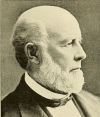
| Hinweise | [Philadelphia and popular Philadelphians (1891) 117: Portrait von Edward C. Knight |
| Zeit |
Ereignis |
| 08.12.1813 |
Geburt von Eward C. Knight in Gloucester County, New York |
| 1832 |
Eward C. Knight kommt nach Philadelpia und arbeitet als Angestellter im Lebensmittelgeschäft von "Atkinson & Cuthbert" |
| 07.05.1836 |
Gründung |
| 07.05.1836 |
Umfirmierung von "E. C. Knright" in "E. C. Knight & Co.", wobei einige Teilhaber aufgenommen werden |
| 1846 |
Eward C. Knight zieht mit seinem Lebensmittelgeschäft von der Chestnut Street zur Südost-Ecke Chestnut Street und Water Street. Er interessiert sich für den Handel mit Kalifornien |
| 1859 |
Eward C. Knight in Philadelphia schließt mit der Firma "Murphy & Allison" (später: "Allison Manufacturing Co.") den Vertrag zum Bau eines Schlafwagens ab, der zuerst auf der Baltimore and Ohio Railroad eingesetzt wird. Erisichert sich Patente für die USA, und bald wird die Nachfrage enorm |
| 1862 |
Erbaut |
| 1868 |
Eward C. Knight verkauft seine Schlafwagen-Patente an Pullman für ca. $2.200.000 |
| 1881 |
Bau einer großen Fabrik an der Delaware Avenue zwischen Bainbridge und South Street |
| Produkt |
ab |
Bem. |
bis |
Bem. |
Kommentar |
| Lebensmittelhandel |
1836 |
Gründung |
1849 |
Umzug |
|
| Zucker |
1870 |
[Hexamer] |
1870 |
[Hexamer] |
|
| Zeit |
Objekt |
Anz. |
Betriebsteil |
Hersteller |
Kennwert |
Wert |
[...] |
Beschreibung |
Verwendung |
| 1870 |
Dampfkessel |
9 |
|
unbekannt |
|
|
|
|
|
| ab 1880-1887 |
Dampfkessel |
8 |
|
Babcock & Wilcox Co. |
Heizfläche ges. |
2120 |
qm |
Wasserrohrkessel |
|
| ZEIT | 1891 |
| THEMA | Beschreibung |
| TEXT | E. C. Knight, the senior member of the firm of E. C. Knight & Co., importers and sugar refiners, is without doubt one of the oldest persons in that business in the United States. The present establishment is the outgrowth of a business he started May 7th, 1836. In 1851 the firm name was changed from H. C. Knight to E. C. Knight & Co., several partners being admitted. The firm as at present constituted was formed in 1886, with Edward C. Knight, Sr., Edward C. Knight, Jr., Richard E. Clay, F. D. Laugenheim and Edward Browning as members. The senior member, a wonderfully preserved gentleman, retains much of that energy for which he was noted when a young man. He can be found daily at the office of the firm at Chestnut and Water streets when not occupied iu railroad or other important business. Their plant is an immense one, and was built in 1881 on Mr. Knight's property on Delaware avenue between Bainbridge and South sts.
It is considered one of the most complete and convenient refineries in the country. The buildings have a frontage on Delaware avenue of 215 feet, running through to Swauson street, while the large storage houses extend from Swanson to Penn street. Five of the buildings fronting on Delaware avenue are used for refining purposes, Nos. 1 and 2 being, when originally built, molasses houses. No. 3 contains the vacuum pans, granulators and packing machinery, etc., an is six stories in height. No. 4, which is eleven stories high, is the bone-black and filtering house, and is perfectly fire-proof for the first six stories, and above that having an arrangement by which each floor cau be flooded with water in a very short space of time. No. 5 is the boiler house, and is equipped with four boilers of 500 horsepower each. The machinery is all of the most modern and approved patterns, being self-acting or automatic, thereby reducing the number of hands and cost of production. The firm employ from 300 to 400 persons about their works. In the building fronting on Delaware avenue there are two copper pans of enormous size; in fact they are among the largest and finest
in the city, if not in the country, and have an estimated capacity of 180 barrels of sugar each. The filters are on the fifth floor of the 11 story building, ami are twenty-four in number, ten feet in diameter and twenty-two feet high, with a capacity of 70.000 lbs. each. Bone-black is an important factor in sugar refining and is used over and over again, being purified, burnt and cooled after each process. The quantity in use is about 1.800.000 pounds. The refinery is not dependent upon the city for its supply of water, having, besides two artesian wells on the premises and which
throw two hundred and fifty gallons a minute, one twenty inch and one ten inch main running into the Delaware from which a large supply can be taken. The capacity of the refinery is about 1500 barrels per day, including granulated and soft sugars. The buildings were erected under the personal supervision of the late Robert J. Barr, then the chief engineer and superintendent for the firm, and are considered by experts as near perfection as it is possible to make them. The shipping facilities of E. C. Knight & Co. compare favorably in size with the immense refinery. They have a river in of two hundred and fifty feet, including two piers, at the head of which is erected a large shed for storage purposes. This, together with their warehouses, affords ample accommodation for 5.000 bags and 2.000 bogheads of sugar. The entire product of this great establishment is warranted perfectly pure, no beet sugar, glucose or chemicals being allowed in the manufacture of sugar; and the granulated and powdered sugars manufactured by them are by a patent process doubly dried. When we say that the refinery is continually run on full time, the reader will understand from the description of the works what an extensive business is done. Their trade is entirely wholesale, and is distributed among the larger cities of the United States. Edward C. Knight was born in Gloucester county, N. J., on December 8, 1813. Giles Knight, his ancestor, came from Gloucestershire, England, in the ship "Welcome" with William Penn and located in Byberry, where he died in 1726. The parents of E. C. Knight, Jonathan and Rebecca Collins Knight, were members of the Society of Friends. In 1832 the son came to Philadelphia and engaged as clerk in the grocery store of Atkinson & Cuthbert. In 1836 he established himself in the grocery business on Chestnut street. Later he became an importer of coffee and ship owner. In 1846 he removed to the south-east corner Chestnut and Water streets, where for nearly half a century he has continued. In 1849 he became largely interested in the California trade. To Mr. Knight belongs the credit of designing and patenting the sleeping car, now known as the "Pullman Car". In the fifties the
sleepers were fitted with rude "bunks", and on a journey from New Orleans Mr. Knight experiencing all the discomfort in traveling in them, while on the road conceived the plans which have brought about such great comfort to the traveler by rail. On his return in 1859 he contracted with Murphy & Allison (now the Allison Manufacturing Co.) for building his first car. It was first used oil the Baltimore and Ohio Railroad. He secured patents from the U.S. and soon the demand became enormous. About 1868 the company organized by Mr. Knight sold their patents to Mr. Pullman for something like $2,200,000. Mr. Knight is not only one of Philadelphia's most honored merchants, but is recognized as one of the leading railroad men of the city. He has been concerned in the following railroad companies as Director: Lackawana & Bloomsburgh, West Jersey. Pennsylvania. North Pennsylvania, Philadelphia & Reading; and President of the Jersey Central and Bound Brook. President of the American Steamship Company and director in many financial institutions. In 1860 he was an elector 011 the Republican Presidential ticket. In 1873 he was a member of the Constitutional Convention. In
1883 he was appointed a member of the Park Commission. He has for years been a director in the Union League. He was President and an active promoter of the Bi-Centennial Association of 1882, |
| QUELLE | [Philadelphia and popular Philadelphians (1891) 117] |
|