|
|
Machine Tool Works, Bement, Miles & Co.
Zum Vergrößern Bild anklicken
| Name | Machine Tool Works, Bement, Miles & Co. |
| Ortssitz | Philadelphia (Penns.) |
| Straße | 24th Street |
| Art des Unternehmens | Werkzeugmaschinenfabrik |
| Anmerkungen | Lage (1886/91): 24th Street und Wood Street (Nordost-Ecke). Stellt Dampfhämmer und Werkzeugmaschinen her. Vergl. 1875: "Wm. Bement & Son Industrial Works" (gleiche Produkte) in der Callowhill- / 21st- / 20th Street; dort um 1890/91 auch als "Bement, Miles & Co.". Auch als "The Machine Tool Works, Bement, Miles & Co." (mit vorgestelltem Artikel). Seit ca. 1885 unter der Firma "Bement, Miles & Co.", mit Büro in New York, Equitable Building. |
| Quellenangaben | [Hexamer General Surveys, Plate 2014 (1886)] [Poor's Manual of Railroads 26 (1893) Anzeige] [Philadelphia and popular Philadelphians (1891) 151] |
| Hinweise | [Poor's Manual of Railroads 26 (1893)] Anzeige; [Philadelphia and popular Philadelphians (1891) 150]: Werk Callowhill Street; [Philadelphia and popular Philadelphians (1891) 151]: Werk 24th und Wood Streets |
| Zeit |
Ereignis |
| 1848 |
Gründung als "Marshall & Teal" im Bereich er Callowhill Street |
| 1851 |
E. D. Marshall (in Firma "Marshall & Teal") fordert William Barnes Bement (vorher in der Lowell Machine Shop tätig) auf, als Teilhaber in die Firma einzutreten. Dieser bringt seinen Neffen G. A. Colby mit ein, und die Firma lautet nun "Marshall, Bement & Colby" |
| 1854 |
Bei der "Marshall, Bement & Colby" wird eine Gießerei angegliedert, wobei die Erfahrungen von James Dougherty sehr wertvoll sind. - Dieser wird später Teilhaber, und die Firma lautet dann "Bement, Colby & Dougherty" und nach einigen Jahren "Bement & Dougherty" |
| 1869 |
Erbaut |
| 1870 |
James Daugherty scheidet aus "Bement & Dougherty" aus |
| 1870 |
Nach dem Austritt von James Daugherty und Eintritt von Clarence S. Bement (Sohn Von William Barnes Bement): Umbenennung von "Bement & Dougherty" in "William B. Bement & Son" |
| 1873 |
Erweitert |
| 1874 |
John M. Shrigley wird Teilhaber bei "William B. Bement & Son" |
| 1879 |
William P. Bement wird als Teilhaber bei "William B. Bement & Son" aufgenommen |
| 1882 |
Erweitert |
| 1885 |
Der Teilhaber John M. Shrigley scheidet bei "William B. Bement & Son" aus |
| 1885 |
Kauf des Anteils von Dougherty an "William B. Bement & Son" und Umbenennung in "Mement, MIles & Co." |
| 1887 |
Der Gründer William B. Bement scheidet aus, und sein Sohn Frank Bement tritt ein |
| Produkt |
ab |
Bem. |
bis |
Bem. |
Kommentar |
| Dampfhämmer |
1886 |
[Hexamer] |
1886 |
[Hexamer] |
|
| Werkzeugmaschinen |
1886 |
[Hexamer] |
1886 |
[Hexamer] |
|
| Zeit |
Objekt |
Anz. |
Betriebsteil |
Hersteller |
Kennwert |
Wert |
[...] |
Beschreibung |
Verwendung |
| 1886 |
Dampfkessel |
1 |
|
unbekannt |
|
|
|
|
|
| Zeit |
gesamt |
Arbeiter |
Angest. |
Lehrl. |
männl. |
weibl. |
Kommentar |
| 1886 |
175 |
|
|
|
|
|
20 Jungen, Rest Männer |
| ZEIT | 1891 |
| THEMA | Beschreibung |
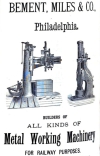
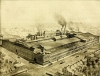
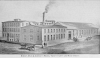
| TEXT | The establishment of Bement, Miles & Co., which covers a large area of valuable ground in the city of Philadelphia, consists of two properties, the larger located on Callowhill street between Twentieth and Twenty-first streets,
and bounded on the north by the Philadelphia and Reading Railroad, and the smaller situated at the corner of Twenty-fourth and Wood streets, running 240 feet east by 170 feet north. The space is compactly covered by buildings two and three stories in height, which afford occupation in busy times to not less than one thousand men. As early as 1848 a small three-story stone building, more or less surrounded with dwellings, stood near the centre of the Callowhill street property, and was then more than sufficient for the small business of the firm of Marshall & Teal, who owned the business. In 1S51 Mr. E. D. Marshall invited William Barnes Bement to join him, with a view of introducing the manufacture of machine tools. Mr. Bement was then employed in the Lowell Machine Shop, at Lowell, Mass., principally in designing machine tools. He accepted the invitation of Mr. Marshall, with the understanding that he should bring with him his nephew, Mr. G. A. Colby, and a co-partnership under the firm name of Marshall, Bement &
Colby was the result. After three years of experience, it was decided that the machine shop should be supplemented by a foundry, and Mr. James Dougherty, whose experience in this line was very valuable, and who in after years added much to the standing of the concern, was admitted into the firm, its name being then Bement, Colby & Dougherty. Subsequently Mr. Colby retired, and Mr. George C. Thomas was admitted, the name being changed to Bement, Dougherty & Thomas. In a few years Mr. Thomas' interest was purchased by the remaining partners, and the firm name of Bement & Dougherty continued until 1870, when Mr. Dougherty reretired, and Mr. Clarence S. Bement, son of the senior partner, was admitted. The firm name then became Messrs. William B. Bernent & Son. In 1874 Mr. John M. Shrigley was made a partner, and in 1879 Mr. William P. Bernent was also admitted, the firm still remaining William B. Bernent & Son. About the beginning of 1885 Mr. Shrigley during that year a consolidation of the works of William B. Bement & Son, and the machine tool works owned James Dougherty and Mr. Frederick B. Miles was effected. Mr. Dougherty's interest was purchased, and the new firm conducted business under the title of Messrs. Bement, Miles & Co. In 1887 the original founder, Mr. William B. Bement, retired from active business and his son, Frank Bement, entered the firm. Since that time no change has been made, and the firm as it stands today consists of Clarence S. Bement, Frederick B. Miles, William P. Bement, and Frank Bement. The manufacture of machine tools at this establishment which commenced so humbly in 1851, increased so rapidly that, some years before the Civil War, the establishment had attained a national reputation, as the determination of the firm from the start was to produce the best designs and workmanship with a view of supplying the wants of those customers only who required machines of the most perfect construction. As time went on, new and improved patterns were added to the list, and now the standard machines constructed by the firm number not less than three hundred. About two years ago the demand for larger tools than could be properly produced in the old establishment led to an extensive addition, which was to be filled with heavy machinery, and supplied with large traveling cranes for erecting. This extension has added so largely to the capacity of the establishment that if the various machine shops proper could be assembled into one, they would constitute a room 100 feet wide by about 1250 feet long. At the present time the larger works are engaged in building miscellaneous tools for locomotive and railroad shops, forges and ship building establishments, while the Twenty-fourth street shop is mainly occupied with steam hammers, hydraulic machinery, and boiler makers' tools. |
| QUELLE | [Philadelphia and popular Philadelphians (1891) 151] |
|