|
|
Elektrische Zentrale Tivoli
Zum Vergrößern Bild anklicken
| Name | Elektrische Zentrale Tivoli |
| Ortssitz | Tivoli (Italien) |
| Art des Unternehmens | Elektrizitätswerk |
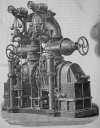
| Anmerkungen | Nutz den dortigen Wasserfall und überträgt die Elektriziät auf eine Entfernung von 28 km nach Rom. Genutzte Wassermenge: 1,9 cbm/s, genutztes Gefälle: 100 m. Lt. [VDI (1888)] stammt die Turbinenanlage von Gebr. Seck in Damstadt (s. Abb.). |
| Quellenangaben | [Wilkens: Elektrische Centralen (1906) 34] [Hedges: Continental electric light stations (1892) 4] [VDI-Zeitschr. (1888) 138] |
| Hinweise | [VDI-Zeitschr. (1888) 138]: Turbinenanlage von Gebr. Seck |
| Zeit |
Ereignis |
| 04.07.1892 |
Inbetriebnahme |
| Produkt |
ab |
Bem. |
bis |
Bem. |
Kommentar |
| Elektrizität |
1892 |
Beginn (Inbetriebnahme) |
|
|
|
| Zeit |
Objekt |
Anz. |
Betriebsteil |
Hersteller |
Kennwert |
Wert |
[...] |
Beschreibung |
Verwendung |
| 1892 (Inbetriebnahme) |
Wasserturbinen |
6 |
|
Ganz & Comp. Waggon- und Maschinenfabrik |
Leistung je |
|
PS |
Girard-Turbinen, n= 170 U/min. 3 Gruppen zu je zwei Turbinen. 1892-1899: Jede Turbine mit einem Wechselstromgenerator 200 kW, 5100 V direkt gekuppelt. Ab 1899: 7 Drehstromgeneratoren à 3500 kVA, 10000 V, 42 Hz |
|
| 1892 (Inbetriebnahme) |
Wasserturbinen |
2 |
|
Ganz & Comp. Waggon- und Maschinenfabrik |
Leistung je |
|
PS |
Girard-Turbinen, n= 375 U/min. Jede Turbine mit einem Erregergenerator 27 kW, 180 V direkt gekuppelt. |
|
| ZEIT | um 1892 |
| THEMA | Beschreibung |
| TEXT | The motive power for this station is obtained, to the extent of about 2000 H.P., from a waterfall giving about 825 gallons of water per second, at a height of 160 feet. Six turbines of 300 H.P. each are used, coupled directly to alternating-current dynamos, each of 230.000 watts capacity, driving at a speed of 170 revolutions per minute. There are also three continuous-current machines, driven directly by separate turbines at a speed of 375 revolutions, used for exciting the alternators. The dynamos at full load give a current at 5000 volts, which is conducted from
Tivoli to Rome, a distance of about 19 miles, by means of bare copper wires, 100 sq. mm. (16 sq. in.) in section, the fall of potential being twenty per cent. At the boundary of the town of Rome, near the Porta Pia, there is a distributing tower with transformers for reducing the 5000 volts to 2000 volts, at which potential the network is supplied, being again transformed to lOO volts at the consumer's premises. A part of the current from the Tivoli falls will be used for street lighting by having forty lamps in series, dispensing with the second transformer. |
| QUELLE | [Hedges: Continental electric light stations (1892) 4] |
|