|
|
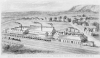
Passaic Rolling Mill Co.
Zum Vergrößern Bild anklicken
| Name | Passaic Rolling Mill Co. |
| Ortssitz | Paterson (N.J.) |
| Art des Unternehmens | Walzwerk |
| Anmerkungen | Built in 1867, and incorporated in 1869; 8 double puddling furnaces, 5 heating furnaces, 3 trains of rolls, and 1 hammer; product, beams, channels, angles, tees, and other shapes for buildings and bridges. |
| Quellenangaben | [Ironworks of the United States (1876) 74] [Trumbull: History of industrial Paterson (1882) 104] |
| Zeit |
Ereignis |
| 1867 |
Bau des Walzwerks |
| 1869 |
Eintragung |
| Produkt |
ab |
Bem. |
bis |
Bem. |
Kommentar |
| Walzprofile |
1876 |
[Ironworks of U.S. (1876)] |
1876 |
[Ironworks of U.S. (1876)] |
|
| ZEIT | 1876 |
| THEMA | Beschreibung |
| TEXT | Built in 1867, and incorporated in 1869; 8 double puddling furnaces, 5 heating furnaces, 3 trains of rolls, and 1 hammer; product, beams, channels, angles, tees, and other shapes for buildings and bridges, merchant bars, rivets, nuts, etc.; annual capacity, 12.000 net tons. Watts Cooke, President, and W. O. Fayerweather, Secretary and Treasurer. |
| QUELLE | [Ironworks of the United States (1876)] |
| |
| ZEIT | 1882 |
| THEMA | Beschreibung |
| TEXT | This is the most important as well as the most extensive establishment of its class East of the Alleghanys and among the largest in the country. It is the only concern of the kind in Paterson and has for many years been regarded, and justly, as one of the chief among the grand industries that have contributed to the growth and importance of the city. It may be well to glance briefly at a very early enterprise of this character before proceeding to a description of the works in question. The most notable among the- industries established at the beginning of the century was the Rolling Mill and Nail Factory, started by Samuel Colt, John Colt and Nicholas Delaplaine. The location was on the site of the present Gun Mill, the building being erected in 1811 and soon afterward put in full operation. The product was nails and sheet-iron work. Russia and Swedes iron was used, rolled into plates and cut up by machinery into nails without heads, which were then picked and headed by hand. There was machinery for drawing wire, also, in the basement and first floor of the building situated in the rear of the one afterward occupied by the Paterson Steam Fire-Engine Works. The company dissolved partnership in 1822, after about eleven years' successful operation, and thereafter the business was continued by John Colt until about 1826 or 1827, when, the price of nails having fallen below the price of the iron of which they were made, their manufacture was abandoned and the machinery taken out and sold for old iron. The late
John Cooke remarks in his paper on "The Iron Industry of Paterson": "Could they have procured the low-priced iron of which nails are now made, and the improved nail machines of today, probably Paterson might now have had a nail factory among her other industries." It may be stated here as an interesting fact that John Colt, while still operating the works, rolled into sheets for the United States war steamer Fulton the copper ingots sent to him by the Government for that purpose. The Passaic Rolling Mill Company are manufacturers of rolled iron and contractors and builders of iron road and railway bridges and similar structures. It is of great importance that a manufacturing centre should be able to supply quickly within itself the necessary material used in its various industries. Many of the stores, the mills and the machine simps of Paterson look to the Passaic Rolling Mill for their supplies of iron, to be resold or manipulated in their several departments. It was in 1867 that the then idle property of the Idaho Iron Company, founded in 1861 by Sherman Jaqua, was bought by the firm of Cooke Brothers (John Watts, William and James) and altered into a mill to make ordinary bar iron. In 1869 a charter was obtained incorporating the Passaic Boiling Mill Company. In 1873
William Cooke retired from the company to engage in business in New York city, and W. O. Fayerweather purchased his interest and assumed the duties of Secretary and Treasurer. More land and buildings were afterward added until at the
present time the business occupies about ten acres, five of which are under cover. From making ordinary bars only the product has increased in variety and now includes what is called structural iron, viz, beams, angles, tees and all the iron parts that enter into the construction of buildings, bridges and ships. There are but five other concerns in the country making a similar line of products, and through the enterprise and marked ability of the management the trademark "Passaic" can be seen branded on iron in almost every portion of the land from Maine to California. In 1876 was added a new department, that of bridge-building. This feature was introduced at a time of extreme depression in all industries, the object being to enable the company to enter into contracts for the construction of the contemplated elevated railroads in New York city. They were successful in their endeavors, and from 1876 to 1880 they furnished thousands of tons of the material and thus aided in affording the people of New York city their much-needed and long-coveted rapid transit. This work gave full employment to over 600 men all through the hard times, the fortnightly disbursement for wages averaging §10,000. In addition to the elevated work many bridges have been built for common highways and railways in the United States, South America and the West Indies. The annual output of the mill has been raised from 2,000 tons in 1867 to 15,000 tons in 1881. This production requires about 25,000 tons of coal (anthracite
from Pennsylvania and bituminous from Maryland), about 4,500 tons of iron ore from Lake Champlain and 15,000 tons of pig iron and much bar iron from the various furnaces in New Jersey and Pennsylvania. The raw material received and the
finished product shipped give the railroads a total freightage of nearly 3,300 tons per month. The various stages and operations in the course of manufacture can be understood much better when seen than through the most elaborate description. In fact no description, however graphic, can convey any adequate conception of the striking scene that may be witnessed in these vast buildings every night, save on Saturdays and on Sundays before 12 o'clock midnight. Above the heads of the workmen, from near the dimly-defined timbers of the smoke-begrimed roof, pours forth the dazzling
brilliance of the many electric lights, flooding every object. Scattered about, in attendance on the different furnaces, appear groups of brawny Vulcans, stripped to the waist and displaying muscles and tendons standing out like cords and knots as they rush to and fro, handling the white hot balls of molten metal, which they trundle from the furnaces to the rolls on iron " buggies". Cannon-like detonations are heard as the immense masses of metal are subjected to the operations of the squeezers and hammers for the purpose of forcing out the slag and compressing the
substance to a size for the rolls to receive and lengthen it; thundering reverberations follow, causing the solid building and even the ground for a considerable distance about to tremble, as the ponderous masses of iron are forced reluctantly through the rolls; showers of brilliant sparks scintillate as in a monster pyrotechnic display as the iron beams, columns or girders shaped in the rolls are sawn to the proper length with the same ease that a log of pine is sawn asunder with an ordinary saw. The combination of overpowering brilliancy from all the furnaces and the exposed masses of white hot metal as it is being hurried through the various processes at times pales even the intensity of the piercing electric light which illuminates all the departments. In the bridge-building department are seen the mighty punches and shears, perforating, clipping and shaping bars of solid metal as if they were merely bars of soap; also steam riveters driving rivets home with a rapidity and thoroughness mere hand-power could never accomplish. All these operations and many more are in progress by day and by night, relays of hands relieving each other, and all is done in the sole direction of converting the rough and uncouth "pig" to the requirements of modern architecture in bridges,
houses, etc. Standing out in the darkness of the night and watching the movements within, amidst the thunder and the glare, and the ruddy light from the fires, and the showers of sparks, but little stretch of the imagination is required for one to fancy himself gazing into Dante's Inferno, or at least into a modern and modified "annex" thereto. The scene will never be forgotten by those who witness it, and the operations are equally fascinating to the curious and imaginative and to the common-sense and practical. All the interior working of the establishment is under the direct supervision of the President of the company, Watts Cooke, who, brought up to the use and in the knowledge of tools, has added thereto great experience in the management of large bodies of men. The large amount of material bought and sold, the manipulation of the finances, the proper and careful execution of contracts running over months of time and
involving thousands of dollars in amount, falls under the management of the company's Treasurer, W. O. Fayerweather, a native of Paterson, educated theoretically in her public schools and practically in a New York importing house, where in six years he passed the intervening stages from errand boy to financial partner, always making, his home in Paterson and being identified with its interests. The active control of the works, covering a yearly value of product of over a million of dollars, with an annual disbursement for wages amounting to nearly three hundred and fifty thousand dollars, is divided between these two gentlemen, who both take pride in making their establishment an honor and credit to the city in which it is located. A feature of interest and importance connected with the works is the recent experiment looking toward a supply of pure water, of which about 100,000 gallons daily are required, independently of that received from the Passaic river. In the hope of securing a flowing stream on their own premises an artesian well was
started by the company in September, 1879. Veins of varying character were successively tapped down to a depth of 1,200 feet, when a stratum of quicksand greatly obstructed operations. This difficulty being overcome by piping the well, a further depth of 800 feet was bored without a drop of water. At this depth, 2,000 feet, a vein of salt water was struck, Professor Cook, the State Geologist, had watched the progress with deep interest and given valuable advice, and while in the interest of science it was desirable to keep on drilling there was no reasonable hope held out of avoiding the salt water, the saline qualities of which would prevent its use in the boilers. Therefore it was resolved to plug the bore above the quicksand and remove the piping and make the copious supply of water, which rose to a point about 30 feet below the surface, available by pumping. A second well was sunk three feet distant from the first to a depth of GOO feet (both bores being 6 inches in diameter), and the two yield a supply of about 150 gallons per minute, singularly free from solid matter and delightful to the taste. Permanent pumps were placed in position, and the works are now fully supplied from these wells. The undertaking, while not successful in accomplishing precisely the object sought, has been abundantly satisfactory in its results ; it has been clearly demonstrated that Paterson has a never-failing water supply held in store in its own foundations. |
| QUELLE | [Trumbull: History of industrial Paterson (1882) 104] |
|