|
|
Gray's Ferry Chemical Works, Harrison Brothers & Co.
Zum Vergrößern Bild anklicken
| Name | Gray's Ferry Chemical Works, Harrison Brothers & Co. |
| Ortssitz | Philadelphia (Penns.) |
| Straße | Green Street |
| Art des Unternehmens | chemische Fabrik |
| Anmerkungen | [Bishop] nur "Harrison Brothers & Co.". Lage (1868): Green Street, oberhalb Third Street; [Hexamer]: Grays Ferry Road, 35th Street und 36th Street (Nordost-Ecke; Schuylkill River). Bis zum Tod des Gründers John Harrison (1833) unter der Firma "John Harrison & Sons", dann Übernahme durch seine Söhne George Leib Harrison (*28.10.1811), Thomas Harrison (1805?1900) und Michael Leib Harrison (1807?1881) unter obiger Firma. |
| Quellenangaben | [Bishop: History of American manufacturers 3 (1868) 73] Wikipedia [Hexamer General Surveys, Plates 631+1206-1207+1483-1484+1767-1768+1961-1962+2195-2196+2777-2778 (1872+1877+1880+1883+1885+1888+1894)] |
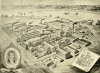
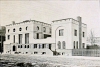
| Hinweise | [Philadelphia and popular Philadelphians (1891) 186]: Werksansicht; [Philadelphia and popular Philadelphians (1891) 187]: Verwaltungsgebäude |
| Zeit |
Ereignis |
| 17.12.1773 |
Geburt des Gründers John Harrison in Philadelphia als sechster Sohn von Thomas Harrison (* um 1640; aus Stoneraise, Castle Sowerby, Cumberland County, England) und Sarah Richards. - Er macht eine Lehre in der Drogerie des Chemikers Townsend Speakman, der den Softdrink Nephite Julep erfand, und studiert dann zwei Jahre in Europa bei Joseph Priestley. |
| 1793 |
John Harrison beginnt in seinem Drug Store mit der Produktion von Schwefelsäure. Wegen der großen Konkurrenz produziert er nur für eigenen Bedarf |
| 1806 |
Die Firma ist voll etabliert als Hersteller von Vitriolöl, Bleiwiß, Essigsäure und anderen Chemikalien in der Green Street. |
| 1807 |
Bau einer Bleikammer zur Herstellung von 1.500 Korbflaschen Schwefelsäure im Jahr. |
| 1831 |
Der Gründer nimmt seine Söhne als Teilhaber auf, verbunden mit der Umfirmierung in "John Herrison & Sons" |
| 1833 |
Tod des Gründers, John Harrison, und Umwandlung aus "John Harrison & Sons" in "Harrison Brothers & Co." |
| 1864 |
Erbaut |
| 06.1880 |
Constantin Fahlberg beginnt seine Arbeit bei "Harrison Brothers & Co." in Philadelphia |
| Herbst 1884 |
Ende der Tätigkeit Constantin Fahlbergs bei "Harrison Brothers & Co." in Philadelphia |
| 1918 |
Übernahme durch DuPont |
| Produkt |
ab |
Bem. |
bis |
Bem. |
Kommentar |
| Farben |
1872 |
[Hexamer Surveys] |
1894 |
[Hexamer Surveys] |
|
| Schwefelsäure |
1793 |
Beginn |
1813 |
mit Platin als Katalysator |
|
| Zeit |
Objekt |
Anz. |
Betriebsteil |
Hersteller |
Kennwert |
Wert |
[...] |
Beschreibung |
Verwendung |
| 1872 |
Dampfkessel |
5 |
|
unbekannt |
|
|
|
|
|
| 1877 |
Dampfpumpe |
1 |
|
unbekannt |
|
|
|
|
|
| 1885 |
Dampfkessel |
22 |
|
unbekannt |
|
|
|
|
|
| Zeit |
gesamt |
Arbeiter |
Angest. |
Lehrl. |
männl. |
weibl. |
Kommentar |
| 1872 |
80 |
|
|
|
|
|
70 Männer) |
| 1877 |
150 |
|
|
|
|
|
120 Männer, 10 Jungen, 20 Mädchen) |
| 1880 |
250 |
|
|
|
|
|
220 Männer, 10 Jungen, 20 Mädchen) |
| 1883 |
400 |
|
|
|
|
|
375 Männer, 10 Jungen, 15 Mädchen) |
| 1885 |
400 |
|
|
|
|
|
360 Männer, 20 Jungen, 20 Mädchen) |
| 1894 |
400 |
|
|
|
|
|
360 Männer, 20 Jungen, 20 Mädchen |
Zeit = 1: Zeitpunkt unbekannt
| ZEIT | 1868 |
| THEMA | Firmenbeschreibung |
| TEXT | John Harrison was the first successful manufacturer of Oil of Vitriol in. the United States. He had spent two years in Europe in acquainting himself, as far as he could gain access to them, with the processes used by the chemists, and after his return to America devoted himself to the manufacturing of Chemicals. How much earlier he succeeded we have no means of ascertaining; but in 1806 he was fully established as a manufacturer of oil of vitriol and other chemicals, in Green Street, above Third. His leaden chamber was a small one, and capable of making about forty-five thousand pounds or three hundred carboys of oil of vitriol per annum. So successful were these operations that in 1807 he had built a leaden chamber eighteen feet high and wide, and fifty feet long, capable of making three thousand five hundred carboys per annum. The price which the acid then brought was fifteen cents per pound. John Harrison was the founder of the present well-known concern of Harrison Brothers & Co., whose chemical works in Kensington occupy the site of their father's old establishment. They manufacture extensively White and Red Lead and Litharge, White and Brown Sugar of Lead, Sulphuric Acid, Alum, Copperas, Pyroligneous acid, and the Carbonates of Ammonia. Their productions enjoy a high character for purity and genuineness. Sulphuric acid cannot be concentrated in leaden vessels beyond a certain density, and for bringing it to the strength required in commerce, the only means then known was to boil it in large glass retorts to the standard weight. This was a precarious operation, and the losses sustained from breaking the glass and spilling the acid greatly increased the cost of the manufacture. |
| QUELLE | [Bishop: History of American manufacturers 3 (1868) 73] |
| |
| ZEIT | 1891 |
| THEMA | Beschreibung |
| TEXT | The founder of this house was John Harrison and the present firm are his grandsons. John Harrison studied chemistry under the celebrated Dr. Friestly, and became deeply impressed with the belief that many articles were imported into this country which could be produced here and thereby render the citizens of this country independent of foreign producers, as well as aiding the industrial development of the youthful Republic. In 1793 he began the manufacture of sulphuric acid, but owing to the crushing competition of the foreign makers his enterprise was confined to manufacturing for his own use and filling orders on a small hut remunerative scale for a few of his patrons. His investment at the start did not exceed 5000. From a letter addressed to President Jefferson dated November 1, 1808, and now in the archives of the State Department at Washington, we learn that in 1804 he had extended the line of products of his laboratory by adding the various preparations of mercury, antimony, copper, etc., used in the arts and medicine, and that then he had invested 40,000. At this time he was manufacturing sulphuric acid with marked success at his establishment on Green street, west of Third, in Philadelphia. In 1807 he built what was for that day quite a large leaden chamber, it was 50 feet long, 18 feet wide, and 18 feet high, capable of making nearly a half million pounds of sulphuric acid annually, and the price of the article then was about 15 cents per pound. The acid prepared in leaden chambers, as is well known, is not the oil of vitriol of commerce, and the only means employed at that time to concentrate it to the required density was by boiling it in glass retorts, a very precarious and dangerous process. The loss occasioned by the incessant breakage of the glass largely increased the cost of the concentrated acid. About this period there resided in Philadelphia Dr. Eric Bollman, a Dane by birth, and of scientific training. Dr. Bollman brought from France the method just discovered by Dr. Wollaston for converting the crude grains of platinum into bars and sheets. One of the first uses to which he applied the sheets was the making of a still for Mr. Harrison for the concentration of sulphuric acid. It weighed 700 ounces, would contain 25 gallons, and was in continuous use for fifteen years. This early application of platinum to this purpose was highly characteristic of the sagacity and ingenuity of the American manufacturer, for the use of the rare metal was at that time a novelty in Europe and known only to a few persons. It is believed that John Harrison was the first manufacturer of sulphuric acid in America, certainly the first to make it successfully, and he was not only the first in America to concentrate it in platinum as a manufacturer, but probably the first of all. In 1806 he added to his manufactures the production of white lead, subsequently apparatus for the manufacture of pyroligneous and acetic acid and their dependent products, white and brown sugar of lead, on an extended scale; also the oxides of lead, colors, alum, copperas, iron liquors, etc. The Green street laboratory long had been too circumscribed for such large operations, and an eligible location was secured in the then district of Kensington - now the Eighteenth Ward of the city - where extensive buildings were erected and large manufacturing facilities afforded. In 1831 he admitted his sons to partnership under the title of John Harrison & Sons. John Harrison died in 1833, and subsequently the firm changed to Harrison Bros., and then to its present title. Later on the facilities at Kensington proving inadequate to meet the demands of the business, a large establishment was projected in the southwestern part of the city, on the river Schuylkill, near the historic Gray's Ferry. Their factories and office in Philadelphia were early connected by wire with their office in New York, this being the first private wire of any length placed in operation. The Gray's Ferry establishment has grown to immense proportious, continuing most of the manufactures originated by the founder, and on a very extensive scale. The white lead plant can produce over 5000 tons annually, and for this and other paint products the plant is the largest and best arranged extant. The products include house painters' colors, colors for coach and car painters, ready mixed paints, colors for paper manufacturers, etc.
While another house claims precedence in the manufacture of white lead in this country, it is now said that it did not produce marketable quantites until about 1808, so that John Harrison would then be really the pioneer in this branch of manufacture, he and his successors having marketed their product since 1806. Messrs. Harrison Bros. & Co. within a recent period have brought about what may be justly termed a revolution in the manufacture of paints and colors in this country. These articles arc so readily sophisticated that the practice of the trade had become quite general of selling sophisticated goods as pure goods. This house recognizing the umnercantile nature of such methods decided to devote all their energies to the production of perfectly pure goods, or goods of plainly stated formulas only. In time other manufacturers followed in their wake, and strictly pure paints and colors may now be obtained without difficulty by anyone with discrimination. The position taken by Harrison Bros. & Co. has made their products the standard for quality amongst consumers. Their "Town and Country" ready mixed paints are in innumerable shades and extensively used throughout the country. The area of the Gray's Ferry works exceeds thirty acres, over half of which is covered by buildings of the best construction. In addition to the plant for the production of chemicals and paints there is an extensive laboratory, a complete machine shop and a large printing office, the latter to supply the great quantity of
advertising matter needed in the large business. From this printing office has been issued a number of publications giving real information to the public, among them is the "Chemistry of Paints," which describes the works and much of the chemistry of the products. This is supplied gratuitously to any one requesting it. The works are being constantly added to, a large three-story and basement brick mill-house, and extensive stable and a very handsome office in the Italian style of architecture being the most recent additions. |
| QUELLE | [Philadelphia and popular Philadelphians (1891) 186] |
|