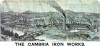
|
|
Cambria Iron Company
Zum Vergrößern Bild anklicken
| Name | Cambria Iron Company |
| Ortssitz | Johnstown (Pa.) |
| Art des Unternehmens | Eisenwerk |
| Anmerkungen | Auch: "Cambria Iron Works". Eigentümer (1876/96): "Cambria Iron Company", Philadelphia. Ab 1898 unter der Firma "Cambria Steel Company". 1876: Six coke stacks. Five stacks at Johnstown. 1896: Six stacks: Nos. 1, 2, 3, and 4 (1853/54); No. 5, 76 x 19, called also Centennial Furnace (1873-76); No. 6, 76 x 193 (1879). The furnaces are equipped with twenty Whitwell stoves. Fuel, Connellsville coke; ore, red hematite from the Menominee range, Michigan; specialty, Bessemer pig iron, spiegeleisen, and ferromanganese; total annual capacity, 400,000 gross tons. |
| Quellenangaben | [Bishop: History of American manufacturers 3 (1868) 479] [Ironworks of the United States (1876) 20+87+114+117] [Directory to the iron and steel works of the U.S. (1896) 24] |
| Hinweise | [Manual of the Railroads of the United States (1873/74) Anzeige]: Werksansicht |
| Zeit |
Ereignis |
| 1853 |
Bau des Walzwerks |
| 1853/54 |
Bau von vier Hochöfen in Johnstown |
| 1853 |
Baubeginn für das Werk |
| 1854 |
Die zunächst aus vier Hochöfen bestehende Anlage in Johnstown wird fertiggestellt. |
| 1855 |
Verpachtung an "Wood, Morrell & Co." . Diese Firma führt nicht nur die ursprünglichen Pläne der Gesellschaft aus, sondern erweitert die Werke großzügig und erhöht deren Kapazität. |
| 1857 |
Bau des Hochofens in Conemaugh Station |
| 1857 |
Das gesamte Walzwerksgebäude brennt ab und wird im selben Jahr wieder aufgebaut. |
| 1862 |
Die Gesellschaft wird umorganisiert mit C. S. Wood aus Philadelphia als Präsident - mit einem Kapital von $1.500.000. |
| 1863 |
Errichtung eines zusätzlichen Walzwerksgebäudes |
| 1865 |
Erweiterung des Walzwerksgebäudes |
| 1865 |
Es werden fast 1.000 Tonnen Eisen in der Woche produziert. |
| 1873/76 |
Bau des fünften Hochofens, des "Centennial Furnace" |
| 22.12.1876 |
Der Hochofen Nr. 5 ("Centennial Furnace") wird angeblasen. |
| 20.07.1879 |
Der Hochofen Nr. 6 wird angeblasen. |
| 1883 |
Erster Umbau der Hochöfen Nr. 1 und 2 |
| 1886 |
Erster Umbau des Hochofens Nr. 4 |
| 31.05.1889 |
Durch den Bruch des 22 m hohen und 284 m langen South-Fork-Damms (Eigentum des South Fork Fishing and Hunting Clubs) treten 20 Millionen tons Wasser aus und überschwemmen die 20 Meilen unterhalb gelegene Stadt Johnstown. Die "Cambria Iron Works" werden schwer beschädigt. Ursache sind mangelhafte Reparaturen, demontierte Entleerungsrohre und die starke Schneeschmelze. |
| 1890 |
Umbau des Hochofens Nr. 5 |
| 1890 |
Das Werk steht ein Jahr nach dem Dammbruch wieder voll in Betrieb. |
| 1892 |
Zweiter Umbau des Hochofens Nr. 4 |
| 1893 |
Der Hochofen Nr. 6 wird umgebaut |
| 1894 |
Zweiter Umbau des Hochofens Nr. 2 |
| 1895 |
Zweiter Umbau des Hochofens Nr. 1 |
| Produkt |
ab |
Bem. |
bis |
Bem. |
Kommentar |
| Walzprofile |
1876 |
[Ironworks of U.S. (1876)] |
1876 |
[Ironworks of U.S. (1876)] |
|
| Bezeichnung |
Bauzeit |
Hersteller |
| Dampfmaschine |
vor 1905 |
unbekannt |
| Dampfpumpe |
1879 |
Worthington Pump and Machinery Corporation |
| Dampfpumpe |
1881 |
Worthington Pump and Machinery Corporation |
| Dampfpumpe |
1883 |
Worthington Pump and Machinery Corporation |
| Dampfpumpe |
1885 |
Worthington Pump and Machinery Corporation |
| Dampfpumpen |
1899 |
Worthington Pump and Machinery Corporation |
| Zeit |
Objekt |
Anz. |
Betriebsteil |
Hersteller |
Kennwert |
Wert |
[...] |
Beschreibung |
Verwendung |
| ab 1880/90er |
Dampfkessel |
8 |
|
Babcock & Wilcox Co. |
Heizfläche ges. |
2140 |
qm |
Wasserrohrkessel |
|
| ab 1880/90er? |
Dampfkessel |
3 |
|
Babcock & Wilcox Co. |
Heizfläche ges. |
250 |
qm |
Wasserrohrkessel |
|
| ab 1880/90er? |
Dampfkessel |
2 |
|
Babcock & Wilcox Co. |
Heizfläche ges. |
290 |
qm |
Wasserrohrkessel |
|
| ab 1880/90er? |
Dampfkessel |
8 |
|
Babcock & Wilcox Co. |
Heizfläche ges. |
2140 |
qm |
Wasserrohrkessel |
|
| ab 1880/90er? |
Dampfkessel |
12 |
|
Babcock & Wilcox Co. |
Heizfläche ges. |
3200 |
qm |
Wasserrohrkessel |
|
| ab 1883-1890 |
Dampfkessel |
36 |
|
Babcock & Wilcox Co. |
Heizfläche ges. |
8270 |
qm |
Wasserrohrkessel |
|
| neu ab 1879 |
Dampfpumpe |
|
|
Henry R. Worthington |
Förderung |
|
cbm/d |
Fördermenge (gesamt): 3.500.000 gallons/d |
|
| neu ab 1881 |
Dampfpumpe |
|
|
Henry R. Worthington |
Förderung |
|
cbm/d |
Fördermenge (gesamt): 5.000.000 gallons/d |
|
| neu ab 1883 |
Dampfpumpe |
|
|
Henry R. Worthington |
Förderung |
|
cbm/d |
Fördermenge (gesamt): 5.000.000 gallons/d |
|
Zeit = 1: Zeitpunkt unbekannt
| ZEIT | 1868 |
| THEMA | Firmenbeschreibung |
| TEXT | Are the largest manufacturers of Railroad iron in the country. The company commenced the erection of the Works in 1853; but becoming embarrassed for want of means before they were fully completed, made a lease of their entire property, in the spring of 1855, to Wood, Morrell & Co. This firm not only carried out the original plans of the company, but, during their lease, greatly enlarged the Works and increased their capacity. In 1862, the Company was reorganized - C. S. Wood of Philadelphia, President - with a capital of $1.500.000, since which time it has carried on the business of mining and manufacturing under its charter. It owns about thirty thousand acres of land - mostly mineral - has four large Blast furnaces, Rolling-mills, Machine shop, Foundry, etc., with numerous dwelling houses for its operatives. The original mill building was burned down in 1857, and rebuilt the same year by the lessees - it is six hundred and twelve feet long, by one hundred feet wide, with cross wings three hundred and seventy-two feet by seventy-four feet. In 1863, an additional mill building, three hundred feet by one hundred feet, with a connecting wing seventy-four feet by thirty feet was erected, and in 1865, a further extension of the building three hundred and fifty feet by an average of one hundred feet, was made. The mill, when completed, will contain forty-eight double - equal to ninety-six single - Puddling furnaces, twenty-four Heating furnaces, seven trains of rolls, four squeezers, and other machinery to correspond. Its production, in 1865, was near one thousand tons per week, and when the extensions and improvements now in progress are completed, its capacity will be equal to the production of from sixty to seventy thousand tons of finished Railroad iron per annum. The stock is principally owned in Philadelphia, where the office of the Company is located. |
| QUELLE | [Bishop: History of American manufacturers 3 (1868) 479] |
| |
| ZEIT | 1876 |
| THEMA | Beschreibung |
| TEXT | Six coke stacks. Five stacks at Johnstown : three, 48 x 13, one, 70 x 15, and one 75 x 20; four built from 1852 to 1854, and one built in 1872-5; one stack at Conemaugh Station (Cambria County), two miles east, 45 x 12, built in 1857, now being remodeled to make spiegeleisen from domestic ores. - Built in 1853: 42 double puddling furnaces, 28 heating furnaces, 1 hammer, and the following trains of rolls: 21-inch rail mill, 5 sets; 18-inch rail mill, 2 sets; 12-inch rail mill, 3 sets; 16-inch merchant mill, 3 sets; 22-inch puddle mill, 6 sets; 21-inch puddle mill, 6 sets, and 30-inch blooming mill, 1 set. Total, 26 sets. Bessemer steel works; two 5-ton converters, and all the appliances for making steel rails. Product, iron and steel rails; total capacity per annum, 100.000 gross tons; average yearly make, 80.000 to 90.000 gross tons. |
| QUELLE | [Ironworks of the United States (1876)] |
|