|
|
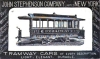
John Stephenson's Car Manufactory
Zum Vergrößern Bild anklicken
| Name | John Stephenson's Car Manufactory |
| Ortssitz | New York City |
| Straße | Twenty-seventh Street |
| Art des Unternehmens | Wagenfabrik |
| Anmerkungen | Lage: Twenty-seventh street, nahe der Fourth avenue |
| Quellenangaben | [Bishop: History of American manufacturers 3 (1868) 153] |
| Zeit |
Ereignis |
| 1831 |
Beginn durch John Stephenson am Broadway |
| 1832 |
Bau des ersten Dampfwagens, evtl. des ersten in den USA |
| 1833 |
Stephenson erhält ein Patent für Verbesserungen von Personenwagen auf Eisenbahnen, das von Andrew Jackson, Präsident der Vereinigten Staaten, Edward Livingston, Staatssekretär unterzeichnet und durch B. B. Taney beglaubigt ist. |
| 1843 |
Erneuerung der Fabrik und Errichtung eines viergeschossigen Gebäudes. |
| 1850 |
Fabrikerweiterung durch ein sechsgeschossiges Gebäude zwischen der Twenty-seventh und der Twenty-eighth Street |
| 1860 |
Der Bedarf an Straßenfahrzeugen sinkt. Daher zunehmend Engagement im Eisenbahnwagenbau |
| um 1870 |
Die "Empresa del Ferro-Carril Urbano y Omnibus de La Habana" in Havanna bestellt Straßenbahnwagen |
| Produkt |
ab |
Bem. |
bis |
Bem. |
Kommentar |
| Pferdebahnwagen |
1870 |
um 1870 für Havanna |
|
|
|
| ZEIT | 1868 |
| THEMA | Firmenbeschreibung |
| TEXT | On Twenty-seventh street, near Fourth avenue, is one of the oldest and best known establishments of the kind in the United States. John Stephenson has been identified with the construction of Cars and Omnibuses from their first introduction into this country. He commenced business, in 1831, in Broadway, where now the Lafarge Hotel stands, and while there, designed and constructed for A. Brower, a leading stage proprietor, one of the first Omnibuses that was run on the streets of New York. This was four and a half feet in width, had elevated or elliptical springs, and swelled very slightly at the sides. The word "Omnibus", painted in large letters on both sjdes, was a puzzle to pedestrians, who pronounced it variously, and generally supposed it to be the name of the owner. Previous to that time, vehicles for the transportation of passengers were constructed on the plan of the family coach, which was succeeded by what was known as the sociable, with side doors. It was not until 1833 that the platform carriage was introduced in Paris and adopted in this country. During the first year of his experience as a builder of Omnibuses, Mr. Stephenson's workshops were destroyed by fire, and he removed to Elizabeth street, where, in 1832, he constructed what was probably the first Street Car built in the United States. This was called the ."John Mason", after the founder of the Chemical Bank, and was designed to run on a branch of the Harlaem Railroad from Prince street to the Harlaem Flats. At that time, railroads were in their incipiency, and Cars were constructed in compartments after the fashion in England. In April, 1833, Mr. Stephenson received a patent for an improvement in Passenger Cars for railways, which is signed by Andrew Jackson, President of the United States, Edward Livingston, Secretary of State, and certified to by B. B. Taney, then Attorney General; and as railroads became established, and the demand for Cars increased, he engaged extensively in their manufacture, sharing the perplexities and pecuniary hazards which are conspicuous features in the history of those early enterprises. In 1843, Mr. Stephenson removed to the site of his present manufactory, and erected a four-story building, forty-four by one hundred feet, to which, in 1850, an addition was made by the erection of a six-story building two hundred feet long, extending from Twenty-seventh to Twenty-eighth streets. These now constitute the workshops, and here, for several years, an Omnibus was built each working day, or three hundred a year, and here Street Cars are now turned off with almost equal facility and rapidity. In the manufacture of Omnibuses, Mr. Stephenson was remarkably successful in securing the requisite strength with the least weight, and for many years enjoyed a popularity as a builder that was nearly tantamount to a monopoly. But in 1860 the demand for this class of vehicles had greatly diminished, in consequence of the general adoption of railways on the streets, and he thenceforth engaged extensively in the construction of Cars for this purpose, applying the principles which his experience as an Omnibus builder had demonstrated to be of value, and so successfully that he was able to decrease the weight of these Cars from six thousand to thirty-five hundred pounds, without in the least diminishing their strength. In the construction of durable carriages of all kinds, well seasoned timber is an indispensable requisite. In this establishment a stock for two years' use is kept constantly on hand. Oak selected from isolated trees found in pastures is preferred to that taken from forests. In the lumber rooms there is also a large stock of the constituent parts of Coaches and Cars, cut to sizes and shaped so that the body of a Car can be put together and made ready for painting in five days. In the blacksmith's shop, there are fifteen forge fires blown by a steam-engine, and here the iron work is so forged that the parts which in use will be subjected to the greatest strain, are made of double thickness, while the other parts have no superfluous metal. The hooks of the connecting rods and shackles, and the clogs of the breaker, are thoroughly strengthened in this way. In the Painting department the workmen are divided into classes, as primers, rubbers, colorers, flatters, letterers, landscape painters, scrollers, varnish finishers, and thus acquire a facility of execution which can only be attained by a daily repetition of the same duty. This principle, so far as possible, is observed in all the departments. But, besides the general principles of construction which tend to expedite work, Mr. Stephenson has made special improvements, some of them patented, which tend to secure durability and diminish the cost of repairs. Of this description is the Patent Truss-rod, and the method of bracing the Cars at the corners, where, in consequence of the short curves in street railways, an immense strain falls, causing the body of the Car to swag or give way. The boxes of the journals of the axles, which are subjected to great friction, are made nearly double the usual length, thus affording fifty per cent, more surface for abrasion. To exclude dirt or grit from the journal boxes, which has been a subject of many patents, Mr. Stephenson employs a rotating gate, composed of two segments of cast-iron, forming a collar, and which keeps the orifice constantly closed by the action of the journal itself. Among the minor improvements which may be mentioned, is the step projecting beyond the body of the car, which has a tendency to lessen the number of accidents, the enlargement of the reel, and, in some instances, the adoption of wooden trimmings for seats in place of cushions, which on some railways have become infested with vermin. Mr. Stephenson has constructed Cars for railways in India, England, Mexico, Valparaiso, and San Francisco. He now employs about three hundred workmen, and is producing about six Cars a week, or one each working day. |
| QUELLE | [Bishop: History of American manufacturers 3 (1868) 153] |
|